Obsessively devoted to excavating the unjustifiably overlooked, forgotten, hidden in plain sight & truly underappreciated in the musical universe, old and new.
No matter who we are in this absurd, brief and messy life we can all lay claim to a peak, a shining moment where we were the best we could be, where all the stars aligned and we freakin’ delivered the goods.
Welcome to “That’s Their Pet Sounds”,our semi-regular feature where we endeavor to spotlight and celebrate a heretofore maybe uncool, often unjustifiably underrated, sometimes polarizing, not as acclaimed as they should be, or “what the hell?” artist’s grandest artistic achievement i.e. their greatest album.
*”That’s Their Pet Sounds”is named after the Beach Boys landmark 1966 LP which is universally regarded as one of the greatest albums ever made but yeah, you probably knew that.
Welcome to casual Friday….
Rupert Holmes’s Best Album: Adventure (1980)
Background: I need to start this in pure, unadulterated “get off my lawn” style but want to offer an apology in advance for the miniature hissy fit I’m about to throw. It’s just before we get into this particular masterpiece by the angel above, Rupert Holmes, we need to talk about the concept of Yacht Rock. I’m a hardliner in that I don’t believe in the whole idea of “guilty pleasure” since you can’t help what you like. It’s easier to just own up and love stuff openly because at the end of the day who gives a rats ass what anyone else thinks. Which segues into why I think Yacht Rock is both a troublingly subjective and wildly imperfect means of musical categorization, as it’s not so much an actual genre as it is a directive on how to hear particular artists and songs, created for primarily comedic purposes.
And to make matters worse, the overall sound that it has come to define actually already had a name before it was called Yacht Rock and was /is specifically tethered to a time and actual group of artists (and loosely, a place). It was called West Coast and from around 1978-1983, it was as pervasive on U.S.radio waves as hair metal was in later in the decade. During those years, the top 40 charts were absolutely brimming with West Coast.
The “sound” was typified by supreme musicianship, slick production, and melodic smoothness and the people that made it tended to be straight, white guys, within the age range of 25-35. And as the state of the art recording studios in Southern California were where the overwhelmingly majority of it was created, where the best known purveyors of it tended to be based at some point, years later, it started getting referred to as West Coast, though as I alluded to, the music itself was created all over. I never even knew it had a name until like 10 or 15 years ago when searching for some “where are they now” type info, I stumbled upon a website called Blue Desert.
Here are some very fine albums from the heyday of the West Coast sound. Nothin’ but pure, unadulterated, bearded romance.
But Yacht Rock also selectively drags in bits of another maligned genre that was being birthed during the same era, that of AOR. Now AOR ( Album Oriented Rock) is basically the musical equivalent of Baby Bear’s bed in Goldilocks and the Three Bears; not too Hard (Rock), not too Soft (Rock) but juuuuust right…in the middle that is, taking elements of both and accentuating neither. For context, let’s just say Journey are The Beatles of AOR …but they are actually, believe it or not, too much of a rock band to fall into the Yacht category. Toto are The Beatles of West Coast and while they have songs that fall firmly into the AOR category, their general smoothness has landed them straight in the Yacht Rock wheelhouse. Breathe in, breathe out…
And as if the latter day categorization wasn’t enough, at the time the sound, let’s just call it West Coast for now, was happening, within the music industry it was referred to as, wait for it, Adult Contemporary aka Soft Rock. Both of those descriptors were code to describe music for grown people who like pop but wanted to hear things that were mellow and non-threatening. There is still an official Adult Contemporary Chart to this day ( also sometimes abbreviated to “AC”) and as of this writing, Maroon 5 are occupying the # 1 spot which I have no smart aleck-y thing to say about because it’s unnecessary.
I know, this is far more confusing than it needs to be….and that’s the thing, because in real time when these songs were actually being released, especially to my kid ears, it just was just plain old pop music. To the average listener of Casey Kasem’s weekly Top 40 radio show back in the late ’70s and early ’80s, these songs currently singled out as Yacht Rock, which are West Coast, with occasional nods to AOR but technically Adult Contemporary were just part of an amorphous blob of hit singles, rubbing shoulders with everything from The Cars to Kool And The Gang. They were pop songs, that’s it.
Clear the runway y’all…
A Man Called Rupert: While singer-songwriter Rupert Holmes has a number of noteworthy achievements in his CV, including writing a Tony award winning Broadway musical and producing a Streisand album, he is most famous for creating what’s become the unofficial anthem of Yacht Rock, the # 1 hit from 1979,“Escape (The Piña Colada Song)”. Based on those career highlights it should be pretty clear that when it came to this music thing, Rupert Holmes was looking at the world through a more mature set of eyes. His primary audience were grown people, actual adults with jobs, mortgages and alimony payments.
The back cover of the 1979 single of “Escape…” featured a handy recipe for making a Piña Colada because this was a record for grown people. Not gonna discuss the front.
1980’s Adventure, Rupert’s sixth studio album, was the follow up album to the previous years Partners in Crime ( which featured 3 Top 40 hits “Him”, “Answering Machine” and the aforementioned “Escape…”). In terms of sales it was a huge failure and none of its singles landed in the pop Top 40. In fact from this point forward, Holmes himself would never again appear in the pop Top 40 performing his own songs ( though he still managed to score a huge hit in 1986 albeit as a songwriter).
Why it’s his Pet Sounds: While the plush production, epically clever lyrics and Billy Joel/Nilsson-esque melodies in his 5 albums prior to Adventure tend to get the accolades (especially Partners, with it’s triumvirate of hits), this is the one Holmes album where absolutelyeverything was on point. It’s the leanest, least jokey and most straight up “ROCK” thing he ever did and is filled end to end with well-scrubbed, orderly guitar solos and shiny bridges. And yup, as is his custom, Adventure is home to more hooks than an overstuffed tackle box.
This album offers no mystery whatsoever. You will never be confused by the lyrical content or be tempted to play it backwards in search of secret messages. Every emotion and situation is described in clear precise language. It’s basically 10 soap opera scenes, miniature screenplays and short stories set to music . This is the Holmes Style™ and a skill that lent itself perfectly to his later endeavor of writing musicals and TV shows. The main lyrical ingredients here are clarity and earnestness with added dollops of cheese, knowing winks and “did you get it” elbowing. You know, kind of like a musical.
And you won’t find any meandering epics or extended instrumental interludes. Every song is unabashedly auditioning to be a single and future radio star.
To summarize, while Adventure didn’t set the charts alight alas, it is a truly seminal Yacht Rock-West Coast-Adult Contemporary-Soft Rock-Pop classic that deserves it’s due because, let’s get “1980” for a second, it’s just totally bitchin’.
*Sidenote: Actually there IS one mystery, that being why in God’s name a teenage girl who was obsessed with Sting and maintained a fat Police scrapbook should have been remotely interested in this album. It spoke from a vantage point that she had zero understanding of, that of a successful, nearly middle aged man living I assume, in LA. This album screamed midlife crisis from its every orifice. Yet it was a frequent occupant of my turntable. And for the record, yes I believed Sting “understood” me & I him. I know we both agreed on the most crucially important of all facts; that Sting himself was hot.
Okay, look sensitive…
The Songs (side one):
The album opens with the epic title track “Adventure” and though I kind of hate myself for doing this, I need to invent a new f-ing category to describe it because it leaves me no choice. “Adventure” is a “YachtProg” song. Its fat, cheesily dramatic keyboard opening bears a striking similarity to what Genesis were turning out in the late ’70s. But while Genesis were still singing about mythical creatures and “kings who were laughing in the rain” at that point, Rupert was offering up an oozingly earnest sermon about how Hollywood’s interpretation of adventure ain’t nothing compared to the unexpected, even more thrilling real life encounters us average Joe’s have. He employs some absurdly dramatic pauses ( you could drive a tractor trailer between his “and” and “then”) and I’m conspiratorially convinced ABBA’s Benny and Bjorn co-opted the vibe from this very song for their own musical Chess a few years later in the form of 1984’s mountainously cheesy megahit “One Night in Bangkok”…only “Adventure” is an infinitely better song.
But if we sell ourselves as somebody else we could make a misconnection
You’ll end up with one who loves not you but THE MASK…
While Rupert Holmes may not be Nostradamus, the prescience in evidence on “The Mask” with its primitive allusions to “catfishing” and pleas to just be your damn self are oddly impressive considering the song is 40 years old. The tune itself is built on a neat sinewy little groove but is also full of surprisingly clever and unpredictable key and tempo changes. To hear him passionately plead alongside an awesomely fuzzy, ascending electric guitar line for you “to tear the mask off“, might cause you in true Twilight Zone style to wonder how Rupert could’ve have possibly foreseen social media’s effect on future human relations in 1980 or then again maybe it’s just proof that people haven’t changed like at all.
“Blackjack” -The intro of the song sounds suspiciously like the kind of music you’d hear while watching a Las Vegas magician suddenly emerge from a cloud of smoke waving a wand while throwing shapes under an undulating spotlight. But it’s most likely just meant to sound “Vegas-y”, as if a wildly spinning roulette wheel could emit music. “Blackjack” is built on a bed of awesomely obvious gambling metaphors to describe love, all double downs, Queen of Hearts and chips but again Rupert surprises, employing loads of cooly oddball turns within the tune. This song rocks in a civilized and orderly fashion and while things don’t get out of hand, it does feature a break constructed for audience participation which I’m certain it didn’t get to enjoy in any significant way in its heyday. Here is the sleeve of the single which while somewhat endearing is the very anthesis of rocking.
Time to throw some light ( and shade) on one of the more unpleasant pop music tropes from days of yore, namely successful 30 plus year old soft rocker guys writing about high school girls. This was such a common thing in the seventies and eighties that it was almost a sub-genre to itself. Paul Davis, Billy Joel, Robbie Dupree, Benny Mardones (and many, many others), all hit the charts with paeans to teenage girls, within which they were either reliving the exploits of their younger selves or, okay benefit of the doubt here, wistfully reminiscing in their current conditions. At that juncture in pop music history, you could get away with this shit with perfect impunity. It was so normalized that it wasn’t even questioned, after all, it had been going on for decades with future legends Chuck Berry and Jerry Lee Lewis leading the charge back in the ’50s in the absolute worst possible ways.
But since we didn’t grow up with these guys and only knew them as grown ass men, this kind of thing could sound extraordinarily dicey ( remember this ?). What also sucked was that despite their questionable content some of these songs actually were freakin’ great…and I confess to an abiding love for several of them (dammit). Rupert’s contribution to the genre “The O’Brien Girl” is generally pretty subdued but while not overtly sexual it does come across as the sentiment of an obsessed fantasist. The lead character in this song has a backstory involving her leaving her previous high school but the story behind her departure is never revealed (though it’s implied something unfortunate happened to land her at Rupert’s school). All in all, it’s a regal and handsome ballad with a gloriously incongruous electric guitar adding a tiny and straight up weird bit of edge.
If any of you have been to a Fleetwood Mac concert featuring the classic line-up of Stevie, Lindsey, Christine, John & Mick, you may recollect a point in the show when the band introduces each other. And you can probably recall which band member got the biggest cheers. Of course even if you haven’t been you can probably guess. It didn’t matter how many insane runs Lindsey did on his guitar or how killer his version of “Big Love” was, it was very clear who the star was, who was the most beloved. It was always Stevie Nicks. And it sucks right, it was sort of “your” thing, I mean you insisted she be in the band and this is what happens. Yup, no matter how hard you’ve worked, your bearded ass will never hold a candle to our beloved, spectral queen. In “Crowd Pleaser” Rupert describes a similar scenario and mostly cowers in the corner as backing singer Chrissy Faith crushes him with her steamroller. The chorus falls somewhere in between Kiss and Blue Oyster Cult. Seriously. I think after getting typecast as the Piña Colada guy, Rupert just wanted to f-ing rock for a minute or at least show people that he could. And bless him, for despite the earnest on the nosiness of this whole song, it’s insanely fun.
The Songs (side two):
“You’ll Love Me Again”– Yes, the sentiment of the title is as troubling as it sounds. It really should’ve been called “Red Flag” for under the guise of a love song, something far more sinister is afoot.
Here is a typical verse :
You loved me once and you’ll love me again
She said ” You think so ?”
I said “I know so, I know so much about you now”
She said “Well maybe”
I said “There is no maybe”
It’s all very Dateline. Which dovetails perfectly into the songs extravagant arrangement, with it’s Phil Collins style drum fills and Beach Boy-esque, Corvette convertible, twanging guitar line post chorus. Oh yes, this is most definitely “Yacht Prog” and it’s a goofy, glorious, passive-aggressive beauty to be sure.
Back in the day, the inherently terrible and misogynistic term “frigid” was a commonly used to describe women who didn’t like or respond to sex in an “appropriately” heated manner. The more “polite” but still inherently questionable version of frigid is cold . While Rupert’s take on this notion, “Cold”is more polite than say the Stones screaming take regarding the same idea, it also manages to serve up a little quiet menace. Here, glaciers, sleet storms, blocks of ice are all overcome by the thawing agent known as “Spanish Wine”. Yeah, you get it. There’s some table turning in the latter half of the song which makes the whole idea of “Cold” feel less hostile ( Rupert is more progressive than Freud it appears). Weird thing is that despite all this, I’ve always kind of loved this song, which I pretty exclusively put down to it’s exceptional, twisting, turning tune and overall grooviness; that part is indisputable.
Which brings us to “Morning Man”, about a guy who is in love with a nurse who works the overnight shift while he works during the day. And so they have to get it while they can. And they make it work, unsurprisingly he is always ready to go (“doesn’t take much to wake me, just you shake your morning man” Rupert croons sweetly). And so you know, it’s a pop song about morning stuff. But holy crap, this tune, it’s just plain swoon-worthingly gorgeous.
The last 2 tracks on the album are the toughest listens, the most Broadway-ish sounding and the least rockin’. They have their virtues ( melodically tight) but they wither in the light of all that came before.
“I Don’t Need You” is silly. Its main attribute is its resolutely bouncy tune. Its sentiments are similar to that of 10CC’s brilliant “I’m Not in Love” but have a decidedly cutesy flavor which quickly upends the pseudo-rockin mood Rupert had been establishing up to this point. To be frank, it’s the kind of thing your Grandparents might have liked had they heard it emanating from your teenage bedroom. Which is a terrible, terrible scenario. I now need to offer an anecdote to drive the aforementioned point home.
If you grew up in the seventies or eighties you will probably be familiar evening talk show host Merv Griffin. Though he was initially meant to rival daytime talk show king Mike Douglas, he was on at night and more akin to Johnny Carson but like the poor man’s version as in he was less charismatic and uh, likeable.
But in his defense, he seemed to care about us kids…or at least the person who booked musical artists for his show did. Which is to say he featured waaaaay cooler musical guests than Carson ever did, like he had Soft Cell on doing “Tainted Love” when it came out and even went so far as to invite them over to the guest sofa to have an actual chat. It was WTF wonderful, incongruous and embarrassing all at the same time. I even remember seeing Devo on there, as well as Marvin Gaye which was undeniably cool. Now in the ’40s and ’50s Merv had been a bit of a crooner and so was often inclined to open his shows with a song. In keeping with the progressive nature of things, he would occasionally attempt songs of a contemporary nature . And on one particular evening, he chose to open with Rupert’s “I Don’t Need You”. The song was sort of new at the time and juuuuust the right amount of corny for an aging TV Host to belt out without completely humiliating himself.
Now while I was well aware that Adventure wasn’t a cool album by any stretch, the idea that this old, sports jacket wearing Hollywood guy was rocking the same thing on his turntable as me really put me off. I genuinely remember thinking WTF, this is my album you old cheeseball. And that is my main memory of this song. Even when I hear it now I think of Merv awkwardly schmoozing around the stage to it and for this reason, I just can’t. But I will give points for its schmaltzy and sweet guitar line because that’s actually kind of cool.
I’ll be honest , the last track “Special Thanks” also pisses me off a little. Despite its good intentions, there is something gruesomely condescending in its tone. It is as the title insinuates a song of thanks. He thanks the waiter for the table with a view. He thanks the pretzel vendor & all the denizens of the park that day who provide a backdrop for he and his love to walk through. He thanks the city for providing the opportunity to live out his dreams. Yes, a little smarmy and unctuous but I suppose since it’s the last song we can cut him some slack; it doesn’t change a thing.
In Conclusion:
Rupert included that genuine little message you see above on the inner sleeve. It is clear by his tone that even he didn’t think a teenage person was likely to “fork out” for his grown up album. And that was probably an accurate observation based on his whole persona and the subject matter. As a recently minted teenager of course I didn’t own an apartment, house or car . But I did possess an obsession with AM radio, an allowance and a blue shag carpeted teen bedroom to play records in. And while I couldn’t entirely relate to the sentiments ( frigid ladies, night nurses, artifice, consumerism…wha?), I was completely enraptured by all the head spinning hooks, which were just plain more important. And though we haven’t really discussed it, I kind of dug his voice with its faintly detectable lisp.
When it comes to straight up melodic mastery Paul McCartney, Brian Wilson and Todd Rundgren are pretty much the gold standard but know what, Rupert Holmes had a similar strain running in him…and you can hear it all over Adventure.
Despite my love of the album, I never felt inclined to write and respond to his message… but maybe in a way this essay is a letter that arrived 40 years late. Or shoot, I’ll just write a quick note now.
Dear Rupert,
I love Adventure and in my lifetime have played it at least as much as “Zenyatta Mondatta” ( but maybe not as much as “Ghost in the Machine”), but still I know every word to every song and can hum every guitar solo if tested. I’m proud to say I have officially lived long enough to understand what you were talking about in the songs. I think this album is your Pet Sounds. I’m eternally grateful it exists. And so no, Thank YOU.
Glorious grunge popper Celeste Taucher aka Talker celebrates the gorgeous epic that sets her heart alight, Death Cab for Cuties’s “Transatlanticism”…
I’m not totally sure when I first heard the song “Transatlantacism”, it had definitely been out for a while by that point (I was eight years old when it was originally released). But when I was in high school really finding my own tastes and discovering music, I fell in love with Death Cab for Cutie. Hard. They’re my favorite band and Ben Gibbard is my favorite lyricist. I loved it right away, but it actually had a second life for me when I moved away to college. My campus had a lake that I would walk around and just sit by listening to this song (the whole album really) and get way too in my feelings.
Everything about this song gets to me. The lyrics are perfect, and very classically Ben Gibbard. The visual he paints of the feeling of distance between two people is so beautiful, and yet so full of desperation and agony. And musically it’s gorgeous, the way it builds into this huge cathartic ending is so moving. I have a few memories attached to it, but the main ones that come to mind are actually of seeing the song done live. I’ve been lucky enough to see Death Cab perform a few times, but there were two particular shows that really got to me. First one took place at the Hollywood Forever Cemetery during an especially emotional time in my life, and the other was in Mexico City during a another really special time. Both experiences were really moving in different ways but I will say it’s really special to stand in a crowd of people, crying, and all singing together with your favorite lyricist.
While the song and album didn’t necessarily lead me to discover other music, it really got me further into Death Cab’s discography. All of their albums carry a lot of meaning for me and have been really essential to my own development as an artist and a human.
I still get emotional when I listen to the song and it will never really lose its meaning or its relevance to me. We’re always going through changes, we’re always missing someone and yearning for something we don’t have. That’s a universal experience of the human condition and I think this song perfectly captures it. I’m sure over time it will evolve to mean different things for me, too.
This song (and Gibbard’s writing as a whole) has been a huge influence on my own work. I think I draw a lot from his writing style and visual storytelling. I’ve wanted to cover it forever, but I don’t think I would do it justice. I think it’s untouchable !
🐬 You can check out Talker’s amazing Wax EP below, one of 2020’s finest :
No matter who we are in this absurd, brief, and messy life we can all lay claim to a peak, a shining moment where we were the best we could be, where all the stars aligned and we freakin’ delivered the goods.
Welcome to “That’s Their Pet Sounds”our semi-regular feature where we endeavor to spotlight and celebrate a heretofore maybe uncool, often unjustifiably underrated, sometimes polarizing, not as acclaimed as they should be or “what the hell?” artist’s grandest artistic achievement i.e. their greatest album.
*”That’s Their Pet Sounds”is named after the Beach Boys landmark 1966 LP which is universally regarded as one of the greatest albums ever made but yeah, you probably knew that.
Now grab yourself a cushion and let’s go chill in the gazebo…
Kenny Loggins’ Best Album :
Celebrate Me Home (1977)
Background : By the end of 1976, after 5 years as a performing duo, pop troubadours Loggins & Messina decided to end their musical partnership. It’d been a great run that saw them score no fewer than 5 platinum albums, 2 Gold albums and a top 10 pop hit with the somewhat polarizing “Your Mama Don’t Dance” ( the “Wake Me Up Before You Go-Go” of its day). Loggins explained the situation in classic rock-speak, stating that things were starting to feel “too comfortable”, that they needed to break up for “creative reasons”, adding that the decision to split “was mutual”. “We both felt it was time to put ourselves in different environments”. But really it was inevitable. For it had become abundantly clear over the course of the partnership that this Loggins guy had something. Not only did he write ridiculously melodic and memorable pop songs like nobody’s business and resemble the world’s sexiest mountain man, he was also blessed with a special voice…which is to say, damn could he sang.
And so from the ashes, in 1977, did the Loggins (heretofore to be referred to as KL) solo career begin in earnest.
Celebrate Me Home, the first KL solo album, was produced by Phil Ramone and Bob James whose merged styles could best be described as “slick” with a side dish of “smooth”. Built on a bedrock of ace musicianship, lush strings, assertively strummed acoustic guitars and fat Fender Rhodes chords, there are no detectable blemishes or visible pores anywhere on Celebrate Me Home. Now while “slick” and “smooth” would no doubt get their asses kicked on the rock ‘n roll playground by “shredding” or “thrashing” or even plain old “rocking”, in the case of Celebrate Me Home, stressing the smooth side of things perfectly suited the lush KL songwriting style. If you ever want to simulate the feeling of watching an exquisitely perfect sunset lasting exactly 45 minutes over the Pacific Ocean in 1977, this is your soundtrack. Okay, I know what you’re thinking and yes, I suppose you could also play Dennis Wilson’s Pacific Ocean Blue with its equally bearded, beached, beauteous, born in ’77 vibe but you’d be settling in for a significantly rougher and more angsty ride. I recommend you just start your evening with Celebrate Me Home and save Dennis as a chaser soundtrack for when you’re getting wasted later that night because it’ll make way more sense then.
Don’t let the riding crop scare you, he’s only looking to tame you with his melodic dreamscapes and lustrous voice.
Why it’s his Pet Sounds:Picking Celebrate Me Home as KL’s peak performance, where his melodic gift was firing at maximum capacity was an easy choice…pretty much. It should be noted that the 3 studio albums that followed were of a supremely high standard and all totally ruled in one way or another, from the dark, lusty moodiness of Nightwatch (1978), to the romantic spirituality of Keep the Fire (1979), to the angry AOR of High Adventure (1982). They are each in possession of some undeniably timeless, epically wonderful songs. And we should also acknowledge latter day album and dark horse Leap of Faith (1991) which was full of handsome, loved up new age pop as well. But as far as nailing it across the board in terms of mood, melody, overall vibe ( and there is one) and expertly mimicking the feeling of being on some languid and dreamy sailboat with an attentive and romantic captain, Celebrate Me Home is without peer. This album somehow manages to make rejection, lying and cheating sound warm, sweet and reassuring.
The inner sleeve photo. No innuendo to see here folks, move along.
The Songs (side one): “Lady Luck”, the lead track on the album is a beauteous, glossy acoustic led groove with a nice fat bass bottom that relates a semi-cryptic tale involving the devil and selling your soul. Or maybe I’m reading too much into it and everything is just a metaphor for cheating and being unfaithful. The song features this soon to be KL trademark of stopping or quieting the band mid-flight to spotlight some ethereal harmonizing or over the top vocal flourishes before waving them back in again. He’s employed this aural quirk in multitudes of songs throughout his career from “This is It” to “I’m Alright” and it always works. Speaking of that, when it comes to singing, Kenny Loggins can also be a scenery chewin’, word stretchin’ son of a gun… which is to say you can expect a fair amount of of vocal taffy pulling within most of his performances here ( and in most subsequent recordings). “Lady Luck” features one of the more endearing examples of that particular idiosyncrasy wherein Kenny reshapes “love triangle” into “love Try-YANGah“. Now that there’s some quality chewin’.
Most of the songs on Celebrate are co-writes, the coolest collaborator being legendary songwriter Jimmy Webb who penned the lyrics to poisonous little rose “If You Be Wise”. While promising on paper, it’s definitely one of the second tier tracks whose main purpose is to act as sweet glue between 2 absolutely killer tracks. It’s a pretty laid back affair with an optimistic melody and features a pretty hummable chorus. Lyrically though, it’s another story, for “If You Be…” is really a shoulder shrugging, finger wagging warning about getting too attached to a touring musician because you know, there are temptations on the road babe and he’s only human.
“I Believe in Love”– Right so as mentioned earlier, KL can sang and this song offers the space and opportunity to show off his entire range, from the cooing falsetto to the full throated blast. It’s both joyful and melodic, featuring an odd tinge of calypso as well as enough breathing room in the chorus to allow KL to seamlessly ask the audience in live settings if they believe in love ( here’s what they said) .
The song was written by KL ( the music) and the long-time Barbra Streisand collaborators and married songwriting team of Alan and Marilyn Bergman (the lyrics). The song first appeared in the 1976 film of A Star is Bornas sung by Streisand in a bitchin’ blue polyester suit. And okay, gonna say it, KL’s version destroys Barbra’s. Crushes it into microscopic dust. Anyway the Bergman’s were a couple of old school composers who weren’t remotely rock ‘n roll ( their credits also included Streisand’s “The Way We Were” as well as her duet with Neil Diamond “You Don’t Bring Me Flowers”). Still they managed to pen a verse within “I Believe…” that is totally rock and doesn’t care about anyone but itself :
But I don’t want to find myself one day
Wakin’ up and lookin’ at Monday
With some what’s her name left from Sunday
I Believe in Love
Right, I’ll call you sometime okay? We still have aways to go this tour and I’ll be kind of busy but I’ll try, no promises. One of the eternal wonders of the Celebrate Me Home album is how skillfully KL plays the roles of both bearded rock stallion and sensitive ’70s hippie guy without ever favoring either. Such is the magic and mystery of Kenny Loggins.
“Set It Free” remains one of the finest KL tracks ever, an epic ballad of realization that sounds like a mournful rainy day for the first 4 minutes and a cultish worship song for the last 2. Bob James’s opening intro on keys and the delicate KL vocal on the first verse literally feels like a warm, enveloping embrace, all swoons and sighs. There’s a great cover version of “Set it Free” by revered Norwegian jazz singer Radka Toneff from 1981 that’s also absolutely worth hearing. In her arrangement, she eschews the entire choral style ending and just sticks to the verses and chorus, offering up a heart-squeezingly desperate and beautiful vocal; it really drives home how exceptional the song is at it’s core. She died from suicide soon after this recording was done, at age 30, making this a undeniably poignant listen.
The romantic tables are turned on the ballad “Why Do People Lie” this time with the woman doing the cheating and KL doing the I don’t wanna believe its. It’s a showcase for the absurdly seductive KL falsetto which he milks here to the 1000th power. Naturally that meant once he took the song into a live setting he could really milk it. Check out this performance of the song from his 1980 album Kenny Loggins Alive to hear an audience member spontaneously combust upon exposure to said falsetto in the second verse. It truly is a weapon.
Right, someone please get me to the time machine asap…
The Songs (side two):“Enter My Dream” sounds just like its title and is pure luxuriant mellowness ( yes, it kind of is like a warm bath and if it gave off a scent it would be that of a subtle, intoxicating vanilla candle, a good one, not one from The Dollar Store). It is quite possibly imbued with subliminal messages because it’s hard to listen to it and not immediately want to go lie down in a field of grass and stare vacantly at the sky for hours. It also features one of those patented KL “stop everything and just listen to me singing and nothing else” moments mentioned earlier in its coda…and despite having heard this song 3000 times, I am still not 100% sure what he’s singing at that point. I mean it sounds like ” And I love a lot about dreaming, and I dream a lot about love“. But honestly, as it’s not printed on the album sleeve lyrics, I have no f-ing idea but who cares right because it still sounds utterly magnificent.
“I’ve Got the Melody (Deep in My Heart)” was written by jazz pop diva Patti Austin who provides the guest vocal on the track as well. It sounds a lot like something you would have heard on a typical ’70s variety show, when the host and guest star do their big duet number. Affectionate, slightly lovey dovey but stopping well short of sexy ( actually it’s miles away, definitely no tongue here ). I call this one a default listen. As in, it was on the LP and I wasn’t going to get up and move the needle to the next track necessarily because it wasn’t terrible just ineffectually pleasant.
It’s about to get dark in here…
KL is of course best known by the general population for his gargantuan ’80s soundtrack hits “Footloose”,“Danger Zone” and “I’m Alright”, all of which are basically fun and unquestionably frothy. I always look at the big soundtrack hits as the end product of KL’s day job. It’s a job he was good at and got paid for but it didn’t really reflect the passions of the Real Kenny™. The songs bore no resemblance to what he was building out in the garage on Sunday afternoons, what he was truly passionate about. The Real Kenny™ can only be found on actual Kenny Loggins albums. They are him and he is them. Which is to say the true KL signature song is not “Footloose” or any of its arm wrestling, golf bag carrying wingmen, but is in fact this gloriously plush and sentimental singalong right here, the please don’t forget me epic “Celebrate Me Home”.
Now near as I can figure, after years of hearing it, “Celebrate Me Home” is about coming home after having been away for awhile and, like a battery getting charged overnight, getting enough attention from family and friends that you can use it to power you up during lonely moments when you go back to…wherever it is you came from that keeps you far from home…which in KL’s case is, you guessed it, the bastardroad .
Still it’s not quite specific enough that its sentiments can’t be applied to other scenarios. Amongst the fascinating, weird and sometimes obvious interpretations I’ve stumbled on across the web, my favorite was seeing the song recommended for funeral services, “home” being another word for, you know, heaven. It’s a stretch but I’m telling you, once I read that I never heard the song the same way again. When you listen to Joy Division or Nico, you expect to brush shoulders with the grim reaper, but to come face to face with the other side in a freakin’ Kenny Loggins song ? It’s just perverse and you’ve gotta love it.
To counter that idea or perhaps offer another version of what “heaven” might be like, please enjoy this extended live version of “Celebrate Me Home” (below) from a show in Santa Barbara in 1981. Watch in slack-jawed awe, at around the 7 minute mark, as KL, here playing the role of “Sexy Jesus”, descends into the crowd and ignites an extraordinary display of audience horniness the likes of which you rarely see outside of a National Geographic animal documentary.
“Daddy” is kind of an awful word. It sounds slimy coming from anyone over the age of 5 but okay. “Daddy’s Back”is a smoothy groove with a memorable tune and breathy, scenery chewing vocal that gushes with endless optimism. Of course based on his previous behavior throughout the album it’s hard to trust that “Daddy” is being truthful when he says he “can see an end to Daddy’s days as a rolling stone” but the rugged, passionate vocal ad-libbing at the end is enough to blind anyone to the truth at least temporarily.
“You Don’t Know Me” is a remake of an Eddy Arnold/Cindy Walker penned standard from 1956 that by the time KL had recorded it, everyone and their mother had taken a crack at. Elvis, Ray Charles,Willie Nelson, Bette Midler, Roy Orbison and Jackie Wilson to name a few hundred. And it was understandable why so many artists would want to, as its story of unrequited love was laid out so straightforwardly that most of humankind could relate to its lonesome yearning.
Thing is nearly every version sounded like it was made in a cheese factory, the majority of them overrun by ludicrously over the top backing vocals and schmaltzy instrumentation working as a devilish tag team to destroy the songs sad dignity ( and usually succeeding)…which is why the KL version stands amongst the absolute best. For one thing the arrangement is so skeletal and spare it sounds like a demo…okay one made by virtuosic musicians but still. And the vocal itself is extraordinarily understated by KL standards as in he doesn’t lose his shit until the last verse and sounds convincingly defeated throughout.
The inclusion of this cover is another reason why this album is so kick ass: to close with something so morose, slow and rainy after the flying above the clouds for nearly the entire LP takes some balls ( or a maybe a strong riding crop).
In Conclusion:Celebrate Me Home only got as high as # 27 in the album chart in 1977 but it did ultimately achieve platinum status in 1980. Which seems about the right pace, for this is the one KL album that seems cool with laying back and letting others speed wildly to their ultimate destination. It’ll get there when it gets there. Look at the cover art, see how blissed out Kenny is to be home after months of touring ? He wants you to be blissed out too, chilled, that’s why he made this for you. Sure, there’s some dishonest unfaithful behavior and disingenuous promise making happening in the songs but babe, that’s just life. The fact is underneath that hoodie beats an enormously empathetic heart with the magical ability of molding pop songs into ravishing sunsets.
If all the hyperbole here isn’t sitting right with you, I’ll offer you a more pragmatic explanation: basically Celebrate Me Home is like a less drugged up, totally shined, fragrantly showered, and contented version of Jackson Browne’s definitive life on the road diary album Running On Empty. It’s a reassuring arm around your shoulder, “bound to roam” but always coming home. It’s his Pet Sounds.
Andy Moreno talks about how after years of unsuccessful flirting she and 20th century country music cult hero Mickey Newbury finally got together via his 1972 album Sings His Own
It’s all about timing. Sometimes years go by before a seemingly perfect song actually achieves it’s moment in the spotlight, or a truly gifted musician gets their deserved day in the sun… or we as individuals arrive at a point where we can finally appreciate a particular artist’s music. My Palentine Hope says we all receive when we’re ready to hear it. I believe this is true and it speaks to just how multi-dimensional music can be, as well as profound.
It might happen globally on occasion, like how the song “Season of the Witch” has recently resonated with a vast number of the general population (or at least movie music supervisors). I feel like I’ve heard it used in at least the last 4 films I’ve watched. Filmmakers have the ability to really highlight songs when showcased in this way, and in this case I have to admit, it consistently packed a punch and made me reconsider my past opinions of ol’ Donovan. The song didn’t necessarily gain strength over time, we just moved toward it and met it where it lived. I believe this was the case for me.
My mate had been pushing Mickey Newbury’s 1971 album Frisco Mabel Joy on me for years, literally decades, to no avail; I just couldn’t get into him. On first, second or umpteenth listen. His voice was not appealing and I wasn’t hearing lyrics that moved me in any way. Frankly, he just sounded like some old guy I wouldn’t like if I met him.
Mickey made his move into my life early, in secret. I’ve always absolutely loved Kenny Rogers and The First Edition’s, “Just Dropped In“ because who doesn’t ? That particular love began the minute I first heard it on the radio, when I was around 6 or 7. I vaguely recall choreographing my own impromptu dance routine to that song in my Mom and Dad’s room involving a mid-song costume change to high heels. Years later, for reasons unknown, I had a tendency to call people late at night and sing it to them while inebriated. This was pre-Big Lebowski but I may have done it post as well. I didn’t find out until years later that Mickey Newbury was the actual songwriter, the same guy I’d been shoving away for so long. I’d also at some point fallen deeply, desperately in love with Linda Ronstadt’sSilk Purse album, specifically the song “Are My Thoughts With You”. I wanted to crawl inside that song and sleep in it at night. Guess who wrote it…yup, Newbury did. After finding out these were his words, it became clear the universe was guiding me to this man.
And so last year as a gift, I purchased a sealed copy of Mickey Newbury’s 1972 album Sings His Own for my husband, not knowing it’s history. We played it early one morning with coffee. I figured I’d let him gush over it until the end of side two at which point I would throw on Sturgill Simpson and be done with it. But he didn’t gush. He was unimpressed. I on the other hand found myself wanting to hear it again after first listen. And then again and again, unable to refrain, as if reaching for more chips. My husband left for work and I kept on playing it, both sides, something I rarely do except when I need a particular song to serve as an emotional crutch for a bit and repeated listening is necessary to ride out a storm. But this repeat play was strictly for pleasure. I found myself at the wide open door of Mickey Newbury’s music and willingly walked right in. I truly fell in love with this album. When “Sweet Memories” plays I often stand up for the refrain like that lady in church, one hand up, head down, sometimes moved to swaying. I’m not embarrassed to say it usually ends with me bawling giant tears.
I read that Mickey was very unhappy with his debut album Harlequin Melodies and considered his sophomore effort Looks Like Rain to be his real first album. And several of the songs off the former were simply repackaged for his third release, the aforementioned Sings His Own. While I agree the debut album doesn’t offer the best representation of him, I find the production surprisingly entertaining with it’s echoey distractions and sound effects. While I kind of get his dissatisfaction, it’s refreshing sometimes to hear these “imperfections” and I think some of the flowery bits actually made him more palatable, at least for me, and help build up some tolerance for the overall “manliness” on display.
I get goosebumps listening to him ride that giant vocal wave in “Time is A Thief”. Yet on “Got Down on Saturday”, which could have been “Just Dropped In’s” little brother, you can hear some “errors”. His golden voice sounds strained, plus the very end of the song hits you sideways and seems out of place….still I love it! It makes me nostalgic for the beloved shortcomings and imperfections of the ’70s.
Okay, on the downside, when he decides to whistle, it hits you right in the back of your throat. I’ve never trusted men who could whistle perfectly like that and there seemed to be a lot of them in the ’70s. And he wasn’t what you would call polished judging by his TV appearances especially this one where he throws Kris Kristofferson under the bus, not once but twice. But he ultimately redeems himself during that same guest spot with his performance of “An American Trilogy” when he slopes down and moans “ hush little baby, don’t you cry”, a stark reminder that an artist’s work can elevate beyond their mortal condition. Just as Whitney Houston took Dolly Parton’s“I Will Always Love You” to giant new heights, Elvis’s rendition of “An American Trilogy” went from being a Newbury song to being The King’s signature showstopper at his own live shows.
And when I hear the Townes Van Zandt intonations in their co-write “The Queen” you have to wonder who influenced who ? But ultimately Mickey’s marks it as his own by closing it out with his trademark howl. His personal story is another good example of the raw ’70s, when it didn’t always flow well for an ultra talented songwriter, when they didn’t get all the lucky breaks. When drinking and lack of a proper publicist could keep you down for years. It’s interesting to see how it happened for some but not others during that same era, regardless of how gifted they were. My guess is he was not willing to play the game at all, even though his music could have neatly fit him into the “outlaw country” scene that was gaining popularity at the time …which I guess speaks to his integrity and may be one of the reasons, beyond his gift, that he’s respected by so many musicians. He wraps it up for me on “Weeping Annaleah”, when he burns;
But when yesterday becomes a memory A memory that we uncovered in time If you still remember that cold December I reigned in your mind Sleeping Annaleah, weeping Annaleah Then you’d be ready for me
But if there’s a doubt maybe I can give out a thousand reasons why…
(“Say It Isn’t So” 1983)
I love Daryl Hall and John Oates. At this stage of my life, I’m pretty certain that I’ve listened to the Private Eyes album in its entirety thousands of times. And within that, the number of times I’ve played “Did It In A Minute” and “Italian Girls” in particular is, by any normal standard, sickly excessive. I’m not trying to scare anyone though the fact that I could easily live out the rest of my days without hearing another Dylan or Nirvana song but would invariably suffer painful withdrawal if I couldn’t hear “Kiss On My List” might. I remain enraptured by most of the same stuff everyone else is I suspect, the endless melodic genius of the tunes and Hall’s ridiculous vocal prowess chief among them but must acknowledge the standard cliche that applies here, namely that Daryl Hall & John Oates provided much of the soundtrack to all the wonder, fear and horror of my impressionable childhood and teen nightmare years. And though the songs weren’t necessarily coming from the viewpoint of a nerdy suburban girl who liked to draw for hours while sitting in a walk-in closet, they spoke to me on some visceral level that I’m incapable of explaining coherently beyond the stuff I just described. Deep down it’s way, way more than all that.
Grading the Albums of Daryl Hall & John Oates aka Why the Hell Am I Doing This?: In the words of late, legendary writer Toni Morrison, “If there is a book that you want to read, but it hasn’t been written yet, then you must write it“. Now to be clear here, I am in no way comparing myself to a real and extraordinarily gifted author, it’s just that this statement kind of explains why I’m doing this. I’ve always wanted to read a piece breaking down the Hall & Oates catalog and ephemera and so figured I’d just make one for fun, for love, and for all the past, present, and future H & O acolytes otherwise known as my people.
Disclaimer (or maybe warning): I confess that this essay features some of my personal history as it relates to the music of Daryl Hall and John Oates. I had to draw on a few experiences to establish the context in several instances but have tried to keep things under control ( tried ). Believe me when I tell you that I am infinitely more interested in breaking down the moody, noir-ish magnificence of the “One on One” video than sharing self-important kindergarten anecdotes because seriously, who cares. And I’ll just refer to them as H & O from here on in for ease of everything. While I’m going to reference some factual history as it relates to the overall sound and imagery, in no way is this mess you are reading meant to serve as an actual history of the band. It’s a fans view of the sound, lights, and colors emitting from H & O as seen through besotted and terminally faithful nerd eyes ( which hopefully one or two of you share ).
Oh no, not sidebars: Yes sidebars, but mostly in spirit, because they aren’t situated physically on the side, they are just stuffed directly inside this essay thing. These “sidebars” feature ludicrous conspiracy theories, potentially embarrassing anecdotes as well as impossibly misguided counterpoints to popular opinions. The truly unhinged and wtf sidebars happen once we hit the ’80s so I hope you will stick it out until then.
Listen to This!: I attached links to the song titles mentioned within the album reviews so you can hear them as you read. It’s kind of like a poor man’s version of a museum tour. Plus there are links attached to some of the names mentioned within so if you want, you can get a little additional background.
DARYL HALL & JOHN OATES ( established 1970 ™):Need to get factual and dry for a second which I want to apologize for in advance. I promise there’s some shit-talking right around the corner. Anyway, since coming on the scene in the early ’70s, H & O have sold over 40 million records, had six # 1’s, 34 chart hits, seven platinum, and six Gold albums. Those are crazy numbers when you consider they happened at a time when you had to buy actual records or tapes in order to hear stuff at your leisure and the only number that was counted technically was that initial time you played it i.e. bought it. Streaming has skewed and forever altered the meaning of numbers but the point is H & O have been insanely successful (and for the record, H & O’s play counts across all the platforms add up to pretty staggering numbers ). But the singles are only half the story. Let’s talk about that for a second…
“Singles remind me of kisses, albums remind me of plans”
(“If I Didn’t Love You” by Squeeze 1980)
Singles vs. Albums: Squeeze’s genius lyricist Chris Difford really nailed the difference between singles and albums in that line, perfectly and poignantly. While H & O are very famous for their kisses ( singles and no pun intended, swear ), their plans ( albums ) are generally not spoken of in reverential terms. You won’t see them on those ubiquitous “Greatest Albums of All-Time” lists unless maybe it’s one solely focused on the ’80s, but even then it’s unlikely ( not cool enough, I’ll get to that shortly ). H & O’s full-lengths are generally regarded as storage facilities for singles that are surrounded by inferior filler/packing material. While that logic applies to ABBA, it does not apply to H & O ( while some may suggest otherwise there is no such thing as an ABBA deep cut, either it’s a transcendent single or it’s caulking, there’s no in-between ).
The fact that H & O’s singles were so successful has clouded the perception of what they actually were at their core. They were an album band. They were a deep-cut manufacturing company, only theirs weren’t meandering, last-minute filler but in fact, all sounded like #1 singles from some alternate universe.
“Maybe I should feel guilty…” (“It’s A Laugh” 1978)
The Scourge of the “Guilty Pleasure”: I’ve never listened to Daryl Hall and John Oates with irony. Not just because I never thought I was personally cooler than whatever album I was listening to ( I wasn’t ), but because when I first heard most of the songs, I was still innocent, trusting, and naive enough to take them at face value. Which is to say, for all its apparent rhyming silliness, “Kiss on My List” wasn’t a joke to me. It was a key member of my teenage crush soundtrack team along with evergreen anthems like The Police’s “Every Little Thing She Does is Magic” and “Misunderstanding” by Genesis.
Of course, some experience the H & O visuals and aural soundscape a lot differently. The utter ’80s-ness of the videos, coyly comical lyrical content, and lush Oates mustache, have ensured their permanent residence in the musical “guilty pleasure” pile. They are considered either with a nod and a wink full of bemused irony or as a punchline. But that kind of thinking has no place here. The concept of “guilty pleasure” is, at its core, bullshit since none of us can help how we’re wired. It’s best to just own up, embrace stuff and not give a shit what people say because honestly, who cares. Obviously “Maneater” isn’t the mortal, soul-baring equal of “Love Will Tear Us Apart”. But “She’s Gone“, well that’s another story.
What are we grading here ?: All 18 official studio albums as well as any key live or compilation albums that were released within the timeframe that H & O were still releasing new studio albums, plus the 2009 box set. I’m going to use the standard 1 to 10 grading scale, 1 being rubbish, 10 being perfect.
About the compilations: I’m sorry but I have to share one more nerd thing. There are a whole lotta hit compilations, toomany, which has inevitably resulted in a lot of repetition. I really want to accentuate the studio album experience here and will only be talking about the compilations I feel are the most significant and/or were the most culturally relevant at the time of their original release.
Also won’t be getting into some of the latter-day, 21st century live albums which while generally fine, serve mostly as archival documents and souvenirs.
“It’s you and me forever” (“Sara Smile” 1975)
Initial Contact:The first Hall & Oates record I ever bought was the 45 aka 7″ of “Rich Girl”. From that point on I was officially hooked though I had no idea at the time that meant for the rest of my life. I also vividly remember spending most of my meager allowance on the Circus Magazine depicted above. I know. It was unquestionably worth forking over hard to come by kid cash to the mean girl cashier at Family Pharmacy, my childhood magazine haunt. Plus it had a poster of hairy Andy Gibb so you know, it was coming home with me no matter what. At the time I couldn’t decide who I thought was hotter but I admit that John’s shirtless come hither thing coupled with my inexplicable youthful fascination with mustaches gave him the edge at that moment. I did ultimately switch allegiance to Daryl but retained a keen Oates appreciation and this cover is the undeniable foundation of that appreciation.
John Sex, Jean-Michel Basquiat and Keith Haring in 1987.I swear this will make sense in a minute.
Question- What is “Cool ?”: I attended the School of Visual Arts in NYC in the ’80s, when visual artists seemed as big as pop stars ( or at least they did to me ). Iconic graphic artist Keith Haring had studied there for a couple of years before dropping out but nonetheless came to do a presentation one afternoon. He’d arrived with fabled and fabulous downtown performance artist John Sex in tow, another SVA alumnus, which was about as NYC ’80s hip as you could possibly get. Keith spoke favorably of his former school, showed slides of his work, answered our student questions, and sweetly drew his trademark radiant baby on anything we put in front of him. But then he did this thing that nearly obliterated whatever goodwill I had for him and everyone else in the room that day.
During his presentation he showed a slide of an album cover he had worked on, some dance thing I can’t recall, and said he frequently got asked to do art for record sleeves but was picky about what he chose to work on. He then mentioned that he’d recently been asked to do an album cover for Hall and Oates. John Sex then jumped in and asked Keith if he’d considered this request. His answer was an emphatic “pfffft, no way“. The obvious implication being that they were lame. Which was made abundantly clear by the tone of his voice as he said it. No way. People laughed. They knew what he meant. It was instinctively understood by every person in the auditorium that day thatHall & Oates were not cool.
Admittedly, everything was working against them in the “this band is cool” column at that point. They were popular. Their videos played in an endless loop on MTV. The songs were catchy and in regular rotation on AM radio ( uncool ). They were in their thirties for God’s sake ( this was regarded as ancient in the ’80s MTV heartthrob days ). And of course, girls liked them more than boys. They were not looked upon as a serious, credible musical entity in any way. And so Keith Haring and my pretentious art school classmates thought them to be corny shit. But they were wrong. Wrong, wrong, wrong. See no matter how “uncool” they were perceived to be by the cool people in the ’80s, whether they accepted it or not, at that time Hall & Oates were the absolute total 100% sound embodiment of New York City.
No, I didn’t say anything after that dark moment, I just sat there and seethed, arms crossed, playing the role of pissed-off fan-girl. “You all just wait, because 35 years from now I’m gonna call you out on this bullshit”. And here we are. Okay, I feel better now.
P.S. I forgave the late Keith in my heart and remained a fan of his…but I do still think he was wrong.
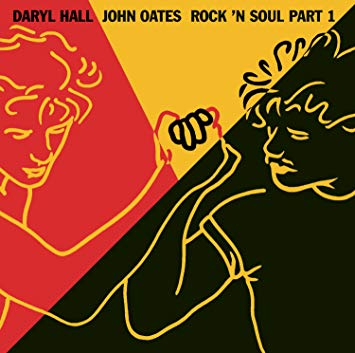
Sidebar!: I believe the album in question was the 1983 Rock ‘n Soul compilation because the cover art they ultimately settled on amounted to a poor man’s version of a Keith Haring drawing i.e. THIS :
“Rummaging through antique clothing store racks of quirky Technicolor bowling shirts, musty record stores with row upon row of vinyl inspiration, vintage guitar shops, seeing beautiful girls writing their own fashionable rule books, druggie burnouts on broken stoops and all this wrapped together under a thick aroma of freshly baked pizza and italian bread…the Village offered up multiple sensory orgasms of possibilities around every corner”
“The maneater wasn’t just that woman. It was New York City”
-Quotes from John Oates’s 2017 memoir Change of Seasons
Okay, so Hall & Oates = NYC: Certain bands are as much a place as a sound. The Beach Boys ARE Southern California. Joy Division ARE Manchester. And Daryl Hall and John Oates ARE New York City. Or to be more specific, ’80s New York City. They embodied the vibe as vividly as any of Larry Levan’s legendary nights at Paradise Garage or Wild Styleor the seedy “Fascination” video game arcade in Times Square which I was always moderately terrified to walk into. They may have been full-on Philly in their origins but their sound was perfectly in sync with the neon, steaming manholes, cigarettes, and candy-eyed synthesized glamour of New York City.
You’d never know it now but back in the ’80s, 8th street, in the West Village of NYC, was ground zero cool for teen people like myself. It was centrally located near all the best record and clothing stores and home to a giant new wave pop culture-infused head shop called Postermat. That place was a teenage pop fan-MTV addict’s dream. It had glass counter displays stuffed with hundreds of band buttons and pins (Bowie, Specials, The Jam, and on and on). There was a massive tee-shirt wall with images of everything from Little Richard to the Union Jack as well as a cluster of poster racks filled with the usual cult heroes (Elvis, Marilyn, James Dean).
It was also located directly across the street from the legendary Electric Lady recording studio, the musical home base of Jimi Hendrix during the last months of his life.
Of course, the studio’s historic legacy meant absolutely zero to my ignorant teenage brain. All I cared about was the fact that Daryl Hall and John Oates recorded their albums there ( ultimately their four GREATEST albums ), across the street from Postermat on freakin’ 8th street, where I walked by nearly every day, and they touched this same sidewalk I’m touching now, and oh my god what if they are actually here or on the way. Walking down that street was always a slightly fevered experience because of this. I did ultimately catch them filming part of the “Possession Obsession” video on what I’m certain was the coldest night in the history of mankind but even with my youthful constitution at its maximum strength, it was just too damn cold to stand out there and watch for too long.
This is the image that is lodged in my mind when I think of NYC in the 80’s. Daryl and his immaculate hair on 6th Avenue and 8th Street in 1983’s “One On One” video.
One Last Thing, Here It Comes…John Oates, Real Talk: Time to address the elephant. It’s no secret that John Oates has been treated as something of a 6th finger in Hall & Oates by the world at large. As in he’s there but is not necessary. As in what exactly does he do and is his guitar plugged in. It was an idea that picked up steam as the duo became more successful, and Daryl became the primary face in the videos, and the primary voice on the hits.
John’s legendary secondary status reached its pop culture apex on, where else, The Simpsons :
In a Pitchfork interview back in 2007, Daryl was quoted as saying that he and John were “not an equal duo and never had been. I’m 90% and he’s 10% and that’s the way it is “.
And all through my years of fandom, I admit I felt this too. Hot CircusMagazine cover aside, when it came to listening to the albums, the Oates tracks ( the ones he wrote and sang lead on ) were barricades, the opening band before the real thing you were there to see. Still, as it was LP days and moving the needle required physical effort, I mostly just let the albums play all the way through, becoming familiar with the Oates-led tracks by default but having nowhere near the same emotional investment in them. The hooks in the Hall-led tracks were just more straight-up swoon-some and surprising.
Once the Sony Walkman arrived on the scene and fell into my hands ( ed. note: I basically hijacked my brother’s so blessings to him for understanding ), the editing frenzy began and it was mostly Oates tracks that ended up on the cutting room floor. The painstakingly assembled mixtapes I was stuffing in this magnificent new gadget were basically non-stop Hall-fests. Daryl, Daryl, and more Daryl.
The inevitable by-product of this editing, this laser focus on only the songs I loved with nothing in between, resulted in these previously adored tracks losing some of their initial luster from overexposure. Like a beloved teddy bear that’s lost an eye, I just plain over-loved them.
To “fix” this issue, I started plugging songs I’d initially ignored into newly made mixtapes hoping it would reignite my fever for the old songs by recreating that anticipatory feeling of waiting for them I used to get when the record was playing on the turntable. Which is what led to my formal Oates Epiphany. Most of the new additions on these tapes were HIS songs. Don’t get me wrong, I’d kinda liked some of them already but something had shifted. They were now sounding really, really good, like way better than I remembered. Is “Cold Dark & Yesterday” ( Oates ) better than “Did It In A Minute” ( Hall )? In a word, no. But it is damn good. Still, are there days I’d rather hear “Friday Let Me Down“( Oates ) than “Method of Modern Love” ( Hall )? Absolutely, most days in fact. And so when I say I love Daryl Hall and John Oates, I do genuinely mean both of them. It took a minute but the epiphany arrived.
And so to honor and acknowledge what maybe doesn’t always get the attention, at the end of most of the album reviews there will be a nod to the “Best Oates Moment” i.e. the song(s) where Oates is the primary composer and/or lead vocalist ( FYI: John’s autonomous contributions were somewhat sporadic over the first handful of albums and several thereafter so I will only reference where the above description applies ).
And now…
The Albums
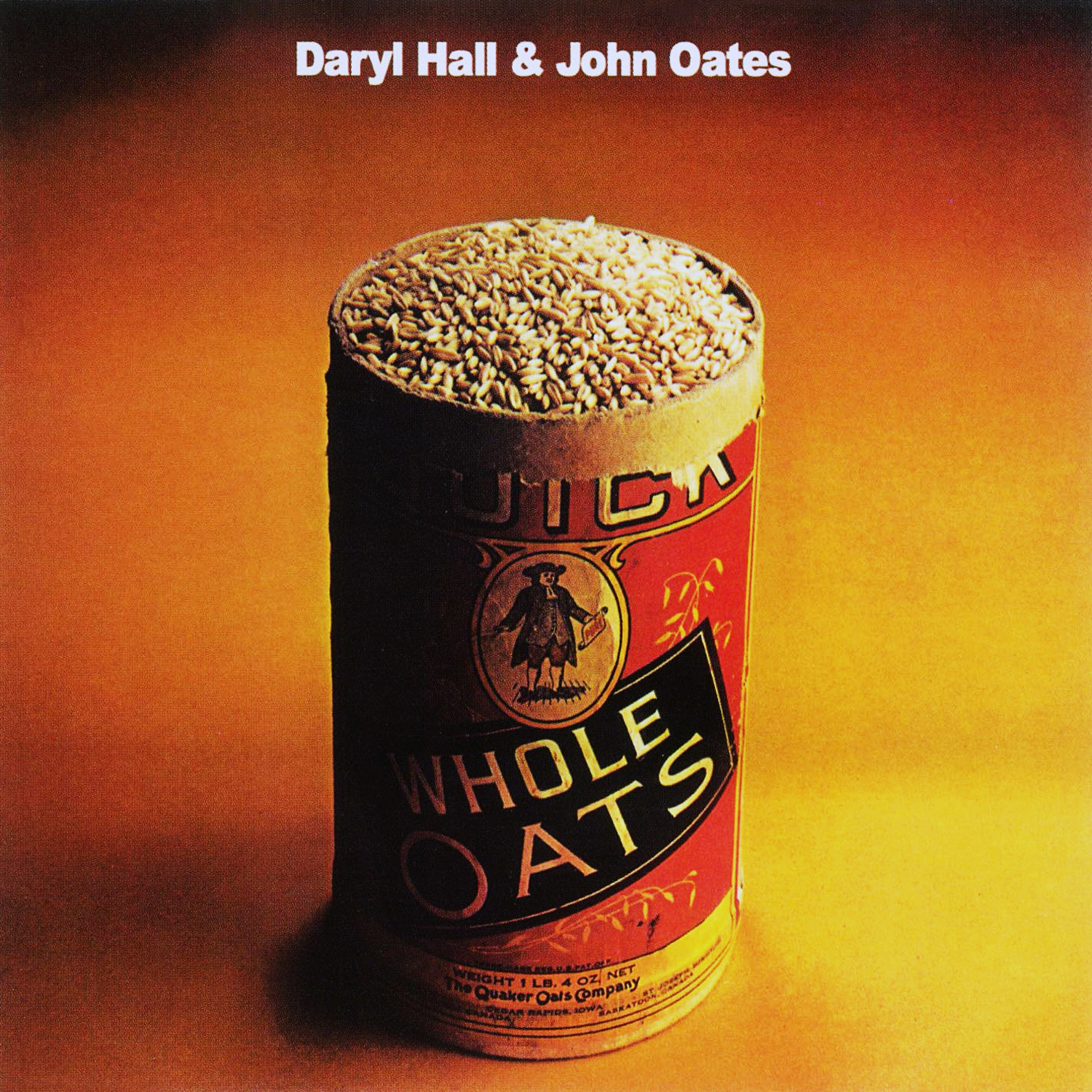
Whole Oats (1972)
Grade: 4/10
John Oates refers to this as H & O’s “dump album”, as it features the most worthy songs they’d accumulated in their arsenal up to that time. The theme of the album is just a simple, “Hi, we’re Daryl Hall and John Oates and it’s 1972” and as such is filled with sunny, quirky, AM radio-ready, sucking on hayseed, folky pop songs and no fixed identity. There’s a lot of talk about heading back to the “countryside”, walking “down by the canyon” and of course, “lying on the needle floor” with who else but “the reverend’s daughter”. The overall sound sits restlessly between early ’70s acoustic style Elton John and the cornier side of Harry Nilsson…but underneath this pile of hay are a couple of tracks brimming with promise and foretelling the H & O sound of the future, specifically Hall’s shining vocal showcase “Lazyman” and the album’s closer, the lush, Todd Rundgren-esque “Lilly (Are You Happy)“. They are both soul with the latter also being fire.
Abandoned Luncheonette (1973)
Grade: 9/10
While the hayseed folk-pop of the debut album is still on display within Abandoned Luncheonette, the soon-to-be trademark, lushly-stringed soul sound officially infiltrates the proceedings, due in large part to the influence of the album’s producer, the legendary Arif Mardin. And fact is the most successful songs are the ones where they abandon the folk-pop and go straight-up soul. As for specific songs, what is there to say about “She’s Gone” at this point ( insert reverential sigh here ) with its oddly joyful, over-the-top angst and legendarily demented proto-video. It features not only the finest vocal interplay H & O ever laid down but generously gifted the world with the seminal line “worn as a toothbrush hanging in the stand” ( As “guilty feet have got no rhythm” was to the ’80s, so was that “worn toothbrush” to the ’70s ). The superb title track, a movie plot in the shape of a song, offers a particularly memorable and soaring vocal from Hall on the chorus. Guitar solos straight out of ’70s cop shows where they are heading to the bad side of town, sophisticated soul ballads; it’s all here. The last-minute of the album is occupied by a chicken in the bread pan pickin’ out dough i.e. a couple of bizarre raving banjo and fiddle solos because, why the hell not.
Best Oates Moment: A 23-year-old John was inspired to write “I’m Just a Kid ( Don’t Make Me Feel Like a Man)” after the experience of being surrounded by even younger people ( girls ) at a show, whom he sensed were looking at him as an old guy even though he himself was technically young. It is lyrically problematic at points with John referring to himself as a “cradle thief”, and his love interest as “little girl”, and then stepping way over the line with “will you survive, will you learn to drive”. It’s hardly 33-year-old Ringo Starr singing “You’re Sixteen” but yeah, it may be slightly dicey. Know what though, best not to think too much and just dig it at face value as the nicely-tuned ’70s rock shuffle that it is.
War Babies (1974)
Grade: 7/10
Generally speaking, even when they were being weird, H & O still made songs that were pretty accessible. Produced by old colleague and super genius Todd Rundgren, War Babies is the most deliberately defiant, sonically experimental, FM radio-ready album H & O ever made and as such, the one with the most “Rock Cred”. As a chick, I can state it’s not really built to appeal to chick ears and seems more focused on attacking key nerve centers in boy brains…which is to say at points it gets dangerously close to Frank Zappa and there is some serious instrumental wanking. When it works, it more closely resembles the noodly yet accessible soul-pop excursions of Todd himself, “Is It A Star” being the best example. And while “I’m Watching You ( A Mutant Romance)” sounds like a lyrically clumsy Lou Reed song, it is still oddly compelling. War Babies is ultimately a slick, sleazy, and desperate piece of work, an acquired taste to be sure but absolutely worth exploration for the open-minded H & O fan.
Daryl Hall & John Oates aka the Silver Album (1975)
Grade: 5/10
This album features in “Worst Album Covers of All-Time” lists so often at this point that it’s become a cliche. And the fact is, the cover’s not that bad, it’s androgynously “of its time” though maybe somewhat unreflective of the music within it i.e. if it sounded like say Diamond Dogs or Young Americans it would make more sense. Frankly, as worst H & O album covers go, this wouldn’t even make the Top 5 ( Dear God, it gets so, so much worse ). Of course, the fact that the cover tends to be the main talking point regarding this one says a lot about the album itself, for despite being the home of the evergreen, eternal, undisputedly wondrous ballad Sara Smile, the rest of it is pretty middling and mediocre. But it does establish the temporary sound address that will serve as home base for the next H & O release, namely the string-laden Philly-style soul being purveyed at the time by the O’Jays, Harold Melvin and the Bluenotes and producers Gamble and Huff. In 1974 H & O parted ways with Atlantic ( shit just wasn’t happening ) and signed to rival label RCA in no small part because of manager, and future head of Sony Music, Tommy Mottola’s relentless belief in their potential. They honor him here with a thinly veiled “tribute” song called “Gino the Manager” and yeah, let’s just get out of here.
Bigger Than Both of Us (1976)
Grade: 6/10
The first half of “Bigger Than Both of Us” is solid and soulfully poptastic. “Back Together Again“, “Rich Girl” ( their first #1 ! ), “Crazy Eyes” and idiosyncratic, haunting ballad “Do What You Want, Be What You Are” are superfine to the last and if we were rating just those this would be at least 7 out of 10. But the quality starts to slip after that and the rest of the album regresses into pretty faceless, paint by numbers b-side quality songs. “Rich Girl” remains a perfect piece of ear candy and the fact that mercurial, contrarian legend Nina Simone, of all people, recorded a freakin’ cover of it powerfully attests to its significant charms.
Best Oates Moment: With its quirky and damn swoony chorus, “Crazy Eyes” is one soulful babe.
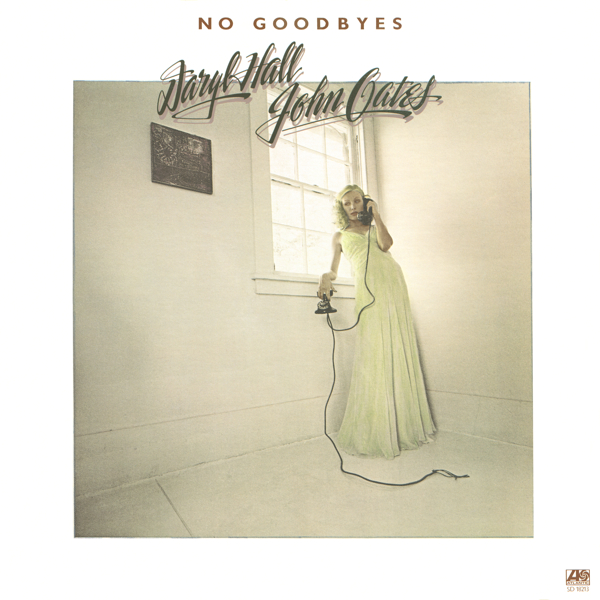
No Goodbyes (1977 compilation)
Grade: 3/10
In 1976 to capitalize on H & O’s success since leaving their label, Atlantic re-released “She’s Gone” as a single. Back in 1973, the song had only gotten as high as # 60 in the pop chart but now that H & O had a few hits under their belts, the world was more receptive and appreciative of its emotional, cynical beauty and it soon shot to #6 on the pop chart ( p.s. it should be noted that band of brothers, Tavares, took their own fabulous version to the top of the R & B chart in 1974 so the song wasn’t exactly an unknown entity). And with that Atlantic kicked out No Goodbyes, to cash in on the new success of “She’s Gone” and recoup some dollars. It featured a handful of tracks cherry-picked from the three albums they did for Atlantic but more importantly added three previously unreleased tracks which is why I’m bringing it up here. Those tracks are okay but Daryl himself is particularly sweet on “It’s Uncanny“, an optimistic, Elton John-esque little bounce and as a result it’s been finding its way into live performances in recent years.
Beauty on a Back Street (1977)
Grade: 7/10
Time to ROCK. Sort of. Beauty on a Back Street is the “hardest” H & O album. It is primarily guitar-driven and completely devoid of hit singles. It is home to “Winged Bull“, considered in some circles to be the worst song H & O ever recorded. While that song is not good per se, it’s not the worst ( though Hanoi Rocks, legendary Finnish AOR glam rockers 2002 cover version might lead you to believe otherwise ). It’s just a pretentious, over-ambitious power ballad that sounds like Led Zeppelin’s “Kashmir” and “No Quarter” mixed together and not in a good way (though admittedly I’m uncertain if there could be one). But it isn’t hurting anybody.
Forget about the bull though, for there are some superbly edgy, truly fine, let’s call them “rockers” populating the top of half of the album. Dark and soulful “Don’t Change“, the Cheap Trick-esque “You Must Be Good for Something“, anthemic shred-festing ballad “Why Do Lovers Break Each Other’s Heart“, old school soulster “Bigger Than Both of Us” ( yes, that was the title of their previous album and as such is a total throwback to their more vintage Philly sound ) and “The Emptyness ” a kind of back-alley Beach Boys song with an extraordinarily OTT Oates vocal that remains oddly endearing. Beauty on a Back Street marks the start of the creative upswing that was to run unbridled for the next eight straight years…after this next cash-in/hopeful gesture thing that is…
Best Oates Moment: The aforementioned “The Emptyness“
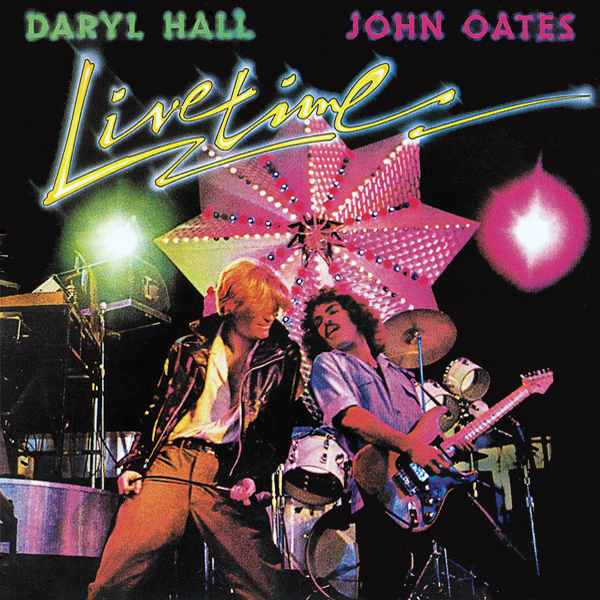
Livetime ! (1978)
Grade: 3/10
Back in the ’70s everyone was doing it. After kicking out a few studio albums, it was de rigueur for any moderately popular rock and/or soul act back then to release a live album. The live releases were not so much souvenirs of particularly special shows as they were placeholders to maintain momentum between studio albums and avoid falling out of the public eye. But despite the motivation behind them, make no mistake, if the wind was right this kind of thing sold ( Peter Frampton, Lynyrd Skynyrd, McCartney & Wings,etc.). That said, Livetime! was not one of them. On the plus side, the garish late ’70s style album cover is super awesome and the track selection itself is decent with all the big hits represented. On the down-side, the overall sound is exceptionally tinny and it includes a straight-up piece of filler in “Room to Breathe”…which wouldn’t be a big deal except for the fact the album is only seven songs in length which only serves to magnify its presence.
Best Oates Moment: While Oates’s vocals on both “The Emptyness” and “I’m Just a Kid…” are ridiculously melodramatic, hearing him give so hard and feel so much for everyone in Hersheypark Arena on that cold December night in 1977 night is all kinds of badass.
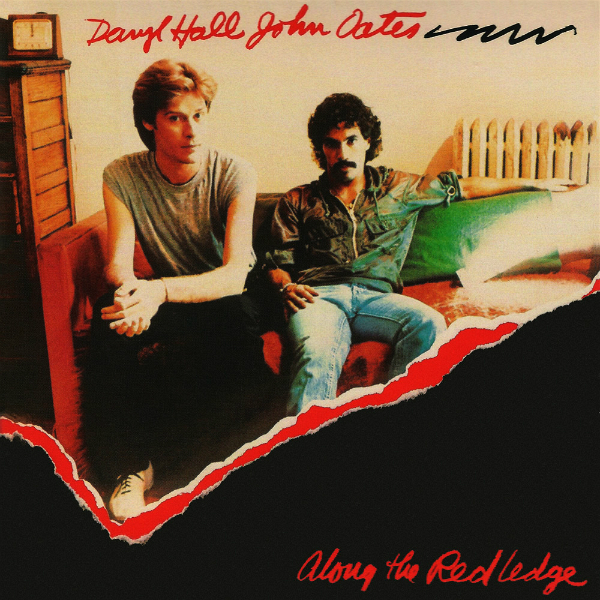
Along The Red Ledge (1978)
Grade: 8/10
Hardcore aficionados often cite Along the Red Ledge as the real sleeper in the H & O catalog, the secret classic…but there is trickery at work here thanks to the dreaded front-loading factor…which is a coy way of saying that the first five tracks are so solid and get you so high that you don’t necessarily notice how weak the rest of this album actually is. Yes, while you’re still tripping on the luscious fumes of the luminous “It’s a Laugh“, “Pleasure Beach“, the worst song H & O ever recorded, is sneaking in the back door of your very ears, riding on the coattails of all the goodness that came before it and hoping you don’t notice how crap it is.
This album is where things started to shift stylistically, seeing the final appearance of the Philly Soul string flourishes while marking the full mobilization of the hook factory. Highlights include the aforementioned “It’s a Laugh”, both cynical and sad with its huge, gorgeous, ascending chorus, and the heartbreaking Beach Boy-esque beauty “The Last Time“. And don’t want to sleep on deep-cut “Have I Been Away“, which is essentially a more melodic precursor of future hit “Everytime You Go Away” and is home to a stunningly acrobatic Hall vocal. And to be fair, the album does end on a hopeful note in terms of quality with the hazily romantic “August Day” so we do get past the iceberg ultimately.
Best Oates Moment: “Melody for a Memory“, an epic and occasionally haunting piece of rock music for staring at city lights with some ridiculously fine co-lead vocalizing from both John ( going low ) and Daryl ( going high ).
X-Static (1979)
Grade: 9/10
And now comes maybe the true sleeper in the H & O catalog. X-Static lives a lonely life within the H & O discography, suffering the statistical indignity of “watching” the four albums that had preceded go Gold and the four that followed it go Platinum while achieving no shiny awards for itself, forever cementing its D-List status. Apart from its lone hit single “Wait For Me“, it is mostly forgotten…which is a damn shame because it’s actually really good.
X-Static is full of piano propelled big chorused prototypes of future H & O hits, songs that had they maybe appeared within the next few albums would’ve been hits, in particular, “The Woman Comes and Goes” and “Running From Paradise“, both super melodic, keyboard-driven bangers. The album’s only genuine hit, the aforementioned plush power ballad “Wait For Me“, remains a swoon inducer of the highest order and is the only track from the album that ever appears in a setlist with any regularity.
The album is slightly time-stamped, due to its couple of desperate but totally infectious excursions onto the dance floor. “Portable Radio” and “Who Said the World Was Fair” are essentially rock-disco, though to be clear are much closer in the gene pool to say Paul McCartney’s popped-out version of the sound than to the Studio 54, snorting coke in the VIP lounge Rolling Stones version. But they are both exceptionally sticky and fun.
This album was reissued in 2000 and featured a previously unreleased bonus track “Time’s Up ( Alone Tonight)“, an absolutely bitchin’ uber-melodic kiss-off pop song and co-write between Daryl and producer David Foster, and it’s a damn shame it wasn’t on the original release.
Best Oates Moment: “All You Want is Heaven” is a complete hook-fest and offers a gentle tip of the cap to the old Philly soul.
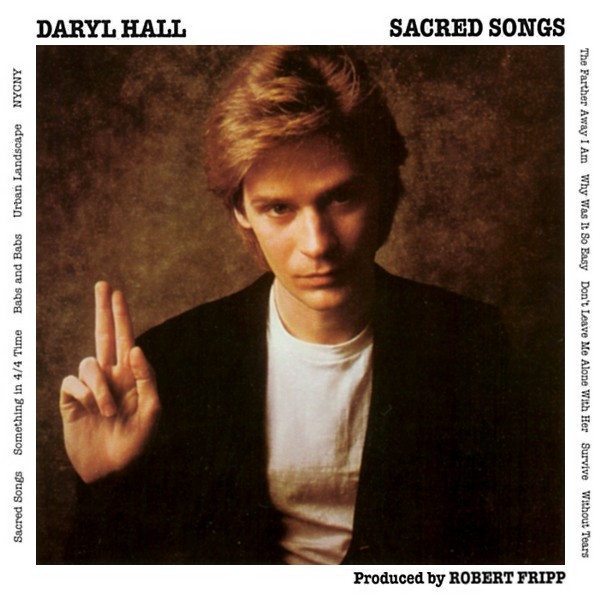
Daryl Hall: Sacred Songs ( Recorded in 1977, released in March 1980)
Grade: 8/10
Sidebar: The Doomed Tale of Daryl Hall & Robert Fripp Otherwise Known as The Turning Point in the Sound of Daryl Hall & John Oates That Led to their Complete Chart Domination from 1980 Onward
When you talk about The Beatles, you’ve got to talk a little about their invaluable and debauched residency in the sleazy clubs of Hamburg. From the haircuts to the profound emotional brotherly bonding, their time there was the foundation for nearly everything that happened to them afterward.
Now while this next stuff didn’t happen during H & O’s formative years, it marked a crucial turning point in their sound evolution and sowed the seeds of what happened next i.e. H & O becoming one of the biggest pop bands in the world. Stick with me here…
The Bonding: Daryl Hall first met Robert Fripp, the main creative force within UK progressive rock legends King Crimson in 1974. Though at that point Fripp had decided to step away from music to explore his spiritual interests ( the official male English Rock star rite of passage of the era. See George Harrison, Pete Townshend, Richard Thompson, etc.), the two remained in regular contact through Fripp’s musical sabbatical.
Let’s Do This: By 1977 Fripp was feeling inspired to get back in the fray and so he and Daryl decided to embark on a couple of new projects. The plan was to produce and create the first Daryl Hall solo album which would dovetail into Robert Fripp’s own album (also his first solo excursion) for which Hall would provide the lead vocals.
Oh to be a fly on this wall. Fripp, Gilda Radner and Hall in 1980.
Project #1: The first Hall/Fripp collaboration and Hall’s first solo album, Sacred Songs is hard to pin down. It’s reminiscent in parts to early ’70s Bowie ( think Young Americans and Station to Station) and full of hazy plastic soul, jagged Fripp guitar solos and ambient interludes. It runs the gamut from hypnotic, post-apocalyptic balladry ( “The Farther Away I Am“, “Why Was It So Easy” ) to anxious New Wave ( Nycny ) to proggy FM radio-ready rock ( “Babs and Babs” ). The best of the bunch is “Something in 4/4 Time“, a gritty piece of power pop that was hopefully a top ten hit in a better, alternate universe. Sounds good right? It is! But it sounded nothing like the H & O albums that had come before it…which turned out to be a problem.
RCA mad: RCA were not happy with Sacred Songs. It sounded nothing like a standard H & O album which, to them, created a marketing conundrum. Worried that its overall sound would confound existing H & O fans and “Rich Girl” lovers, and kill whatever existing momentum had been created, they refused to release it, it was, in classically cruel record company speak, shelved. Hall and Fripp were not happy about this and openly complained to no avail ( at least not right away ). Unfortunately, the RCA stonewall didn’t end there.
Undeterred aka Project # 2: In 1979, Hall and Fripp recorded the second installment of their collaboration, the Fripp solo album, ultimately titled Exposure featuring Hall’s lead vocals on all tracks. RCA weighed in again. On the premise of contractual restrictions, they refused permission for Hall’s vocals to comprise the whole of the album. The edict handed down resulted in Fripp’s only being able to include two of the Hall vocal tracks. This forced Fripp to recruit other singers to re-record songs Hall wrote and had already recorded.
Fuck You: To summarize RCA had a very specific vision of what a Daryl Hall-infused record should sound like and it needed to jibe with their pre-ordained marketing plan. All this served to ( rightfully ) piss Daryl off forever. In his 2007 interview with Pitchfork, he straight up says “That’s when I completely fell out of love with the music business”.
On Second Thought: Eventually, good sense prevailed. After some track leaking, open complaining by Hall and Fripp and letter writing by fans who’d gotten wind of the whole mess, RCA eventually acquiesced and released Hall’s Sacred Songs in March of 1980. Time has been kind to it and it’s been rightfully celebrated as a minor cult classic over the course of the 21st century.
A Seed Takes Root: Hall and Fripp’s collaborative efforts produced an eccentric, sometimes challenging, inherently soulful, and peculiar kind of pop music that served as a sonic blueprint for the H & O sound that came to run riot over the charts in subsequent years. Next in line is the gigantic, fantastic, hybrid flower that grew from the seeds of the Hall & Fripp collaborations…
Voices (1980 aka the album that marked the point at which Daryl Hall & John Oates officially became HALL & OATES)
Grade: 10/10
Diagram A: Daryl Hall & John Oates Voices is better than Fleetwood Mac’s Tusk, let me explain…
Wait a Minute Baby: In 1979 Fleetwood Mac released Tusk, their highly anticipated follow-up to the massively successful Rumours album. It was a 2-LP, 20-song behemoth that felt less like a group effort and more like a random sampler featuring the work of three disparate artists ( the Mac songwriting core of Lindsey Buckingham, Stevie Nicks, and Christine McVie ). It was generally regarded as an incoherent mess, albeit one with a handful of truly brilliant songs sprinkled within it, amongst them Nick’s eternally exquisite “Sara” and Buckingham’s commanding title track.
Thump and Clangor: The main problems fans, label, and critics expecting Rumours II seem to have had with it were related to Lindsey Buckingham’s contributions. The 1979 Creem Magazine review of Tusk described his anxious, helium-infused proto-new wave offerings as “dull sketches buried in thump and clangor”. Which is to say they were just a little too quirky and eccentric for people to get their heads around, more “Vegetables” style Brian Wilson than say “Wouldn’t It Be Nice” style.
Sonic Sea Change: Over the past 20 years or so there has been a major shift in opinion regarding Tusk. It’s gone from being a legendary disappointment to being considered the boldest and most inventive work the band ever did, as well as the album all the cool kids now namecheck as their favorite Mac release. And the Buckingham tracks that everyone had a problem with? Those are the songs generating the most accolades. Its enviable afterlife has seen it lauded in every way possible from being given a latter-day review score of 9.2/10 on Pitchfork, to having two books written about it, to its being released as a super deluxe 5-cd box set.
NY/LA: Voices is the NYC version of the LA to its core, Tusk. Only it’s a better record. It’s a mix of anxious, bizarro-new wave and pop-piano hook-fests that go down way easier than any of Tusk‘s jittery excursions. Even at its weirdest, every track on Voices sounds like a radio song. While Tusk is self-absorbed and insular, Voices is out wandering the streets looking for trouble.
What Album?: But of course, where Tusk has retroactively been lauded as a masterpiece, H & O’s Voices is generally just thought of as an old pop album…when it’s even thought of as an entire album at all because the enormous popularity of its singles, “You Make My Dreams” ,”Kiss on My List” and “You’ve Lost That Loving Feeling” have gone a long way to rendering the rest of the tracks on the LP invisible.
The Songs: Perfectly dolled up demo “Kiss On My List“, and the electro-soul blueprint of the future “You Make My Dreams” are the glamour queens of Voices, drawing the crowds and looking good. The spare and sharp quartet of “Big Kids“, “It’s So Hard to be in Love with You“, “How Does it Feel to be Back” and “United State” mix soul, New Wave and Cheap Trick and make something completely new; nothing in pop sounded quite like it at the time. The weird and edgy songs, “Gotta Lotta Nerve“, “Africa” and “Diddy Doo-Wop” exist in the same sonic universe as Tusk tracks “The Ledge“, and “Not That Funny“. And the cover of the old Righteous Brothers chestnut “You’ve Lost That Lovin’ Feeling” is significantly dirtier and street-ier than the original and full of highly entertaining, over-the-top soloing from both Daryl and John. I still think “Every Time You Go Away” ( which was ultimately covered by British singer Paul Young , slathered in synthesizer, and sent on its way straight to #1 on the pop chart ) is a weak link and not a patch on any of the wondrous balladry that had come on previous albums ( “Do What You Want“, “Lilly” ). It seems funereal compared to the up-all-night vibe that exists within the rest of Voices and worst of all, is missing the H & O signature move i.e. the “did you get the license plate number, what the hell just happened” hook. Yeah, I acknowledge and accept that I’m likely standing alone on that one.
Voices > Tusk: Voices is not the best H & O album but it is the most important, for with it the blueprint of the future became official. And so yeah, Tusk is a beauty in places but as far as innovative, accessible pieces of pop music art go, listen to this, Voices is better.
Best Oates Moment: The kick-ass Cheap Trick meets the Temptations opening track “How Does it Feel to be Back“
Private Eyes (1981)
Grade: 10/10
Private Eyes is H & O’s definitive artistic statement. It’s their Pet Sounds. Their Blue. Their Purple Rain. Home to millions of whiplash-inducing hooks and some of D.Hall’s finest vocal performances, it is the album to offer up should anyone ever ask you where to start in the H & O canon. It’s where the frequently/forever sampled/ no bass-no drum, electro-soul ballad extraordinaire “I Can’t Go For That ( No Can Do)” lives. The rest of the album is split between the gloriously urgent and shiny ( “Tell Me What You Want“, “Head above Water“, “Some Men” ), plush piano pounders ( “Private Eyes“, “Did It In a Minute“,”Unguarded Minute“), and Oates-ian scenery chewers ( “Mano a Mano“, “Friday Let Me Down” ). A sinewy lizard in the form of a song ( “Your Imagination” ) and a bow to H & O heroes The Temptations and the Four Tops ( “Looking for a Good Sign” ) featuring a Hall vocal par excellence, round things out. Private Eyes is true vintage NYC-pop music-art perfection.
Best Oates Moment: “Friday Let Me Down” is an oddly joyful rejection song that lies somewhere between the Go-Go’s and Springsteen and nicely showcases the extraordinary cruelty of that classic torture device known as the answering machine.
H20 (1982)
Grade: 10/10
H2O as a whole is a pretty cynical affair, with every song to the last expressing some manner of confusion, anxiety, or frustration, albeit in the most popped out, addictive manner possible. It’s all sweet outer coatings with bitter centers ( “Guessing Games“, a stellar cover of Mike Oldfield’s “Family Man” ) and dark city grooves ( “Open All Night“, “At Tension“, “Art of Heartbreak“), its centerpiece being Hall’s gorgeous, world-weary ballad “One on One“. And bonus points for the video of the latter featuring Daryl impeccably decked out in his ’50s street corner finery walking through a long-gone ’80s NYC: it remains a swoon-worthy and gorgeous memory of the olden days.
This is the album where Hall starts to push the envelope vocally, unleashing and shredding to magnificent effect on “Family…” and in the coda of “Go Solo“, a precursor of what was to come on the next studio release, Big Bam Boom…
“Oh Oh here she comes”. Okay, just a few words on THE SONG. Despite the name of this essay, I’m tired of “Maneater“. Partially because it’s a little silly and it lends itself so easily to mockery and as a result is the song haters will generally wield as the primary example as to why H & O suck. But mostly, I’ve just heard it too many times. Like Beatle lovers who hate “Hey Jude” ( get it ) or Bob Marley fans who couldn’t endure another minute of “One Love” ( please tell me there are some ), “Maneater” is not, nor will it ever be a part of my evergreen H & O playlist. Of course, having seen people completely lose their shit to it in a live setting, I understand why it still needs to happen. With its 380 million-plus plays on Spotify ( and counting ), the love for “Maneater” runs deep. And in its defense, Charlie De Chant’s sax solo within THE SONG completely annihilates every other ’80s sax solo that ever existed ( including you “Careless Whisper”) but from a personal standpoint, I’m just gonna sigh and hit fast forward forever.
Best Oates Moment: “Italian Girls” with its lyrical references to Sophia Loren, pasta, and Vino Rosso is a patently ridiculous, melodic, and awesome piece of candy.
Oh, it’s no secret to me…
Sidebar : The Misogyny Thing aka “She was open all night”
Success breeds backlash and so as H & O’s chart dominance began to grow, so too did the negative criticism. Hence a few writers began calling out what they perceived was overt misogyny within the lyrics. The nature of the complaint was that within the typical H & O song women were more often than not, presented as cruel and manipulative ( they’d “pay the devil to replace her” after all ).“Maneater” and “Open All Night” were thought to be particularly hostile ( the chorus of the latter being “She was open all night, while I was away, you were open all night” ). The irony of course was that the duo’s primary songwriting partners during their biggest years were women, namely sisters Sara and Janna Allen, the former of whom had a hand in both aforementioned tracks.
But okay for argument’s sake, could “Open All Night” be said to possess a questionable sentiment? Well technically, yeah. While it remains a gloomy beauty of a song, there’s an undeniable thread of judgement and anger running through it. But it’s not part of some broader manifesto. The critical assertion of misogyny always felt like a bit of a broad and lazy stroke, some selective cherry-picking to justify disliking them. The weird part is until these magazine reviews brought it up, I hadn’t really noticed because I was processing what I heard in a really different, naively fantastical way.
Like some prehistoric form of fan fiction, I was sensing something a little “different” lurking within the songs…something deeply, inherently queer. As in, it sounded like some of these love-themed songs were addressed to boys. It didn’t matter to me how many times Daryl sang the word “girl”, to my ears that was just a red herring. It was a classic “Paul Is Dead” scenario, with me twisting and deliberately mishearing words to support my desired theory. When Daryl sang “I should’ve listened more” I heard it as “I should’ve listened BOY”…and okay, I still do. When he trilled “You know I ain’t no danger boy”, I inserted an imaginary comma between the latter two words.
Now to be clear, these thoughts weren’t triggered by the rumors that had regularly dogged H & O since their infamous Silver album cover ( that Daryl and John were in the old parlance, lovers ). That tale seemed, and was, so on the nose as to be patently ridiculous. No, my Spidey sense and wild teenage imagination were ignited by a handful of highly interpretable often vague ingredients within the music itself, ranging from the “New York City vibe” described earlier, to what I perceived as a knowing “lilt” in Hall’s vocal delivery, to the brief lyrical turns ( from the “crewcut rainbows” mentioned in “Some Men” to the repeated “blowing” in “Delayed Reaction” to not being able to “go for that” in you know what song ). Further gasoline was thrown on the fire when in a 1983 interview in Rolling Stone, Daryl said, “The idea of sex with a man doesn’t turn me off, but I don’t express it. I satisfied my curiosity about that years ago. I had lots of sex between the ages of three or four and the time I was fourteen or fifteen. Strange experiences with older boys. But men don’t particularly turn me on. And, no, John and I have never been lovers. He’s not my type. Too short and dark.”
The “Paul is Dead” saga or more specifically, The Beatles themselves had convinced me that no song was ever to be taken at face value, that every single one was a puzzle waiting to be solved, you just had to be savvy enough to catch the clues and code words. Of course, I wasn’t trying to solve a complex conspiracy theory here, I was a teenage girl looking to imbue my favorite H & O songs with mystical romantic qualities because honestly, I thought it was hot. Now please enjoy Daryl bringing all of the above home on this staggeringly wondrous version of “Laughing Boy” from 1976. Watch here. Hot.
Rock ‘n Soul Part 1 (1983 Compilation plus 2 new songs and FYI, there were 2 different covers)
Grade: 9/10
Rock ‘n Soul was the first bonafide, all killer, no filler H & O hits collection and though it’s now primarily an artifact of the olden days, its initial release was a pretty big deal as it marked the debut of two highly anticipated new tracks. The first, “Say It Isn’t So” is unquestionably one of the greatest H & O songs ever. Its echoey, hip-swinging, strutting down the runway tempo is perfectly set by T-Bone Wolk’s booming bassline and it features some of Hall’s absolute finest vocal scenery-chewing and word stretching ( “I know that you lie-eeeed” ). The other new track, the stuttering and cynical “Adult Education” is not as melodically lush but is still a great sneery, finger-wagging, synthesized beast. And oh yeah, oh yeah, I’d be remiss if I didn’t mention the video. “Adult Education“, the movie, is four and a half minutes of confusingly arcane symbolism, set in an underground tomb and featuring a true star-making performance by John Oates. Open-shirted with eyebrows vacillating in a manner somewhere between Groucho Marx and Milhouse Van Houton, he aggressively brandishes the neck of a guitar ( the neck, just the neck ) and comes across like some weird aberration of Prince, if Prince couldn’t dance. He totally, shamelessly goes for it and serves up a performance that is equal parts bold, beautiful, and utterly cringeworthy.
Big Bam Boom (1984)
Grade: 9/10
You know how around Xmas time there are some houses whose occupants opt for the extreme method of decoration with seizure-inducing light displays, elaborate manger scenes, a motorized Santa checking names, and reindeer occupying every available surface? This album is like those houses. It’s noisy, synthetic sensory overload. Introspection is out of the question. But it’s also ridiculously fun, in fact, the cover tells you all you need to know. Of all the albums H & O made in the ’80s there are none more intrinsically, biologically timestamped EIGHTIES than BIG. BAM. BOOM. It is also the last truly great Daryl Hall and John Oates album. “Out of Touch” the anthemic lead single ended up being their last #1 song ever, a notion which if posed at the time would have seemed absurd. Big Bam Boom serves as a showcase for some top-class Daryl Hall end of song improvising with nearly every track featuring some ridiculously clever, virtuosic ad-libbing during the final minute ( or in the case of “Method of Modern Love” the last two-plus minutes which is total f-ing beauty ). Highlights include the handsome “Some Things Are Better Left Unsaid” which starts wistfully sad, then like most everything else here, ramps up and increases in volume as things progress, allowing Hall to really wail, and the aforementioned “Method…”, the synthetic soul, love pledge that sounds like Smokey Robinson in space, which is kind of who H&O were at that point.
Best Oates Moment: Sweet, singing on the street corner throwback “Possession Obsession” and the slightly sinister, groovily hypnotic “Cold Dark and Yesterday“. Both are wickedly wonderful.
This photo from backstage at the Live Aid show in Philly in 1985 will never not be completely insane.
Tina Turner knows: After witnessing the triumvirate of Kenny Loggins, Steve Perry of Journey, and Daryl singing their respective lines at the recording session for USA for Africa’s We Are The World in 1985, Tina Turner exclaimed something to the effect of “damn, these white boys can sing! “. She had a point.
Live at the Apollo (1985)
Grade: 4/10
Both a labor of love and dream come true for H & O, this album recorded live at the fabled Apollo Theater in Harlem features a supergroup comprised of Daryl, John, and two of their absolute idols, Temptations legends David Ruffin ( the rough ) and Eddie Kendrick ( the smooth ) running through a handful of hits from both groups. It’s a sweet document, though with a little bit of a “you had to be there” vibe, both a tribute and a baton passing, and made all the more poignant by the fact that by 1992, both Ruffin and Kendrick had passed away.
Daryl Hall: Three Hearts In The Happy Ending Machine (1986)
Grade: 7/10
Welcome to 1986 when there was no such thing as “enough” and bigger was thought to equal better ( shoulder pads, hamburger patties ). This was especially true within the world of record album production. On the half-full side, the second Hall solo album could be said to resemble a more grown-up version of Big Bam Boom, loud, glossy, armed with head-spinning hooks and a wider worldview. But there is a half-empty take to counter that, namely that the Hall voice, the most valuable tool in the arsenal, is more often than not buried in layers of synthesizers, echo, and shiny guitars to suffocating effect. To be fair, this was the style of the time, and Dave Stewart of Eurythmics, gifted but essentially the poor man’s Jeff Lynne, was at the helm, so there was no way it wasn’t gonna sound like this, with everything turned to 11 and Hall often fighting to rise above the racket.
But underneath this noisy neon blanket live a handful of great, GREAT songs. The H & O-ish “Foolish Pride“, one of the few tracks where the Hall voice soars with clarity, break-up ballad “Someone Like You“, twanging riff-heavy “Dreamtime” and stadium-soul anthem “I Wasn’t Born Yesterday” are all pretty fabulous at their core.
Part II, A Change of Season
Hold on tight for we are about to go off a cliff. It pains me to say this but from this point on in H & O’s career, the quality of releases whips wildly between sort of okay to adequate to not-so-great, with a few moments of brilliance sprinkled in for good measure. The endless touring, the fatigue, the understandable desire to explore outside the confines of H & O all probably affected what happened from this point forward to some degree. And so the latter-era H & O records as a whole aren’t great…but there are definitely beauteous songs nestled within them.
Ooh Yeah! (1988)
Grade: 3/10
“Ooh Yeah ! was an unfocused album. My head and my heart were not into it”.
-Quote from John Oates’s 2017 memoir Change of Seasons
It’s never a good sign when the Wikipedia page for an album has no information other than the names of the participants, general statistics and song credits. While that serves as a confirmation of its existence, it’s also a reflection of where it stands in the big picture. And it’s especially odd when it’s an album that actually went platinum… which is to say we all loved H & O and were very excited that finally, after four long years there was a new studio album. And we were all (mostly) disappointed once we heard it. Ooh Yeah! qualifies as both the worst H & O album and the biggest letdown. It’s the most slickly produced with the most unfinished-sounding songs. Hooks are scarce. It seems distracted. To add insult to injury, the cover is also terrible ooh yeah. The strongest track by far is the LP’s lone hit, “Everything Your Heart Desires“, with its laid-back Temptations vibe. Runner up award goes to “I’m In Pieces“, an over-the-top Jackie Wilson-esque, unrequited love ballad that while somewhat hampered by an overblown production ( and saxophone ) is still pretty okay. I’d like to say Ooh Yeah! is a misunderstood cult classic whose mysteries will eventually reveal themselves but no, truth is it will only ever be an album that came out in 1988 by Hall & Oates.
Change of Season (1990)
Grade: 5/10
“So Close“, the first single off Change of Season is a great song, widescreen sad, nostalgic with lots of space for the Hall voice to run free and wild. That said, Hall hates the version that leads off the album, having been forced by the record company to bring in, wait for it, Jon Bon Jovi to fatten up the production and make it more “radio-friendly”. Which, to be frank, had to suck. As a compromise, Hall’s preferred, unplugged version was included as a bonus track. The Bon Jovi version is a cacophonous monster, a nearly five minute death match between the production and Hall’s voice with the latter coming out on top, (by shredding, raging, and steamrolling over every shiny guitar chord that charges its way Super Mario style). And truth be told, it’s still pretty great. But yes, Daryl’s instincts were correct, the unplugged version is the truer rendition, the real heartbreaker. The rest is a bit faceless for the most part except for “I Ain’t Gonna Take It” which is a gloriously defiant little monster that would’ve fit perfectly on Hall’s aforementioned Three Hearts album.
The End of an Era: In 1990, John Oates shaved his renowned mustache off after a show in Tokyo. Asked about it in a 2011 interview, Hall said he thought it was “bold”…and mentioned that “when he did that, he also shaved his head. It was a statement. He was a shaved-head, bald-lipped motherfucker!”. Bold.
Daryl Hall: Soul Alone (1993)
Grade: 6/10
Soul-rock hippie space cadets The Family Stand were one of the finest and most underrated bands of the ’90s. While their idiosyncratic sound basically ensured their never finding a regular home on radio or MTV, they were the recipients of a lot of love from other musicians and were regularly tapped to work on other outside projects. The two male members of the trio, Peter Lord Moreland and V. Jeffrey Smith produced and co-wrote the majority of Soul Alone with Hall, the three creating a sleek, lush, soul sound, full of Marvin Gaye-style flourishes and eccentric hooks that still sound pretty damn good today. You will find the Hall voice front and center throughout the album, where it should be, a real about-face from his previous solo excursion, Three Hearts. The plush and fabulously patronizing, “I’m in a Philly Mood” is superb. And melodic deep cut “Wildfire” is pretty exquisite with its twisting, turning chorus. Plus there’s a sweet nod to Mr.Gaye with a wistful re-interpretation of his “When Did You Stop Loving Me…“. The song quality levels out a bit after those three tracks to just plain old good as opposed to brilliant, but the standard remains resolutely high.
Daryl Hall: Can’t Stop Dreaming (1996)
Grade: 3/10
Released first in Japan and soon after in the U.S., Can’t Stop Dreaming is a mixed bag with a lot of co-writes and is not an especially memorable listen. The sweetly uplifting title track is the standout here, with a very ’90s R & B feel and classic H & O hook…but the rest is surprisingly faceless and veers dangerously close to smooth jazz in parts. And there’s a superfluous remake of “She’s Gone” which conveys none of the passion or urgency of the original.
Marigold Sky (1997)
Grade: 5/10
There was some hype with this one as it was the first new H & O studio album to appear in seven years and it had been assumed by that point that they were through doing new music as a band. And…it’s okay. The standouts are the title track which has a genuinely appealing ’90s country vibe and the gloriously shiny diamond that is “Romeo is Bleeding“. The latter features a big fat hook, a big fat synth and a big fat Hall vocal and qualifies as one of the greatest “lost” H & O tracks ever. They were playing it at the shows around the album’s release and honestly I wish they would start including it again because it killed. “Romeo” dwarfs everything here and alone it scores a 10/10.
Greatest Hits Live (2001)
Grade: 7/10
Recorded in 1981 on the Private Eyes Tour, this was at one point being considered for official release during H & O’s ’80s mega-years according to the sleeve notes, which is why I’m including it here. And while there are plenty of actual “greatest hits” on it, there is also weird shit like “Mano A Mano“, “Diddy Doo Wop” and “United State” which are oh so cool to hear in live form and I 100% approve of. And Hall’s vocal on “Wait For Me” is complete and utter fire.
Do It For Love (2003)
Grade: 3/10
Seriously, is someone just punking us with these album covers? I just can’t. Anyway, like 1990’s Change of Season, there are a whole lotta hands beyond Daryl and John’s involved in the songwriting here, making for a less than cohesive listening experience. There is a tendency to grade on a curve with stuff like this because when a beloved artist makes an album after years of recording dormancy that doesn’t completely suck, most of us feel a great sense of relief. And that haze of relief results in a whole lot of over-the-top hyperbole and excessive praise. But because of the ridiculously high standard H & O have set in the past, it would be impossible for an album like this not to be a disappointment. The cool electronics of the eighties are nowhere to be seen and the sound here is closer to 1990’s Change of Season, with a lot of glossy acoustic guitars. Actually come to think of it, maybe the cover was trying to tell us something. The Philly soul flavored title track is okay if a little rom-com soundtrack-ish and the sweet cover of New Radicals plush and lovelorn “Someday We’ll Know” is an inspired choice ( in fact a full-on collaboration with New Radicals main man Gregg Alexander would be just too damn wonderful, getting a fever even thinking about it).
Our Kind of Soul (2004)
Grade: 5/10
This lovingly curated cover album features a mix of Motown, Philly Soul, and originals and has its heart in the right place. I saw H & O play just prior to the actual release and was totally blown away by their performance of The Temptations deep cut “Fading Away“…but that passion doesn’t quite come across on the studio version. Which is to say in a live setting, these songs really come alive but as studio recordings they tend to fall a bit flat.
Home For Christmas (2006)
Grade: 4/10
Christmas albums are always a dicey proposition and how “good” they are depends on how high your tolerance threshold for holiday music is as a whole. Back in 1983, H & O released a sweet, kitschy version of “Jingle Bell Rock” as a single, the video of which is a masterclass in mugging, grinning, and complete cuteness and ended up recording a new version for this release ( which is okay but not a patch on the aforementioned version ). As for the rest, they tried to make things a little more eclectic by including a couple of originals among the standards, and there’s a really fine, shuffling cover of The Band’s “Christmas Must Be Tonight“. And have to call out the Hall vocal on “O Holy Night” which is exceptionally pretty. At the end of the day, it’s a laid-back, delicately crafted Christmas album and that’s really all it’s trying to be. Mostly though I love the pooh bear and piglet style cover.
Do What You Want, Be What You Are (2009 Box Set)
Grade: 8/10 ( it covers everything but…let me explain)
I guess the real question is if you are not a completist do you need this comprehensive 74-track collection? And the answer is…maybe. It’s a great overview to be sure and there’s a bunch of previously unreleased stuff…but unfortunately the majority of that stuff is of the live variety and not particularly essential. The fact is H & O didn’t leave a helluva a lot on the cutting room floor; the best songs really did land on the actual studio albums for the most part. Still, there are a few interesting curios (and a nice booklet breaking down the songs in the four-cd physical version) including “Don’t Go Out“, an Oates track that didn’t make it onto Private Eyes.
Laughing Down Crying (2011)
Grade: 5/10
“He was my best friend in the whole world. He was my musical advisor and teacher.” That’s Daryl Hall talking about longtime H & O band leader and multi-instrumentalist Tom “T-Bone” Wolk ( Literally the “&” in Hall & Oates ), who died the week recording began for this album. It lends a truly bittersweet air to Laughing which also features the last track T-Bone ever played on ( “Problem With You” ).
The 64-year-old Hall voice is in pretty fine fettle throughout but this one is mostly for hardcore completists. In other words, it’s okay. But, but here’s the thing, there are some genuine flashes of that old school Hall melodic gift, a nifty hook here ( “Wrong Side of History” ), a big chorus there ( “Crash & Burn” ), and enough proper tunes to suggest that he’s still got it in him.
BeforeAfter (2022)
Grade: 8/10
BeforeAfter is a fine and eclectic compilation of Daryl’s solo career to date. It is non-chronological and comes over more like a coolly curated mixtape than a dry historical overview which makes it a pretty engaging listening experience. This collection was built with everybody in mind. It not only provides a nice indoctrination for newbies but rewards longtime fans with eight previously unreleased performances from Daryl’s beloved TV show Live From Daryl’s House.
It’s great to see deep cuts like “Right As Rain” and “Talking To You (Is Like Talking To Myself)” dragged out of the shadows and into the spotlight. And the inclusion of riotous, fox-in-the-henhouse-of-sound, “NYCNY” is an awesomely cheeky touch. But for old-schoolers, the treasures lie in the live treats.Sacred Songs nugget “North Star”, featuring guitarist Monte Montgomery, sounds especially lush and languorous here and Hall’s vocal is pretty killer. Even better though, are a tag-team of tear-inducing covers, the Eurythmics “Here Comes The Rain Again” starring Dave Stewart himself on guitar, and “Can We Still Be Friends”, a super-emo duet with Todd Rundgren both of which I don’t recommend listening to unless you have your crying towel handy.
Yes, there are a few wondrous tracks it would have been great to see included (“Wildfire” where are you? “Something In 4/4 Time”, miss you my manic pal), but those are just minor, nerdy quibbles.
John Oates- The Solo Albums
True confession. I haven’t spent a lot of time with the five Oates solo studio albums, the first of which, released in 2002, had one of the most tragic album titles in the history of recorded music, Phunk Shui. I can only explain it like this. You know how sometimes, even as an adult when you are around your parents (or parent) you involuntarily regress into the surly teenager you used to be, giving one-word answers and eye rolls when they ask you questions and occasionally recoiling from hugs? That’s kind of how I feel when confronted with John Oates solo albums. Muscle memory takes over and I become that impatient H & O fan from my younger days who just wanted to hear the Daryl-led songs. And I feel some guilt about this because as I’ve been saying all along here, John was responsible for some absolute bangers over the course of H & O’s history. And it seems like he’s had a really good time recording all of his solo albums.
Based on all that I’m reluctant to step into the role of Grinch and slam them. I’ll just say they run the gamut from groove-based soul to retro folk to swampy blues to country rock with a few cover versions thrown in for good measure. They tend to harken back to early guitar-based H & O and so if you are a fan of that sound go forth and Phunk Shui.
The Oates solo studio discography: Phunk Shui (2002), 1000 Miles of Life (2008), Mississippi Mile (2011), Good Road (2013), Arkansas (2018)
Who The Fuck Are Daryl Hall & John Oates?
Daryl Hall and John Oates were never part of a scene. They were popular but they were also total outliers, oddballs, weirdos. They were creatively restless soul scientists, the kind of sharks who had to keep moving forward to stay alive, expertly distilling elements of Motown and New Wave while adding bits of folk and prog to make something completely new. Their songs featured some of the most majestic pop singing you’re ever gonna hear in the form of Daryl Hall. Cool but not cool, NYC to the core but actively stuffed into Yacht Rock playlists, white boys but with a deeper shade of soul. Back in 1985, Daryl said, “I think we’re the ’80s Beatles”. And he had a point. Both bands were completely ubiquitous in their respective heydays and the popularity of their songs has ultimately transcended age, race, and gender. There were some lean years when no one cared and some creative missteps but within all of it, there were songs. Brilliant, beautiful, ridiculous, and heartbreakingly perfect songs. Only one way to end this…
Robert Fripp and Daryl Hall’s Opus of Glorious, Paranoid Weirdness:
If you wanna hear Daryl Hall at his most manic, unhinged, and free, check out the 2006 reissue of Robert Fripp’s Exposure which features all the previously unavailable Hall performances. It’s a long, long way from “She’s Gone”.
The Daryl Show:
Live From Daryl’s Housestarted as a web series in 2007 and as a result of its popularity grew into a broadcast TV series in 2011. It usually features some cooking with Daryl looking on hungrily and admiringly, but mostly it’s live-ass music featuring Daryl and his kick-ass band. They perform with both established artists and new kids, offering up stuff from the extensive Hall songbook as well as originals by the respective guests. It’s plenty fun since a lot of deep cuts like “Somebody Like You“, “Babs and Babs” get airings and some of the performances are amazing. The 2009 episode featuring Todd Rundgren duetting with Daryl on “Can We Still Be Friends” is a particular heart-squeezer after which I always need a minute to collect myself.
The Book of John:
As you may have noticed, I’ve incorporated some quotes from John’s eminently readable 2017 memoir Change Of Seasons in this piece. It’s a breezy, engaging read and features some genuinely off-the-wall anecdotes that even if you are not a hardcore H & O fan make it worth checking out. Which is to say if you’ve ever wondered what it would’ve been like to have had the late legendary gonzo journalist Hunter S. Thompson as a neighbor, wonder no more because John’s got stories y’all.
The mission of Picking Up Rocks has always been the same, to shine a light on the best pop music regardless of label affiliation or level of fame or social media presence or perceived coolness…because who cares. A great song is a great song. And whenever we stumble upon a great song ( and there were a lot in 2019) we want to share it with you no matter if it was born in a garage, someone’s bedroom, a state of the art studio or a freakin’ treehouse !
Did that sound angry ? I swear it’s unintentional, guess I’m just weary of seeing the same songs mentioned on every year end list. Look, I genuinely like Lil Nas X, Lizzo and Billie Eilish. But know who released songs as good as theirs this year ? Kingsbury, Whitelands and The Hails. It’s okay if you haven’t heard all of them because that’s why we’re here, to both celebrate them and maybe introduce you if you haven’t.
I have listened to thousands upon thousands of songs this year because I am a crazy person who is always looking for a song to alter and upend the daily grind. Culling the master list down to the 50 best has been both nightmarish ( because there were lots of goods) and revelatory ( had forgotten just how good certain songs were) but we did it ! And so here they are, PuR’s TOP 50 SONGS OF 2019 ! 50 awesomely wonderful tracks by some equally wonderful artists all neatly arranged for you to listen on Soundcloud or Spotify ( links below). It’s my sincerest hope that you’ll discover something or someone within in who rocks your life and makes you swoon or at least say fuck yeah repeatedly.
THANKS TO ALL THE ARTISTS FOR THESE AWESOME SONGS, YOU ARE THE SUN.
No matter who we are in this absurd, brief, and messy life we can all lay claim to a peak, a shining moment where we were the best we could be, where all the stars aligned and we freakin’ delivered the goods.
Welcome to“That’s Their Pet Sounds” our semi-regular feature where we endeavor to spotlight and celebrate a heretofore maybe uncool, often unjustifiably underrated, sometimes polarizing, not as acclaimed as they should be, or “what the hell?” artist’s grandest artistic achievement i.e. their greatest album.
*”That’s Their Pet Sounds”is named after the Beach Boys landmark 1966 LP which is universally regarded as one of the greatest albums ever made but yeah, you probably knew that.
And now please join us on a trip over the top…
Tears For Fears BEST ALBUM : Seeds of Love (1989)
Background:The general consensus is that Tears For Fears 1985 album Songs from the Big Chair is their magnum opus. That it is The One. It remains the duo’s best-selling album by far (multi-platinum) and is filled end to end with angsty, earnest, occasionally pretentious but seriously wonderful pop music. Over the past ten years or so, even the most hardened critics have had to come clean about its undeniable and considerable charms. It now appears on every single “Best Albums of the 80’s” list without fail. There it eternally sits in all it’s radio-friendly, big chorused glory, the existentially tortured, two-headed pop turtle amongst your Sonic Youths, Smiths and Public Enemies. Now while the deep cuts on this thing are pretty great ( yeah “The Working Hour”, I’m talking about you) if we’re being truthful, the heart clutching love people have for Big Chair is primarily related to its triumvirate of enormously popular and memorable megahit singles. Let’s rank them in order of wonderfulness:
1.“Head Over Heels” which consists of unrequited love, familial disappointment and a pretty glorious hook. Also, bonus points, its video takes place in a library, the architectural equivalent of a secret crush. We will likely be swooning along to this thing forever. 10/10.
2.“Everybody Wants To Rule the World”: The best 80’s pop song that was partially inspired by the Cold War, easily crushing its two chief high profile competitors in that category: “Two Tribes” by Frankie Goes To Hollywood and Sting’s “Russians” the latter of which we’re not even going to discuss because I just freakin’ can’t. The chorus and intro get all the glory in “Everybody…” but the real heroes here, the heavy lifters and secret genius’s within it, are the sunshine strewn, singalong guitar solo, and the clever little vocal embellishment by Tears man Curt Smith immediately following it: “Say that you’ll nevernevernevernever need it”. Also remains pretty glorious.
3.“Shout”: And now the party is over. This bitter chant was a massive hit but okay, I’ve never liked it. Yes, it is undeniably memorable in that insidious, easy to sing along to the chorus way but it’s also an interminable dirge: it’s missing the unspeakably wonderful melodicism that is not only showcased in the two aforementioned tracks but in the album’s handsome deep cuts as well.
That aside, make no mistake, Big Chair is a very good record…but it isn’t Tears For Fears greatest artistic achievement.
No, to experience Tears for Fears at their maximum Tears for Fear-edness, behaving in the most Tears For Fears manner possible, we need to turn an ear to Big Chair’s spoiled and overfed younger sibling, 1989’s Seeds of Love. It’s full of over the top windswept melodicism and cryptic weirdness. Its scope and overall sound have an underlying unity, which is to say Seeds sounds like one big fat song as opposed to eight smaller ones. It comes across as a singular emotional vision. It’s bigger than Big Chair, way, way bigger.
Why it’s their Pet Sounds: Basically Seeds of Love is the Good Morning Burger in the form of an album. It is made entirely of musical carbohydrates. It is bloated, garish and grandiose. It is pompous and overwrought. It’s also Tears men Roland Orzabal and Curt Smith at their most adventurous and playful, more so then they had been up to that point and have ever been since. It is also positively brimming with estrogen. As in, five of the album’s eight songs were co-written by singer-pianist Nicky Holland. As in, Oleta Adams’s ridiculously soulful vocalizing is prominently featured on several key tracks including the behemoth “Woman in Chains”. As in, that very song is about toxic masculinity. Seeds is fueled by Girl Power.
This album had an extremely difficult birth, taking roughly three years and millions of dollars/pounds to complete to everyone’s satisfaction ( namely Roland and Curt). Those years saw key Tears stalwarts Ian Stanley ( keyboardist & co-writer) and Chris Hughes (producer & co-writer) both leave the fold due to that dusty old classic, creative differences, as well as the scrapping of all the initial album recordings that had been done by the legendary UK production team of Clive Langer and Alan Winstanley. This ultimately led to the guys taking on the production themselves assisted by engineer David Bascombe. It was a bumpy road.
And, unsurprisingly, Roland and Curt themselves were starting to really get under each other’s skin, ultimately resulting in the latter’s quitting the band in 1991 after the tour in support of the album. This departure was followed by some genuine Mean Girls style retribution wherein both Roland and Curt released nasty songs describing each others shortcomings on their first solo releases after Seeds: “Fish Out of Water” where Roland talks shit about Curt (“the only thing you ever made was that tanned look on your face”), and “Sun King” where Curt talks shit about Roland (“boy you looked so bad”). Burn baby burn.
And so Seeds was born under duress.
As for the contents of the album itself, this is one of those cases where you can actually judge a book by its cover, which looks like a Sgt.Pepper album and a Metropolitan Museum of Art Calendar that have melted together in the sun i.e. it sounds exactly like it looks. It’s completely flooded with color, and there are no empty spaces. Tears had never exuded light-heartedness or humor prior to this album, and the subject matter in the Seeds songs hold to that standard. What you get are mostly despair songs as opposed to love songs…but the despair is about the state of the world, not another singular person. It’s full of fun stuff like political hypocrisy, inter-band hatred, and the impending apocalypse. Honestly, it’s kind of angry but it hasn’t given up, it desperately wants things to get better. It’s some Everest, epic and majestically beautiful pop music and even though it’s about that dry, dense real world stuff and not I love you baby, it’s still extraordinarily romantic.
“I Love a Sunflowuhhhhh”…
The Songs: This album is officially eight tracks long. When it was released back in 1989 that was it. Eight tracks. If you go to Spotify or iTunes now, you are presented with the expanded version which features four additional tracks, former b-sides and what not. Here’s the deal, while these bonus tracks are okay, they are not part of the original album release…and so you should ignore them. We’re excommunicating them from the listening experience here. With that in mind I’m now gonna get all Dark Side of the Moon on you: In order to really experience Seeds properly, the album needs to be listened to in sequence . It’s a suite, a body, all the songs feel connected and meld into each other…and, okay, you may want to sit down, I’m going to use the P word: it is a little bit Prog. But with a small p. This isn’t Yes or Rush, don’t get scared. This has soul, big fat soul. And as stated earlier, it’s also somewhat…excessive. This record is just excessive. Just like this piece you’re reading now. The average running time for each song is six freakin’ minutes. It is full and I do mean FULL of horns, strings and piles of backing vocals. The whole thing is as a slick as an oil filled rain puddle. There are no sharp edges in here. And oh yes, Phil Collins makes an appearance playing his GIANT GUEST DRUMS. I know, it sounds like the very definition of “Eighties “. But wait, it is also full of absolutely transcendent hooks. Like in every song. And though it doesn’t get talked about much when we talk about Tears, Roland Orzabel possesses one incredibly soulful whine of a voice (That’s a compliment I swear) and can swoop from the depths of the ocean to the most manic falsetto in mere milliseconds and sound pretty fantastic. And co/backing vocalist Oleta Adams’s stunning supporting voice pulls him so far up throughout the album and is so in sync with his, that half the time it’s impossible to tell where he ends and she begins. For years I confused who was singing what in certain songs, so similar in timbre were the two. And so, the songs…
“Woman in Chains”: The band first encountered Oleta Adams whilst she was performing in a hotel bar in Kansas City back in 1985 while they were on tour, and oh lord, if you’re going to unexpectedly discover a singer in a Kansas City bar, you couldn’t haven’t been more fortunate and blessed than to stumble upon freakin’ Oleta Adams, and her soaring, heavenly voice. “Woman” is one of the the album’s signature songs and is, in a nutshell, about man’s commitment to overtly masculine behavior and how heinous it is…but it is not a clinical presentation or scholarly dissertation, it is a total power ballad duet. Like freakin’ “Almost Paradise” by Ann Wilson and Mike Reno, the gigantic love blob from “Footloose” that put the O in Overwrought , only “Woman In…” is about ingrained misogyny, because you know, this is Tears For Fears we are talking about here. Widescreen and beautiful.
As mentioned earlier there was some serious band discord happening through Seeds birthing process. “Bad Man’s Song” is about that very thing. Roland is the real life Bad Man in question and describes a scene that took place on the bands Big Chair tour wherein he heard the band talking about what a tyrant/asshole he was through a hotel wall. The vocal interplay between he and Oleta A. is exceptional here, and this incredulous, but accepting acknowledgement of bad behavior has got soul, soul, soul.
“Sowing the Seeds of Love” was the first single released off the album and is, for all intents and purposes, The Beatles’s timeless pop chant “I Am the Walrus” with a chorus that sounds like sunshine replacing the original one that sounds like rain. It is bitter and fun at the same time, calling out Margaret Thatcher’s infamously cruel reign and using Paul Weller’s musical transition from The Jam (Where he was the rebellious mod man of the streets) to The Style Council (Where he was a complacent coffee bar soundtrack provider) as a metaphor to drive the point home. It’s also one of Roland Orzabal’s finest vocal performances, featuring all kinds of quirky note stretching and emotional word spitting. While we’re here I would like to state, politics aside, I think Style Council were better than the Jam. More tunes, more romance and yeah, I know you don’t agree and please leave me alone on this because I can’t help it.
“Advice For The Young at Heart”: “Everybody Wants to Rule’s” older, more mature sibling, “Advice” positively shimmers while emitting the sweetest light on the whole album, both airy, and wistful. It’s also the only song to feature a Curt Smith lead vocal (Uh oh).
The next four songs feel connected in sound and scope and are Seeds secret foundation. They are what makes this thing truly great. Starting with “Standing On The Corner Of The Third World”, the Tears version of a quiet/loud song. No, that does not mean it sounds like the Pixies (Thank God). It sneaks in delicately, then gets all in your face loud, with big horns, and assertive backing vocals…but it’s all kind of sad. It’s somewhat convoluted and cryptic lyrically but seems to be talking about hiding all your bad thoughts or things you don’t want to admit to or show and using the now dated term “third world” as a metaphor for that place you hide them because, big picture, it represents a place people try to deny and forget. At least that’s what I think it’s about. This lyrical interpretation thing is always a losing game. Which leads us into… the plush and windy “Swords and Knives” which starts at birth and walks headlong into death as embodied by…“Year Of The Knife”. Is this song about regret and denial ? Is it a deathbed scene between father and son? I have absolutely no idea. All I can tell you is it’s a gigantic heartbreak locomotive and features some pretty fabulous screeching (No, seriously) from Roland…once this ends we survey the countryside from the mountaintop as the closing ballad wafts in over the credits, that being…
“Famous Last Words”: Tears’ version of a love song. Which means it is about embracing one other in the face of a pending nuclear apocalypse wherein all that will be left is “insects and grass”, all the while “listening to the bands that made us cry” which while completely fatalistic is undeniably romantic .
In Conclusion:Despite its going platinum, this record remains a bit of a sleeper. You don’t hear it mentioned too often these days, if at all. Which is a pity because it’s the finest thing this band ever did ( high praise because they did some seriously fine things especially on their first two album releases). It’s cynical, anxious and confused by the world but is all hope and love at its core. And it still sounds as melodically magnificent as the day it was born. Oh Seeds, you’re so pretty when you’re angry. Don’t ever change.
One of my abiding memories of art school ( okay, I’m one of those people, please don’t hate me) involves a particular incident that occurred during a regular weekly critique class. The professor was a successful professional photographer, not world famous, but known enough. A normal class session with her involved our taking turns hanging our latest masterpieces on the wall, after which she would lead a discussion of the works’ respective “merits”. We were teenagers in NYC so yeah, there were a lot of photos of local landmarks, homeless people, or in my case, parking meters and empty swings ( I was shy so I only took pictures of inanimate objects not people). By the end of the semester she’d grown so frustrated with the quality of our output thatshejust couldn’t take it anymore. In the middle of a class one day, she snapped. Exasperated, she turned toward us and yelled ” You are all visually illiterate !“. No one responded. My pictures weren’t on the wall at the time thankfully… buuuut, you know, it was pretty clear she’d meant all of us, that we collectively sucked. And I too was an official member of the visually illiterate.
I’ve pondered this observation over the years and narrowed it down to one primary source. If I was visually illiterate™, in my mind there was clearly one main culprit. It wasn’t my lack of art history education that adversely affected my vision, I’d had a whole bunch of that. It’s just that DaVinci, Van Gogh, and Degas couldn’t compete with the behemoth that dominated every creative thought that sprouted within my mind. That behemoth was a book, and that book was The Beatles Illustrated Lyrics. It took a hold of me as a child and kept me in a headlock for years. It acted as the filter by which I absorbed, appreciated and created art. I blame this book for everything.
That’s Alan Aldridge on the right, the man responsible for all this.
Okay so the brief history of the book goes something like this.The Beatles Illustrated Lyrics was published in 1969. It was conceived by illustrator Alan Aldridge who up to that point was mostly known for his slew of stunning novel covers for Penguin Books ( Come look at these, oh man ). His Beatle idea was inspired by an interview he’d done with Paul McCartney for the British Sunday Newspaper The Observer in 1967 which also featured his own illustrations. Upon the articles publication, Aldridge was inundated with approving, excited fan mail. People went nuts for these illustrations. That overwhelmingly positive response gave him an idea, as in if people loved this handful of images this much they might really go crazy over a whole book of Beatle inspired art. Soon after he approached many of the leading graphic artists of the time including David Hockney, Ralph Steadman and Peter Max, and asked if they would be interested in creating pieces of art based on specific Beatle songs. In nearly every case the answer was a resounding YES. It’s amazing to think that at that point The Beatles were so almighty and ubiquitous and had such cultural cache that well known artists in a completely different medium literally jumped at the opportunity to make artaboutThe Beatles art. It was meta before they actually called stuff meta. Aldridge offered the eager artists a list of songs to choose from and those that didn’t get chosen, he would illustrate himself. He also posted multiple ads soliciting fan art to potentially include as well. And so The Beatles Illustrated Lyrics was born.
This is the 1967 Observer cover that started it all.
I met this book by accident. My Mom’s book collection was housed in a tall shelf at the foot of a staircase. The bottom half featured a set of World Book Encyclopedias from 1973 and a myriad of books about antiques. The higher shelves featured more adult fare including Nancy Friday’s “My Secret Garden” ( for those unfamiliar, a then bestseller featuring explicit true life sexual fantasies written by what seemed to be hundreds of suburban housewives) as well as several romantically themed horoscope books ( “Sexual Astrology” anyone?). The books in this “adult section” were the absolute epitome of the beige but swinging seventies. My brother and I had been warned not to touch anything on those top shelves. She’d made it implicitly clear that the books “up there” were “not for children”. That was all the incentive I needed to pursue some in depth exploration. Without really saying anything, Mom had said too much. With that admonition, I made it my mission to get on a step ladder and/or literally use the shelves themselves as steps to examine these illicit books at the top of the mountain whenever she went out. And that’s how I first got my hands on The Beatles Illustrated Lyrics. I knew who the Beatles were, had heard songs on the radio but I hadn’t truly discovered them yet. I was a late pop music bloomer and to be frank didn’t know very much until I turned 10 or so (read about the epiphany here). Still I was inexorably drawn to this book. It was the biggest book on the top shelf and it had a cartoon on the cover. It was essentially a picture book. My attraction to it couldn’t have been greater if it had been covered in chocolate. And so down it came into my kid hands every chance I got.
I experienced a tiny surprise unrelated to its content when I opened it for the first time. Inside the front cover was a crumbling, dried, pressed rose. This book clearly had some secret sentimental value to Mom. Not that I cared, the most important thing I noted upon this discovery was that if I made one wrong move, the flower would slide and rain out of the book in tiny pieces like confetti . So whenever I took it down from that initial point forward, I would sit on the staircase in front of the bookshelf, gently lay it across my lap and read it in a gravitationally sensible way to ensure nothing happened to the flower thus further ensuring that Mom wouldn’t find out that I was perusing her “dirty” books ( because of course in my ridiculous, paranoid little peanut brain, I assumed she was actually dusting for fingerprints and checking to see if books had been shifted around every day. I was an idiot).
The book is laid out simply. There are Beatle lyrics with accompanying illustrations next to them ( or nearby). Some are literal, some are visual interpretations only the actual artist could explain the meaning of. But there is a consistent visual that makes itself known pretty quickly.
Breasts. This book is absolutely brimming with them. Nearly every song’s accompanying artistic interpretation features a breast depiction. There are more breasts in this book than there are pictures of Ringo ( this is not an exaggeration, if you feel like counting you’ll see). To a lot of people, The Beatles were clearly SEX.
And so inevitably there is also some tasteless, misogynistic shit in this book. Though as a child I wasn’t conscious of it and didn’t fully comprehend what I was looking at, the weird subversiveness of some of the art. I took everything at face value. Check out the faces below representing “Dr.Robert”, “Sexy Sadie” and “Helter Skelter” respectively.
Beatles = Breasts
Questionable but know what, I totally love these. Helter Skelter is Helter Skelter.
Of course initially, my absolute favorite works were the ones with the actual Beatles in them. Especially Alan Aldridge’s ridiculously colorful, cartoony and psychedelic ones. I wasn’t even close to what you’d call a Beatle fan at that point, owned no Beatle records, and they were long broken up…but the gravitational pull of even their mere images was indescribably strong, especially the McCartney visage ( it’s official, Paul is magic). I still think the Aldridge depiction of “There’s A Place” (below) is better than the actual song.
Yeah,Yeah,Yeah
I quickly developed favorites and it wasn’t long before I started getting out my tracing paper and copying stuff so I could look at them in the privacy of my room. Not just the ones depicting Beatles, oh no, but the ones of cartoon eyeballs murdering each other. A young man with enormous sideburns making out with an old lady. A “Taxman” eating humans and expelling them, literally. The tightly buttock-ed “Mr Kite”. I could not stop staring at this shit. And so no one was safe from my pencil.
I’m gonna say it: Mr.Kite has a nice ass.
As I got older, I inevitably grew weary of the book, wasn’t moved or shocked by it anymore and forgot about it, meaning I didn’t look at it much, if at all, once I was a teenager. Little did I know it was too late, it had infiltrated my mind forever and was never going to go away even if I never looked at it again. To this day, I love (live) to draw ( in ballpoint pen mostly) and I can see this book in literally everything I make, I can’t deny it. It’s in me.
Yeah, that guy at the end of the top row is Paul McCartney, so we’ve come full circle. In fact my Mom has recent drawings I did of John Lennon and George Harrison hanging in her house. Drawings directly inspired by the ridiculous book she attempted to warn me off.
A friend was in the UK recently visiting his in-laws and mentioned that his elderly father in law insisted on gifting him with a book from his vast home library. The book was not of his choosing. He was specifically offered a vintage copy of…The Beatles Illustrated Lyrics. The fact that his 80-something father in law thought that this particular book was important enough to make a special show of giving it to him as a keepsake, well, I took it as a weird yet beautiful affirmation. The book is unquestionably a product of its time but also a wonderful mess of sometimes questionable, often beautiful imagery: a truly oddball timepiece.
To close, here’s my favorite piece (below). It’s by French artist Jean-Michel Folon and accompanies the lyrics to “Blackbird” in the book. It’s both sad and optimistic and its relationship to the song is loose and interpretable. It’s the blankest, emptiest piece in the whole book …but at the end of the day kind of says it all.
This is a sad story. British singer Ephraim Lewis made a grand total of one album. It was called “Skin” and released in 1992 and was full of chilly, introspective, life affirming alt-soul. While overall it’s a pretty fine record, it’s also undeniably “of its time”, featuring very slick early ’90s production values ( faux strings, muted horns, shimmery backing vocals) and that pseudo electro-cool groove that became so common in the wake of Massive Attack’s “Blue Lines”. Still, it’s full of sinewy, anthemic and memorable songs and the filler is minimal. And Lewis’s voice is absolutely beautiful, rising up from the bottom of the sea to the most glorious of falsettos with ridiculous ease. It sounds like a first album, full of promise, a few killer songs, and endless potential. And frankly, in that respect, it’s no different than Jeff Buckley’s “Grace”, another by no means definitive statement, despite the grand hyperbole regularly attached to it. Like “Grace”, it’s a snapshot of an ascending talent who was going to make something truly great in time.
While not perfect, there are some undeniably stunning moments on “Skin” , specifically the slinky, sinister groove of its initial single “It Can’t Be Forever”, the desperately keening title track, and the languid and sultry beauty of “Drowning In Your Eyes” (the latter being the finest recorded moment of Lewis’s career). The vocals are absolutely faultless throughout.
Elektra, Lewis’s label, believed in him wholeheartedly and why not, he had absolutely everything going for him, the voice, the looks, all of it. They had expectations and believed “Skin” would be big.
The video for “It Can’t Be Forever” received a bit of MTV airplay and the album garnered a few positive reviews and went on to sell over 100,000 copies worldwide. Pretty damn good for the debut of a previously unknown singer… but disappointing from a record company perspective based on the millions of promotional dollars that had been invested to launch it. Besides “Skin”, Lewis also contributed an ethereal beauty of a song on the forgettable “Made in America” soundtrack in 1993. And… that’s where it ends. That was all his recorded output. He never got to make his grand artistic statement, his big record. He was dead before he even reached his 27th birthday. He died in 1994 under dramatic, sordid, and still not quite explicable circumstances in LA, where he’d been working on recordings for his second album with none other than Glen Ballard, the legendary producer/writer behind Alanis Morissette’s “Jagged Little Pill”.
His death wasn’t publicized and at that point in the technological universe, even though I was working in a mega record store, I didn’t hear about it until a month after it happened. It was shocking and extraordinarily sad news to say the least. Two years earlier I’d met Lewis at one of those old school record release party things set up by his label and he’d been a charismatic sweetheart. It was a pretty low-key event to celebrate the release of his aforementioned debut album. The venue it was held in was decorated with cheap cardboard “flats” depicting the album cover and, as apparently talking to him wasn’t enough for my immature, overly jacked up arse, I took the liberty of tearing one right off the wall in front of him, like you do, and having him sign it for me. He laughed and said “Ha, tear it right off why don’t you !”. This is it:
A bit battered and stained (from what I have no idea) as I had it hanging on my office wall, frameless and vulnerable from the next day onward. Anyway, he happily let me fangirl all over him, allowed me to ask inane questions and stand way closer to his person than I probably should’ve.
Admittedly, I was already a bit of a fan at that point and prior to that meeting had fallen pretty hard for his brand of spiritual, sexy alt-soul. Plus he was British which appealed to my obsessive Anglophile tendencies. He was important enough that for all these years I’ve kept that page at the top of this piece from a 1992 Vibe Magazine in an old portfolio case in my closet. Just never wanted to throw it away.
Here’s where things get complicated. Electra believed in Lewis’s potential and were willing to keep investing in him but they needed hits. Which to them meant casting aside his producers/co-writers from the unsuccessful ( in their eyes) first album, Bacon and Quarmby and connecting Lewis with someone with a proven track record, namely the aforementioned Glen Ballard ( who at that point had a myriad of big time credits to his name including co-writing Michael Jackson’s mega”Man in the Mirror”).
And things were changing not just professionally for Lewis, but personally. By 1993, he had parted ways with his long-time girlfriend and fallen in love with a man. According to Paul Flowers, his boyfriend at the time, Lewis said he’d never felt more contented or at peace with himself as he had within this new relationship.
In early 1994, Lewis headed to LA to begin work on his second album with Ballard. By all accounts he was feeling pretty good. And more comfortable with his sexuality. It was all coming together. But it only took a heartbeat’s worth of time for everything to crumble into pieces. While in LA, Lewis immersed himself in the local nightlife. Met people. Partied. And ultimately indulged in drugs.
On the night of March 18th, 1994 police were called to the apartment complex Lewis was staying at while recording in LA. He was creating a disturbance, yelling, climbing from balcony to balcony undressed and behaving in a disturbing manner that suggested he was having a bad reaction to some kind of drug he’d ingested ( post mortem reports support this). By the time he crashed through a top floor window, the police had physically reached him and there was a confrontation. Something occurred resulting in his falling off the top floor balcony onto the street below and suffering life ending head injuries as a result. Sordid, terrible, shocking. There’s been speculation that the police had something to do with this, that they’d tased him, which resulted in his panicking then jumping. Another story went that he’d threatened them with a makeshift “knife’ fashioned from a piece of broken glass from when he’d crashed through the top floor window and was in such a deranged state that he’d suddenly leapt off the building without prompting. We’ll never know.
It’s a terrible story. A terrible waste…but there remains this sweet old record out in there in the world you can still listen to right now, that’s worth listening too, that may really touch you. And there is also this heartbreakingly beautiful live performance which says more than anything we’ve offered here :
That voice huh ? Still makes me cry. Ephraim Lewis, he was something.
No matter who we are in this absurd, brief, and messy life we can all lay claim to a peak, a shining moment where we were the best we could be, where all the stars aligned and we freakin’ delivered the goods.
Welcome to “That’s Their Pet Sounds” our semi-regular feature where we endeavor to spotlight and celebrate a heretofore maybe uncool, often unjustifiably underrated, sometimes polarizing, not as acclaimed as they should be, or “what the hell?” artist’s grandest artistic achievement i.e. their greatest album.
*”That’s Their Pet Sounds” is named after the Beach Boys landmark 1966 LP which is universally regarded as one of the greatest albums ever made but yeah, you probably knew that.
Forget about those celebrity Halloween parties and remember Seal this way…
Seal’s BEST ALBUM : Human Being (1998)
Background: What is the first thing that comes to mind when we think of Seal? Generally speaking, it’s one of these three things, in no particular order:
3. The annual, oddly insufferable Hollywood Halloween party he up until recently hosted with his former wife, supermodel Heidi Klum.
And once that party started, Seal crossed the line from being a “musician” to being a “celebrity“. The ubiquitous and unending documentation of these parties fed this identity to such a large degree that it was remarkably easy to forget that this guy was once a credible artist responsible for some of the ’90s grandest, most emotive ear candy.
No.
Okay, so there’s that. But nearly as unfortunate is what his most predominate artistic activity for the past 10 plus years has been, namely wandering down that same dusty road trodden by Rod Stewart, Michael McDonald, Barry Manilow as well as a myriad of others in the twilight of their careers i.e. putting out cover albums of classic but at this point seriously hoary old standards and mostly obvious soul classics, an exercise that no matter how sincerely intended, is the very definition of cheap applause and in some cases, desperation. When the response to new albums of original material is literally no response, well, it’s cover time. Albums like these should all have the same title, I Give Up and, as they inevitably sell in truckloads, I Give Up: Volume 2. Now in Seal’s defense, some of the choices on his two soul themed cover albums (titled Soul…and yes, Soul 2) are undeniable beauties: “What’s Going On”, “I’ll Be Around”,”Free” to name a few…but they are counteracted by the presence of the hairy warted heads and hands of “Lean On Me” and “Stand By Me”, the most unwelcome guests/passengers in the history of the NY subway system.
One more cherry on this cake : One of Seal’s top five most streamed songs on Spotify is a pasted together version of he and Frank Sinatra “duetting” on “Santa Claus is Coming to Town”. Okay. Enough.
Time to push all that aside and focus on something else. Something really, really good that came at a really, really bad time. Seal’s third album Human Being was released in November of 1998 just as the full on Britney/Backstreet/Max Martin/TRL era was making it’s insane ascent. By then Seal was 35 years old and when it came to pop music in 1998, that was the same as being a senior citizen. Human Being with its lush orchestration, ballads and overtly sad subtext was not remotely in step with what was happening. It was not awesomely sweet rainbow colored candy, it was more like a half empty glass of water, sitting on a window sill, with rain pouring outside. It was a total lament…but also, it was totally gorgeous.
“Come be sad with me luv”
Why it’s his Pet Sounds: If you ever wanted to make a list of the 10 best Seal songs ever at least 5 of them would be off of Human Being ( okay, I know you probably wouldn’t but if you did). It’s that deep.
This album features these things in equal amounts :
1.Grandiose, widescreen instrumental backdrops.
2.Seal’s gigantically beautiful raspy voice.
3.Existential wrestling ( with bonus weary resignation).
4.Frustration and befuddlement about this life and the people in it.
5.Cryptic lyrical content.
About that last thought, here’s the deal: Seal’s words can sound as vague as a watercolor painting of a freakin’ lake…as in you kind’ve know what he means, because the song titles are pretty leading, and there are bits of coherent emotion within the songs but overall the feeling being expressed is not 100% specific.
There’s this website songmeanings.com where people post their often kind of out there and highly personal interpretations of song lyrics , and most of the commentary offered in regards to this album goes something like this, to paraphrase: “I’m not sure what he means but this is my favorite song of all time”. Basically you can read into them what you want and the lack of deep specificity makes it easier…and know what, that’s okay. This record is more about a combination of things coming together as opposed to showcasing one singular shiny feature.
Nearly every song is a ballad and the musical foundation for the majority of them is chilly and electronic, with some added guitar flourishes and cinematic strings to heighten the overall drama…but even with that abounding heaviness, make no mistake, these are pop songs and as such the tunes themselves are strikingly memorable ( lotta hooks). There’s really no filler.
And because of the aforementioned consistency in the mood and tune quality, it’s one of those records that works best as a full listen as opposed to skipping around. There’s parity.
Every song melds into another. You could liken it to how Marvin Gaye’s immaculate What’s Going On album is basically one song sped up and slowed down for 30 minutes but like a really, really good song.
Which is all to say that this is a complete piece of work and holds true to what the idea of an album really is. I know how overly precious and get off my lawn that shit sounds but just want to underline that Seal clearly put some real thought into this thing as a whole. It’s all magical, moody and full of wonderment.
The Songs:
When it comes to his own songs, Seal isn’t a party guy. Seal is more of an emotional apocalypse kind of guy. Here are lines from the respective chorus’s of three of his biggest singles prior to “Human Being” in the ’90s : “We’re never gonna survive unless we get a little crazy“, “It’s just a prayer for the dying“, “Is there still a part of you that wants to live“. In keeping with this tradition, the main line in the chorus of the title track here is “We’re mere human beings, we die“. The soaring vocal makes the fact that we are all irrelevant, easily replaceable dust balls desperately in need of love seem panoramically glorious which is a real achievement considering how depressing the sentiment is. This one was dedicated to Tupac Shakur and Biggie Smalls who had died not long before but you can read a lot of different things into its cold and sinister groove with a hook and it stands as one of Seal’s finest moments. ( * note: the album title is Human Being while the single is “Human Beings“, plural. Confusing but there you go).
“When a Man is Wrong” is an anthem about the old yin/yang, angel/devil, right/wrong, open/afraid relationship shiz that confuses and drives most of the planet and has one of those outstretched arms, billowing white shirt, standing on a cliff overlooking the sea style codas. In keeping with the over the top theme, if pushed to describe this song in one word it would be majestic. This is a majestic man of a song.
….but truthfully, it’s hard, and maybe unfair, to single out specific songs as the highlights since, as alluded to earlier, they all kind of blend together to make one beautiful thing. That said “Still Love Remains”, a giveth and taketh away tune about how someone can be ruined if you take it away, but life goes on and you’re both still alive, is especially handsome ….and Seal’s vocal on the acoustic driven bridge is a swoon inducing marvel.
“No Easy Way” feels like Seal singing directly into your ear about how things are over, over, over, but he sent you some “Rilke by hand, hoping you would understand“, even though he wouldn’t normally do that kind of thing but he still loves you even though he is maybe still a little pissed about how it all went down. This song has a heartbeat and it is very sad.
I have no idea what “Lost My Faith” is about. Seriously. Someone may be calling it a day but they’ll be there if you trip up…I think, but at the end of the day it doesn’t fucking matter, it’s got beautiful eyes, and has one of those patented Seal panoramic, soaring chorus’s and you need nothing more.
Everything feels connected sound-wise, like all the songs are holding hands with each other. In fact, I used to get them mixed up all the time, so similar were they in tempo and construction. Which is to say Human Being is actually filled to the gills with swoon inducing marvels. “State of Grace” (topic: uncertainty), “Colour”(topic: be here now), “Just Like You Said”(topic: losing you) all fit the bill and fill the heart.
Okay, said there was no filler but“Princess” is close, as in it’s not up to the standard of the rest of the album . Seal sings “Daddy’s little lemon ain’t all she’s meant to be” and then uses the word “bitter” in the next verse, and well, yeah. Thankfully it’s the shortest thing on the record, with a running time of less than 2 minutes, so let’s just pretend it’s not there.
In Conclusion: The liner notes in this thing were voluminous and because the primary formats at the time of release were cd and cassette, they were very hard to read without going insane. The text was absolutely minuscule and the content consisted of email correspondences between Seal and friends encouraging each other’s creative impulses and saying what a good time they had the night before, as well as lyrical excerpts.
Here are some of the liner notes. They are very small.
You don’t need to read them. They won’t enhance your experience of the album…only bringing this up because in the liner notes of Seal’s prior release, his self-titled second album, he wrote a very romantic and zen anecdote, featured in the thanks/credits section, about meeting a friend for the first time, that’s been hard to forget.
Story went like this; One day in 1992, in NYC, he’d spontaneously wandered into a fortune tellers storefront/parlor and proceeded to get his palm read. The reader offered mostly outlandish rubbishy predictions but also said that he was about to embark on some of the most wonderful and traumatic times in his life. And that just as the traumatic stuff began he was going to meet a friend who would help “share the strain” and offer him unending inspiration to keep going …and that ended up happening. The guys name was Paul, and he refers to him as “my dear friend” and Seal said that that particular album was as much a reflection of Paul’s life experience as his. There’s something kind of moving about that little memory especially since he was speaking of a friend and not a romantic partner. See that’s the thing about Seal and it’s all over this record, he’s a big picture guy. In his eyes the world is full of soulmates; friends, partners, humanity itself. It’s literally encapsulated in the title of the damn album, Human Being. It’s perfect not just musically but in that way too. It’s his Pet Sounds.


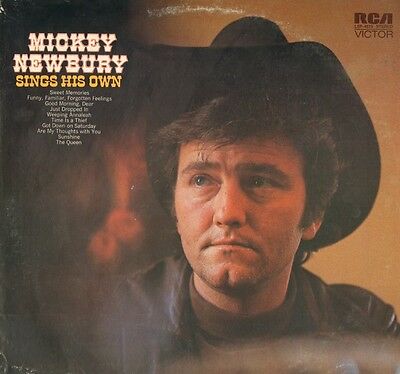


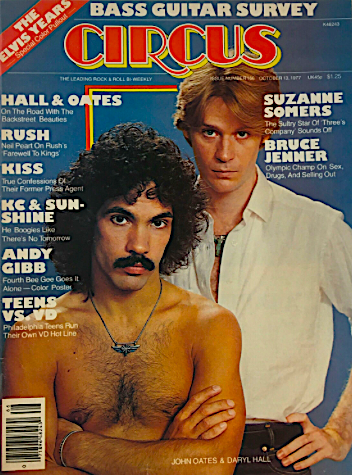
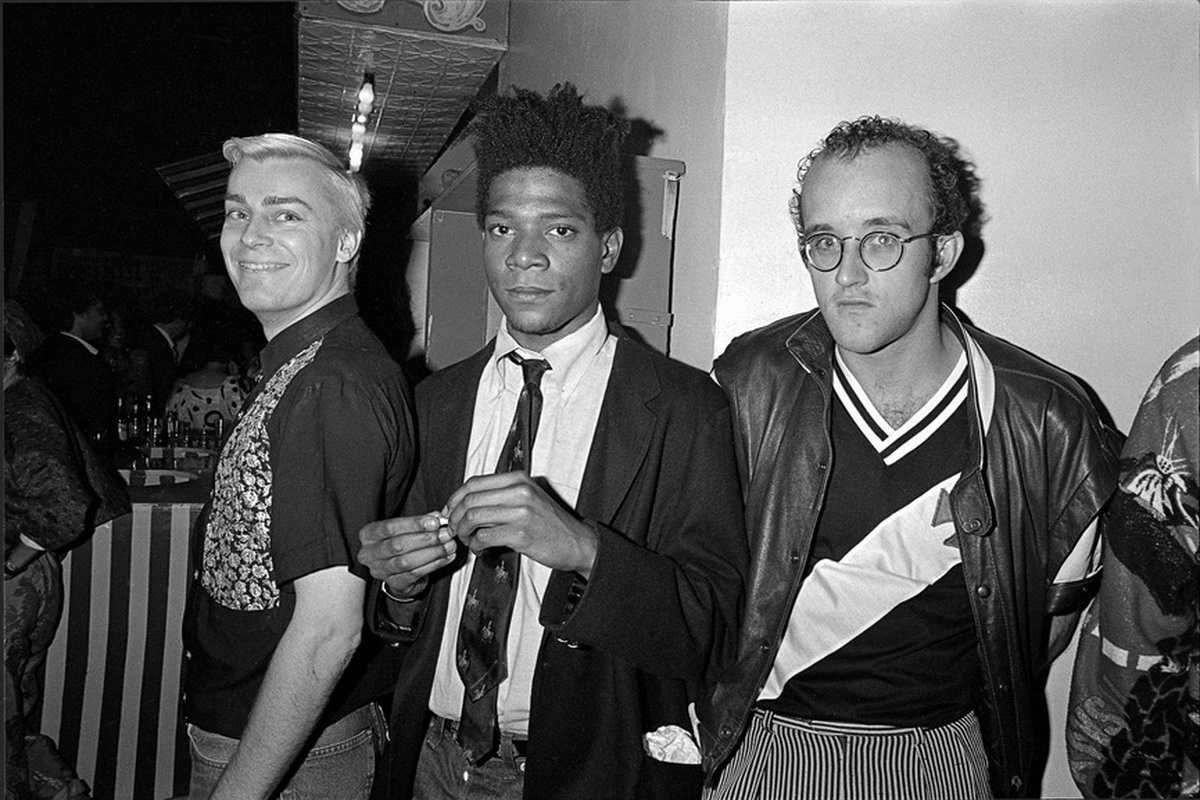 John Sex, Jean-Michel Basquiat and Keith Haring in 1987. I swear this will make sense in a minute.