

Have you ever wished the spaceship would come get you already and take you back to your home planet? If so, the Electric Light Orchestra is your band and Jeff Lynne is your starship commander. In 2024, ELO apparently entered its final stage in our galaxy, with the passing of the band’s longtime keyboardist/right-hand man, Richard Tandy, and Lynne wrapping up his farewell ELO tour.
We (me, Hope, and historian Matthew Restall), think it is therefore time to turn the PuR eyeballs toward the melodically-otherworldly, rain-soaked universe of ELO. Climb aboard as we dissect ‘n’ discuss, rate ‘n’ rank the entire ELO and solo-Lynne discography. Love, longing and lightning await you…

MATTHEW: The origin story of ELO is too complicated to detail heavily here (if you’re a serious fan, you’ll know it already; if you’re not, you won’t care to be dragged into the weeds). So here’s a very short version. Two friends (Roy Wood and Jeff Lynne) had moderately successful bands in late-1960s England (The Move, 1965-72, and The Idle Race, 1966-72, respectively). In 1970, Wood persuaded Lynne to leave The Idle Race and join his band, but with the goal of creating an additional parallel band. The plan was to keep making pop-rock with The Move, while exploring strings-based prog rock (“classically based original music,” Wood put it in 1970) as the Electric Light Orchestra. How did it go? Keep reading!*
(*I found these three very useful: Barry Delve’s On Track…Electric Light Orchestra; John Van Der Kiste’s Electric Light Orchestra: Song by Song; and Lynne’s liner notes to the Box Set we discuss later.)
HOPE: Matthew and I were part of the second generation of Beatle fans who had been babies and/or toddlers when they initially swept the world. While it was fun (and revelatory) rumbling through their vast discography during our ‘70s kid-dom, we still craved new sounds that “belonged” to us and weren’t hand-me-downs from a previous generation (like you do). Enter the Electric Light Orchestra, aka ELO, the ultimate gift for those born-too-late-for-The Beatles kids. While ELO were not specifically invented for children, their sound had a kind of rainbow candy-tunefulness and over-the-top drama that especially appealed to the tween-nerd ear. What they lacked in pin-up-ability and heartthrob-iness they made up for in barnacle-like choruses and dreamy lyrical imagery. Most importantly, they had an insanely cool logo that could be easily replicated on junior high notebooks (not to brag, but my ELO logos killed).
MATTHEW: Oh yes, there were some ELO spaceships on my school notebooks, too (not a patch on yours, I’m sure). And I agree that the timing for us was perfect: you and I turned 12 the year A New World Record came out. With that leap from clunky prog to Beatles-from-Birmingham pop-rock for our generation, I was hooked. And I still am, a half-century later.
Don’t Bring Me Down: Just a note on the format of this essay, Matthew and I are going to be taking turns offering up our ELO assessments and our names will appear before our respective comments. The peak chart positions in the UK and US for each album are listed beneath their titles. We are going to rate each album individually as we go (on a classic 1-10, hate-to-love scale).
MATTHEW: We’ve adopted a fairly inclusive approach here. As well as the obvious eleven Electric Light Orchestra albums of 1971-86, we also rate and discuss the half-ELO Xanadu, the two solo Jeff Lynne albums, and the three comeback albums of this century (released under ELO or under Jeff Lynne’s ELO). A grand total of 17. We ignore precursor bands The Idle Race and The Move, Wood’s Wizzard, Lynne’s later supergroup The Traveling Wilburys, as well as ELO drummer Bev Bevan’s 1989-99 offshoot band, Electric Light Orchestra Part Two. Are our choices justified?
The Studio Albums, (1971-2019)

The Electric Light Orchestra (1971)/ No Answer (1972, in the US)
(UK #32, US #196)
HOPE: There’s a funny bit of folklore attached to the title of the slightly-later US version.
MATTHEW: Yes, I love that bit of ELO-lore! The story: the US label called the UK to ask for the album title; nobody picked up, so “no answer” was written on the message slip by someone whose boss read it as, well, the answer. Nice.
So, is this first album the place to start for the ELO-curious, for those who wonder how the band went from obscurity to international stardom, then from guilty pleasure to national treasure (a rhyme I just stole from the above-mentioned Barry Delve)?
HOPE: Ironically, this first album would be the last one I would recommend to an ELO naif! Yes, the idea of combining rock sounds with orchestral flavors and pouring Beatles-flavored syrup on top was a genuinely inspired one. And to be fair, this debut LP is sonically adventurous in places, extremely earnest everywhere and somewhat successful as an initial mission statement. But it’s not a fun or remotely transcendent listen, which is to say the songs ain’t that great. The Electric Light Orchestra aka No Answer album is an exceptionally “proggy” affair. There’s unpleasantly kitschy prog (“Battle of Marston Moor”). There’s meanderingly indecisive prog (“Nellie Takes Her Bow”). And of course there’s a bit of medieval-flavored prog because that was the law (“Whisper In the Night”). It also veers dangerously close to being a Beatle pastiche at times i.e. like a proto/more serious version of The Rutles, especially on ”Look At Me Now” (which is in love with “Eleanor Rigby”) and “10530 Overture” (which openly worships at the altar of “Dear Prudence”)!
MATTHEW: Lynne has commented on the “great fun” he and his “good mate” Roy Wood had in making this album, and it shows. He has also conceded that “it’s a pretty whacky one, so innocent yet so bold. It goes to some really strange places.” That it does. I agree that as an introduction to ELO, it doesn’t work. The ingredients that would later constitute the classic ELO sound are not all here, and those that are present are not combined in the ways that Lynne would later come to perfect. Half the album was written by Wood (whereas Lynne himself would write most of the next one and all of every subsequent album), and that alone makes No Answer unique in the ELO catalog. As Lynne had joined Wood and Bev Bevan for the second half of The Move’s life (its four 1968-71 albums), and Bevan was the drummer here (and would remain ELO’s drummer), this is more of a transition album from The Move to ELO—with The Move still alive and releasing singles at the time. That original Lynne/Wood plan for the two bands to continue to exist in parallel, with almost the same personnel, one rock, the other an experiment in breaking down the rock/classical music divide (as Emerson, Lake, and Palmer were also doing) is crucial context. Heard as such—as experimental fun by three good mates, all young and talented—the album is an enjoyable curiosity.
HOPE: The strongest tracks present on the debut were written by Lynne, specifically the goofy ‘n’ wistful “Mr. Radio” (time and technology have ensured that songs about the radio all sound impossibly romantic now) and the aforementioned opener, “10530 Overture,” which is home to one seriously majestic and memorable riff (that song really knows how to enter a room). That leads me to a question! This turned out to be the only ELO album on which Roy Wood was a full-time participant. So, I’ve gotta know Matthew, what are your thoughts on the Wood solo and/or Wizzard albums he did post-ELO?
MATTHEW: Yes, that opening riff to “10530 Overture” is awesome, not surprisingly ripped off multiple times (yes, I’m looking at you, Paul Weller). But the track wears thin by the end. Similarly, “Look At Me Now” has its charms, but it’s more very early Pink Floyd than ELO (if one wanted to be uncharitable: it’s second-rate Syd Barrett). Although now you’ve mentioned “Eleanor Rigby,” I hear that too. And so it goes for 41 minutes: a scattering of intriguing or beguiling moments mixed with thin-wearing very-early-‘70s English prog rock, more often evoking other prog acts than later ELO. And that Beatles influence is indeed evident on “Mr. Radio,” which I like too. In fact, I was leaning towards “Overture” and “Radio” as my standout picks, when I realized that they were the two that Lynne picked for the Flashback compilation. Go Jeff!
As for Wood and Wizzard (yup, two zeds), apologies to the fans, but I’ve tried and … I just can’t.
HOPE: Me neither.
Favorite two tracks: Matthew, “10538 Overture,” “Mr. Radio”; Hope, “10538 Overture,” “Mr. Radio” (yup, I concur)
Album Rating: Matthew, 4/10; Hope, 3/10.
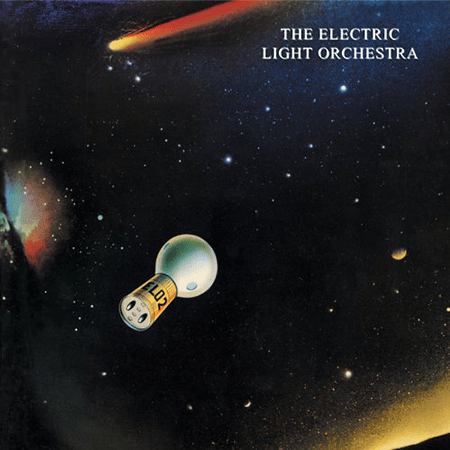

ELO 2 (1973)/ELO II (in the US)
(UK #35, US #62)
MATTHEW: You might expect that the first five ELO albums might form a steady upward curve of evolution towards the triumphant records of their imperial phase. But they don’t. Or, because Wood departed early in the recording of this one (going off to found Wizzard, never to return), you might expect this sophomore effort to represent a noticeable shift from the murky cello-swamped debut towards a poppier future. But it doesn’t. If anything, it goes deeper into the prog woods, where it tends to get lost. There’s a hint of Lynne’s songwriting genius on Side One’s “Momma,” which rolls into the brilliant smash-up on Chuck Berry’s “Roll Over Beethoven” (more a cover of The Beatles’ cover) with the signature opening riff of Beethoven’s Fifth Symphony. Forget the single edit (notable as ELO’s first visit to the singles charts); the album version is essential ELO. But the rest of the album is a bit of a slog, its tracks too long, the strings weighing them down rather than helping them soar. For me, at this point, that curve is flat.
HOPE: There’s a funny, opinionated line within the album’s Wikipedia page that I want to share. Ready?: “Along with its predecessor, ELO 2 is the least commercial-sounding album the band released, although it reached the British Top 40 album chart, whereas its more concise follow-up, On the Third Day, did not”. There’s a detectable sprinkle of “I’m a long term ELO fan” in that assessment (“more concise”) but I see what this contributor was getting at. ELO 2/II might “only” be five tracks (the shortest of which clocks in at nearly seven freakin’ minutes) but I agree with you Matthew; it is a freakin’ slog…and right from the start too. While I’m not a fan of the album’s best-known song “Roll Over Beethoven” (I accept my banishment from the church of rock ‘n’ roll), it would have been a far better choice to open the LP than the proggy, clumsy mudball that is “In Old England Town (Boogie #2). Its evil twin “From the Sun to the World (Boogie #1)” sounds like a handful of unfinished songs Frankenstein’d together. Enjoyably dirty symphonic chugger “Kuiama” is stretched to an ungodly 11-minutes thanks to an unnecessary, extended instrumental break. So yes, as our Wiki-friend suggested, ELO 2/II is not terribly “concise”. The album would be a complete fail (to me, to me) if not for the pretty, moody “Momma” (aka “Mama” on U.S.edition of album), a crystal ball of a song that hints at the beauteous sonic direction ELO would be heading.
MATTHEW: Banished! “Roll Over Beethoven” is indispensable ELO! But I understand: I’m not allowed by family members to play it in my house or in the car unless I’m alone. It was the first ELO track I ever heard on the radio; I was 9 years old, a budding little music nerd, and I thought it was great fun. And no doubt someone reading this can relate. But I get why others might hear it the way I hear, for example, “In Old England Town.” As for you, Hope, you called Jeff’s “Momma” pretty, so you’re allowed back into the church of rock ‘n’ roll.
HOPE: I’m with your fam: I wouldn’t let you play “Roll Over” in the house (or vehicle) either. Fast forward.
Favorite two tracks: Hope, “Momma”, the first four minutes of “Kuiama”; Matthew, “Momma,” “Roll Over Beethoven.”
Album Rating: Hope, 3/10; Matthew, 3/10.
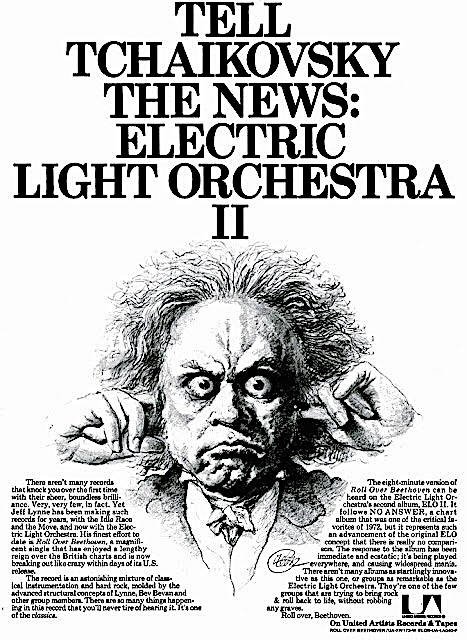
Look at this crazy ass print ad for ELO II.
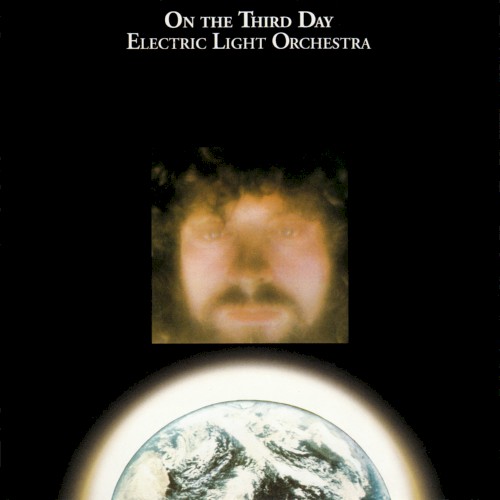
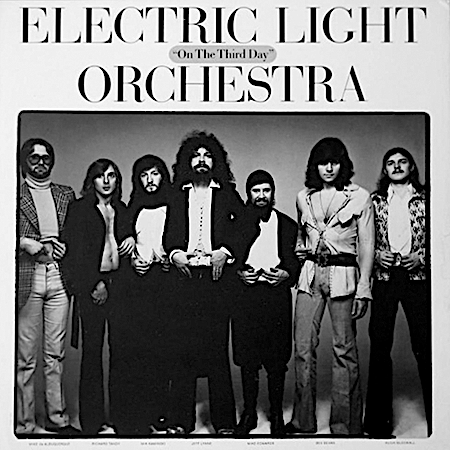
On the Third Day (1973)
(UK did not chart, US #52)
MATTHEW: In retrospect, it is not surprising that after the first two albums briefly popped into the UK Top 40 album charts, this failed to chart at all. For the best track on here—in fact, the best ELO song to date, and the first song that could sit without shame in a compilation of gems from their best albums—wasn’t even on the UK release. A post-album single release in the UK, “Showdown” was hastily added to the US version. Without it, Side One is more muddled prog, billed as four tracks but really one 16-minute composition of the kind that dominated the first two albums. Side Two, however, saves the third day (as it were). The passable instrumental “Daybreaker” leads into the stomping joy of “Ma-Ma-Ma-Belle,” which borrows the riff-powered hard-rocking fun of ELO 2’s “Roll Over Beethoven” and serves it up within an original Lynne composition. It’s fantastic. Unfortunately, this is not the breakthrough ELO album, and the remaining two tracks are more full of potential than realized promise. “Dreaming of 4000” is like a mish-mash of demos of three songs that all evolved years later into great tracks on classic albums. The closing track is Lynne’s homage to Grieg’s “In the Hall of the Mountain King,” a reference I grew to appreciate in my teens (having missed this album in real time, as most people did), being brought up on classical music and thus thrilled by how this was both respectful and disrespectful. In retrospect, it is fun, but still too sluggish to rate anywhere high in the ELO song discography.
HOPE: Opening On the Third Day with a freakin’ 16-minute suite of four songs billed as individual entities is a cheeky move (self-important too, but I appreciate the cocky trickery of the gesture). That said, OTTD (let’s just call it) is a low-key log jam of missed opportunities. “Ma-Ma-Ma-Belle” would have been a glorious, glammy Godzilla of an opener. If only sophisticated stringed-popper “Showdown”—the finest ELO tune at that point in time—had been available for inclusion on the UK version and wasn’t clumsily slapped onto the U.S. version of the LP at the end of Side One. And it sucks that the exceedingly handsome, ascendingly-chorused “Bluebird is Dead” is hidden within the suffocating aforementioned suite of “muddled prog.” But OTTD’s issues extend far beyond its sequencing. Fact is, apart from the three aforementioned tunes, it doesn’t feature enough memorable songs to lift it out of mediocrity.
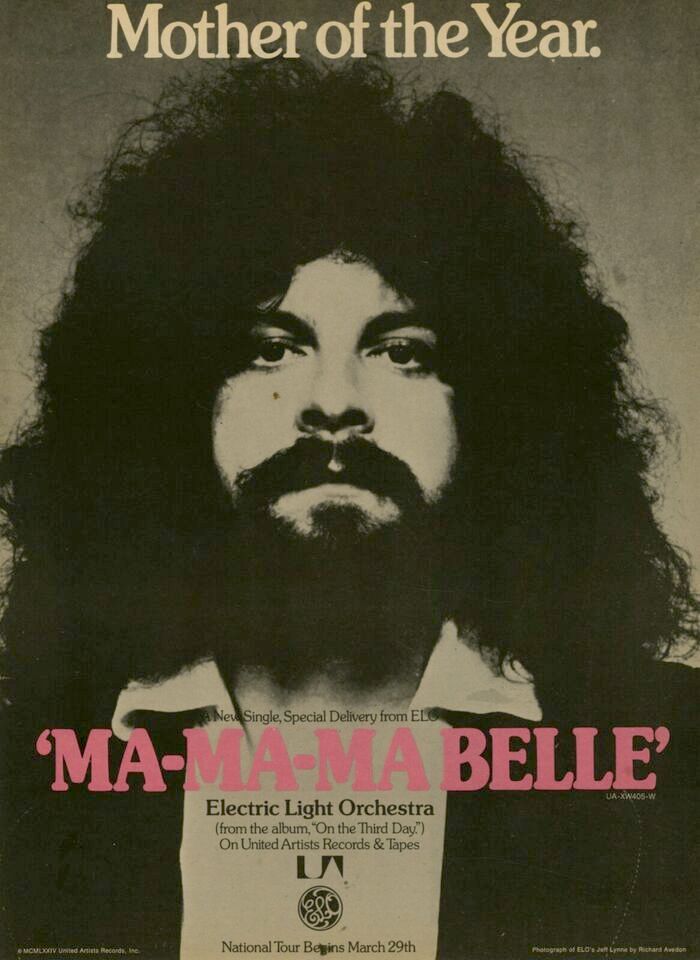
Hi Mom.
MATTHEW: You’re right about “Bluebird is Dead”; removed from Side One and sequenced with “Showdown,” it becomes one of the album’s keepers. “Showdown” is quintessential ELO, the starting-point blueprint for its future classics. Did you know OTTD was originally conceived as a double LP, with one live disc and one comprising “a 45-minute number with millions of different movements” (as Lynne declared at the start of 1973)? Presumably “Showdown”-free. Sorry for your loss, prog fans.
HOPE: Good lord almighty, was it? Even now, 50+ years on from this nixed plan, the thought of a 45-minute prog-adventure piece by ELO circa 1973 sounds, let’s just say, aurally difficult. On a more positive sidenote, I want to worshipfully acknowledge soul diva (and primary Paul Anka duet partner) Odia Coates’ fabulous cover version of “Showdown” from 1975. It doesn’t eclipse the original but it comes damn close. Hear it here.
Favorite two tracks: Matthew, “Showdown,” “Ma-Ma-Ma-Belle”; Hope,”Showdown”, “Bluebird Is Dead”
Album Rating: Matthew, 4/10 (UK), 5/10 (US); Hope, 3/10 (UK), 4/10 (US).
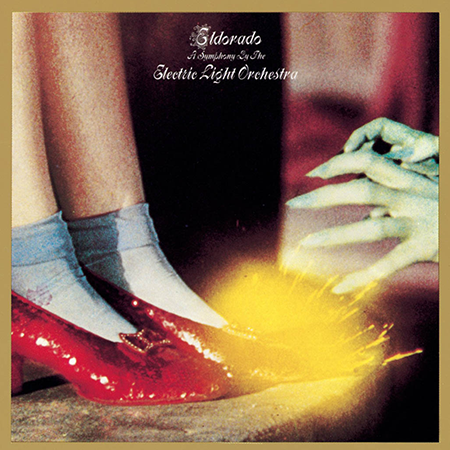
Eldorado: A Symphony by the Electric Light Orchestra (1974)
(UK did not chart, US #16)
HOPE: Eldorado is confusing. For starry-eyed romanticists (you, me, most ELO fans), this lushly orchestrated album describing the extravagant, fantastical daydreams of an ordinary soul, sounds pretty heavenly on paper. The actual record though is another story. Apart from the spaced-out, swoony classic “Can’t Get It Out Of My Head” and epic string-fest “Mister Kingdom”, the other songs telling the tale are not as engaging or unassumingly majestic as the subject matter. Faceless and (oddly) over-the-top fodder like “Laredo Tornado” and “Poorboy” don’t hold up as singular entities. Nor do Speakeasy era-flavored “Nobody’s Child”, pompously-intro’d “Boy Blue,” or the title track with its bellowing vocal impression of Roy Orbison.
Okay, now here’s the confusing part for me; while it isn’t full of shiny diamonds—only two out of the 10 tracks qualify as keepers—it’s kind of fun to listen to Eldorado as a whole. It’s like a book that isn’t that great but its occasional moments of inspiration make it worth hanging in until the end. What do you think Matthew, am I crazy?
MATTHEW: Actually, I think you are sane and spot on. There are moments or pieces of songs on Eldorado that are brilliant (I love the guitar riff on “Laredo Tornado,” the furious strings at the end of “Overture” and “Poor Boy,” and Lynne’s vocal performance on the title track, for example). But they don’t amount to an album full of great songs that on their own stand up tall with the classic tracks on ELO’s imperial phase albums. That said, the album has grown on me recently, especially once I accepted that it needs to be played in one sitting, appreciated as a whole. I get why this is rated so highly as classic ELO by some fans. Played as a single composition—a symphony, if you like, as the subtitle proclaims—it can be an enjoyable, inventive, coherent concept album, clearly better than its three predecessors.
HOPE: Until we started writing this, I hadn’t realized just how gradual the evolution of the signature ELO sound was.
MATTHEW: Yes, and Eldorado is an important step in that evolution. I must admit that for decades, I tended to leave Eldorado on the shelf in favor of albums like A New World Record. A crucial feature of the best ELO albums is pacing: Lynne is a master of the deft sequencing of rockers, mid-tempo pop, and ballads. And Eldorado isn’t one of those albums (the first of them would be A New World Record). There is also a relentlessness to Eldorado, the weight of its 40-piece orchestra making it feel longer than its 39 minutes. Also, having one brilliant smash single is always a problem for an album, and “Can’t Get It Out of My Head” overshadows the rest of the record. Or certainly Side One; that classic hit aside (ELO’s first Top Ten single: #9 in the US), Side Two is better, with “Mister Kingdom” channeling Lennon and “Across the Universe,” “Nobody’s Child” echoing early musical theater, and “Eldorado” giving a melodramatic twist to the melodic melancholy pop he is soon to perfect. Keyboardist Richard Tandy (arguably ELO’s second string, as it were, for the next decade), never co-wrote songs, but his influence on their structure and sound can be heard here—and increasingly as the band moved towards their imperial phase.
By the way, can you hear angry hired orchestral musicians noisily packing up during the quieter piano part to “Nobody’s Child”? I can’t! Some claim to hear it on “Eldorado Finale.” I believe the story but I’m not convinced the slamming cases are audible. The musicians’ adherence to union rules—fair enough!—was reputed to be one of the reasons why this was the last ELO album recorded in the UK.
HOPE: Right, so because I care, I put on the giant Bose headphones to see if I could detect these infamous sounds. I could not.
Favorite two tracks: Hope, “Can’t Get It Out of My Head” ,”Mister Kingdom”; Matthew, “Can’t Get It Out of My Head,” “Eldorado/Eldorado Finale.”
Album Rating: Hope, 5/10; Matthew, 6/10.
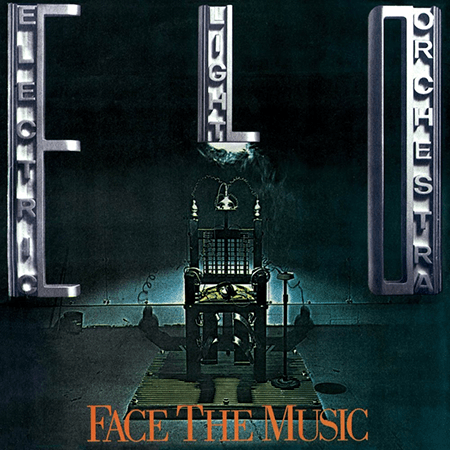
Face The Music (1975)
(UK did not chart, US #8)
MATTHEW: I’m conflicted over Face the Music. I discovered it almost in real time, the year after it came out, soon after A New World Record (when I was twelve). I’d later find chances to explore the four previous ELO albums, and to appreciate how much Face the Music showcased the steady honing of talent and skill by Lynne and his bandmates (the drumming on this fantastic, for example). And yet it has ever since remained overshadowed in my mind by its sequel—this one fine but flawed, that one pretty much flawless. Is that unfair or unfortunate?
HOPE: Let’s just call it evolution (again)! I’d characterize Face the Music as “half-full”, albeit in two completely different ways. On the one hand, it was definitely a sonic step forward in terms of overall sound, song quality and sophistication which was cause for great optimism and a characterization of “half-full” (So I’m with you there). On the other hand it is literally “half-full”, as in exactly four of its eight songs are keepers, and four are not. The album’s two best known tracks and members of the aforementioned ‘fab four’—nasty pop locomotive with fab Lynne vocal “Evil Woman” and woozy dreamboat “Strange Magic”—are both justifiably regarded as ELO classics. That said, my primary love interests on this LP are less famous cuts: The wistful, unspeakably gorgeous “One Summer Dream” with its coy melodic nod to the schmaltzy, #1 pop instrumental hit from 1959 “Theme from A Summer Place,” and the galloping, swirling-stringed duet between Lynne and bassist Kelly Groucutt, “Nightrider.” As alluded to earlier, the other four tunes aren’t stellar. From tolerable orchestral rock drama queen and undeserving opening track “Fire On High” to ordinary, unexciting Lennon-esque “Waterfall”, to cringey monsters “Down Home Town”and “Poker”, none hold a candle to the album’s “fab four”.
MATTHEW: I’ve rated Face the Music higher than Eldorado, because I think 6/8 tracks are excellent (yes, Hope, more than your 4/8!), all deserving of spots on “best of” mixes, with Side One the first truly great Side One in their catalog (and there are several). But, ironically, Eldorado is arguably more successful as an album, due to its consistency and lack of total misfits like the two songs I pretty much loathe here: “Poker” and “Down Home Town.” They aren’t horrible on their own (to be generous, “Poker” is a very creative slightly-proggy take on the English pub band sound that was about to evolve into punk). But they don’t belong here. They’re B-sides that ruin Side Two.
HOPE: I’m mostly with you, especially in regard to the listening experience of Eldorado vs. Face the Music. But I can’t commit to a much higher overall rating for Face because there just plain aren’t enough good songs present. All I can do is offer this corny characterization: Eldorado and Face the Music are ELO’s coming of age albums, occasionally glorious, often confused but evidence of the band growing bigger and stronger and well on the road to figuring out who the hell they are…and they did, damn did they ever, on what came next.
Favorite two tracks: Matthew, “Evil Woman,” “Strange Magic” as obvious choices, but the bookend tracks “Fire on High” and “One Summer Dream” when I’m feeling less obvious; Hope, “Nightrider”, “One Summer Dream,” but I maintain a loyal fondness for “Evil Woman” and “Strange Magic.”
Album Rating: Matthew, 8/10; Hope, 6/10.
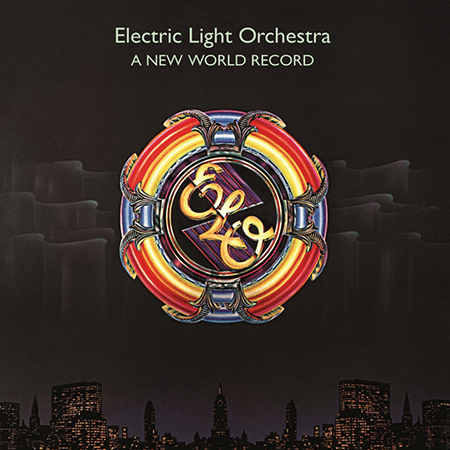
A New World Record (1976)
(UK #6, US #5)
HOPE: Home to a slate of equally dreamy and eccentric radio anthems, A New World Record is the first certifiably kickass ELO album.
MATTHEW: Isn’t it amazing, the pure joy of dropping the needle or tapping the Play button on an album that requires no skips, prompts no sighs of disappointment? Trust is a beautiful and liberating thing, and from the dramatic opening string section of “Tightrope,” we trust that Jeff and his mates aren’t going to let us down. In some ways, this feels like just another step forward from the clunkiness of the first album to the perfection of Out of the Blue, like a better version of Face the Music. Yet, somehow, it’s not a step, but a leap. Similar to its predecessor, but with the ELO ingredients mixed exactly right. For the first time, there are no experiments that don’t work, no clumsy cello chunks, no tiresome old-school rock indulgences—hell, there aren’t even filler moments. Every track is great, and—more importantly—it works spectacularly well as an album, shining most brightly when played exactly as Lynne delivered it—from that spectral opening of “Tightrope” to the ethereal bliss of the long end to “Shangri-La.”
HOPE: You are so right. It is truly a giant leap. A New World Record is the sound of the ELO spaceship that has been circling overhead on the five preceding albums, finally landing.
Rocked-up, be-stringed joyride “Tightrope” is the perfect opening track. Masterfully straddling the line between silly and sincere, the angsty and endearingly dated ballad “Telephone Line” remains a fab choice for home-alone-karaoke (For those of you who have “performed” this track “off-stage”, I see you and I am you). My nominee for album underdog/lynchpin is the widescreen-romantic anthem “So Fine” which is basically Springsteen’s “Born To Run” done ELO style. And want to give honorable mention to the short, sweet and swoony “Above the Clouds” which sees our heroes morphing into something akin to the Birmingham Beach Boys. Then of course there’s “Livin’ Thing”. Back in 2006 Q magazine had this song at #1 on their “Guilty Pleasures” ranking. First off, fuck the concept of “guilty pleasures”. Embrace your internal wiring! Own your musical loves! Don’t let anyone tell you how you should feel! Sorry, that characterization just makes me crazy. It’s just that “Livin’ Thing” rules. From the soulful falsettos (“you-ooh and your sweet desire”) to the classical string flourishes to the kitschy vocal effects (“I’m takin’ a dive-dive-dive”). It’s so freakin’ kooky. I think this is why I adored it so much as a kid.
Backlit afros. Blue Satin. ‘Bev Bevan’ boldly emblazoned on the bass drum. Beautiful.
MATTHEW: How can this album be so similar to its predecessors and yet so much better? It’s like a master class in how the ingredients can be right, yet that doesn’t matter unless they are assembled in the right way. As a reminder of that, “Do Ya” is on here, re-recorded as a great ELO track, eclipsing its origins as a just-ok single by The Move (their only song to chart in the US, reaching #93 in 1972). The album’s other rocker, “Rockaria!”, is a self-parody, a sly and witty poke at the band’s own conceptual rationale. A tiny touch seals the deal on how hilariously successful the song is: a false start made in rehearsal by Welsh soprano Mary Thomas was dropped into the beginning of the final mix. Finally, why do I so love “Shangri-La”? Perhaps because in my early teens I’d listen to ANWR on my headphones in bed, and the outro to this last track sent me to a place of happy dreams—to my own slumbering Shangri-la.
HOPE: Oh yes, the updated version of “Do Ya” is infinitely hotter than The Move’s original take. I don’t love “Rockaria,” meaning I wouldn’t single it out for repeat plays, but in the context of the album its OTT rock ridiculousness and Mary Thomas’s operatic runs fit the album’s epic personality. I’m also not as big of a “Shangri La”-head as you (I like it, don’t love it), nor do I adore”Mission (A World Record)” with its excessive Beatle-isms. But again, within the context of ANWR (let’s just call it) they totally freakin’ work. They are wondrous glue.
And gotta acknowledge something that doesn’t get lauded very often: Jeff’s Lynne’s voice. His growing vocal confidence is on full display throughout ANWR. He flexes (“Tightrope”), he coos (“Above the Clouds”, “Telephone Line”), he belts (“Do Ya”) and he sounds really f*cking good doing every single thing. A New World Record is a succinct mofo, with none of the chaff that overwhelmed/diffused the five previous albums (to varying degrees). This album was the one that turned my admittedly non-committal flirtation with ELO into full-on love (forever).
Favorite two tracks: Hope, “So Fine”, “Above The Clouds”; Matthew, the first four tracks comprise the best Side One in the catalog, but if I have to pick only two it would be the ballads “Telephone Line” and “Shangri-La.”
Album Rating: Hope, 10/10; Matthew, 10/10.
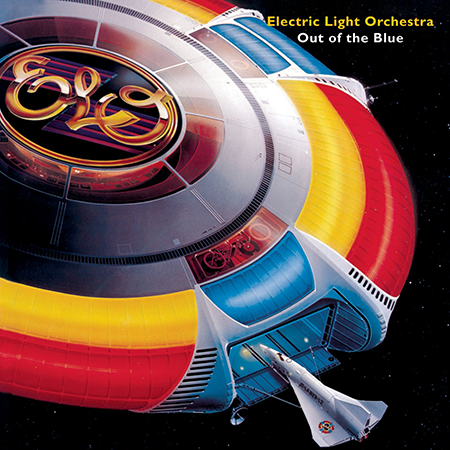
Out of the Blue (1977)
(UK #4, US #4)
MATTHEW: How do you follow an album that sells five million units in its first year, launching your band after five years of struggle into the stratosphere of one of the top rock bands in the world? It would be improbable, perhaps impossible, to produce an even better album the following year—and a double album at that. Yet that’s what Lynne, Tandy, and Bevan did. It sold ten million copies its first year, and settled into the UK charts for 100 weeks. Delve calls it “A New World Record on steroids,” the band’s “creative apex”; for Van Der Kiste it’s “ELO’s magnum opus,” their Sergeant Pepper. Many superlatives have been used, and many apply.
To me, Out of the Blue is simply one of the very best doubles ever delivered. A 29-year-old Lynne legendarily wrote it with astonishing speed in the Swiss Alps (14 of its 17 songs in just two weeks), but arguably the real magic happened in the Munich recording studio. There was an alchemy to the capturing of that creative momentum, turning the 70 minutes of Out of the Blue into a remarkably coherent masterwork—despite its content ranging from the silly to the sublime, from whimsical to epic. An unusually wet German summer also inspired what is hands down my favorite vinyl side in the whole ELO catalog: Side Three, its four songs comprising a continuous “Concerto for a Rainy Day.”
HOPE: Number one in our hearts and an unassuming but respectable #183 on UNCUT’s 500 Greatest Albums of the 1970s list, Out of the Blue aka OOTB is the greatest, most magnificent ELO album ever. I should note that back in the day I used the cardboard spaceship included with the LP to store weed. I can still see that random, pathetic, reeking little roach sitting inside of it like it was yesterday.
MATTHEW: Now that is the best use of an ELO record sleeve or CD box that I’ve ever heard. I shall never see those ELO spaceships the same way again.
HOPE: The tween-teen years are not a time of patience. So a double album—or “two-record-set” as we sometimes used to call it in the ‘70s—was a real test of the average kid’s attention span…meaning a young one in possession of a giant, new ELO album could only be counted on to only get so far in terms of musical immersion…meaning when confronted with four whole sides of music, your (my) restless, juvenile arse tended to fixate/focus on one particular side. And when it came to OOTB that was Side Three, otherwise known as “Concerto for a Rainy Day.” Menacing, windswept melodrama (“Standin’ in the Rain”) slides into tear-jerking balladry (“Big Wheels”) leading to a burst of shimmery, hopefulness (“Summer and Lightning”) culminating in a celebratory sing-a-long anthem “Mr.Blue Sky” (Also known as every kid’s favorite ELO song). That’s one hell of a side there.
MATTHEW: I love “Concerto for a Rainy Day” so much that I want it played at my funeral. I (hopefully) won’t hear it in my coffin, and my family won’t thank me for it, but what the hell (as it were). Rain is Lynne’s favorite metaphor for melancholy, and blue his favorite multi-purpose metaphorical color. That makes “Concerto” quintessential ELO, with its drama, then its sadness, then its giddily joyful ending. Perfect for a funeral, right?
HOPE: I couldn’t possibly top that, which is clearly a sign that it’s time to talk about the tracks occupying the other three sides of OOTB. Those songs fall into two categories: The Sublime™ and The Stalwart™. Members of The Sublime™ team include swoony, galactic ballad “Starlight”, kitschy-ridiculous “Jungle” (Hello, cringey tap-dancing break!) and the shimmery duet between Lynne and bassist Kelly Groucutt, “Sweet Is the Night” with an honorable mention for lushly whirling instrumental “The Whale”.
The rest of the tracks make up The Stalwart™ crew, a supporting cast of seven that act as a super fine adhesive, holding the whole epic together (“It’s Over”, another one of those Beach Boys-by-way-of- Birmingham tracks, is the best of the bunch but compliments to “Night In The City” and “Steppin’ Out” which sound like delicately demented Bee Gees songs). Devil’s Advocate query time!: While the 17-song OOTB is full of wonder and oomph, do you think it would have been as sonically impactful if it had been edited down to a single 10-12 song LP?
MATTHEW: Let’s face it, most good double albums would be better edited down to (an infeasible) three sides. But not OOTB. I’d not want to lose a single track. Not even “Jungle,” which as the seventh track plays the role that those eye-rolling comic relief moments do in the middle of Shakespeare dramas. (Yes, I just compared ELO to Shakespeare. Problem?) It’s good for a smile, throwing into relief the dramatic impact of the songs around it. As for your deft dichotomy, Hope, Sublime™ vs Stalwart™, I may ruin it by packing most tracks into the Sublime bag: “It’s Over,” “Sweet Talkin’ Woman,” “Night in the City,” “Starlight,” “Believe Me Now/Steppin’ Out,” “Sweet is the Night,” “The Whale.” (All of “Concerto” would be in there too, of course.) Every one of those is so rich, so full of melodic beauty and musical wit, so endlessly enjoyable. Even what’s left (the Stalwarts) is brilliant: two of the album’s four UK hit singles (“Turn to Stone” and “Wild West Hero”) and two that could have been singles (“Across the Border” and “Birmingham Blues”).

Here’s a pic of the full fold out cover featuring the gorgeous art of Shusei Nagaoka just because. Still waiting for this ship to come and get us already.
HOPE: And I guess that’s ultimately the thing: While OOTB is (gloriously) ‘50s movie-melodramatic and downright silly in (a lot of) spots, there aren’t ANY bad songs. What’s crazy is that those very qualities, coupled with the ELO’s ongoing, overt Beatle-lust and their always OTT orchestration made the album (and the band themselves) an easy target for crusty music critics to lay into when it was first released. The 1978 Rolling Stone review by Billy Altman was typically brutal and elitist:
One could say it, and one would be right, though self-absorption is not any grounds for attacking a rock band; it’s almost impossible to think of a band or an artist that isn’t mainly ego. When one crosses over into self-indulgence, however, it’s a different story completely. I didn’t read the credits until after I had waded through the four sides of this totally uninteresting and horrifyingly sterile package. What I heard was a meticulously produced and performed set of songs…without any noticeable passion or emotion. All method and no madness: perfectly hollow and bland rock Muzak. Solos are virtually nonexistent, which makes perfect sense because an individual statement by any one instrument would set the ELO ship jaggedly off course by injecting some heart into the proceedings. Group commander Jeff Lynne obviously is consumed by his vision of the totality of the ELO sound, floating slowly through the void.
Damn Billy, you sure did hate ELO. But so did a lot of other music critics. That’s just how it was back then, yup. If you’d have asked me to define what “self-absorption” was as it related to OOTB when I was 13, I wouldn’t have understood what the hell you were talking about. Here’s what I know now that I could not have articulated at the time: In order to enjoy and appreciate OOTB, it’s best to cast aside all cynicism just as you would if you were watching a Broadway musical. You’ve gotta give in to the spaced-out silliness to get maximum pleasure from it. Maybe that’s why this album spoke to us so hard as kids. Because our taste and desire existed at the most base level imaginable. All that mattered (and still matters) is how it made us feel!
From its big-chorused-drama to the out-of-this-world art on the gatefold sleeve to the fabled cardboard spaceship inside, OOTB was like some fabulous new toy to me, the best toy. “Chooka chooka, hoo la ley” muthafuckas.
MATTHEW: Ha! I like the irony of Altman’s accusation of hollowness, as hollow sums up his review: lazy, knee-jerk rockism empty of any insight beyond the risible complaint that there aren’t solos (which isn’t even true, but of course he wouldn’t have bothered to actually listen to the album). No heart? Out of the Blue is in fact nothing but heart. And the love that millions of fans have—and will have for generations to come—for its imaginative, playful, and infinitely melodic celebration of pop-rock is deeply heartfelt. Oh Mr. Blue, you did it right, indeed.
Favorite two tracks: Matthew: As this is a double, I’m picking “Concerto” and its four tracks: “Standin’ in the Rain,” “Big Wheels,” “Summer and Lightning,” and “Mr. Blue Sky.” Hope: Ok, four it is! “Starlight”, “Big Wheels”, “Turn to Stone”, and “Summer and Lightning,” …but I also love “Sweet Talkin’ Woman” . . . and “The Whale” . . . and “Jungle.”
P.S. Weirdy sidenote: In 1977, Jeff Lynne gifted Helen Reddy, one of the decade’s premier easy listening chanteuse-superstars, with a song he wrote called “Poor Little Fool”. It appeared on her 1978 album We’ll Sing in the Sunshine and sounds like an Out of the Blue deep cut. Yeah, it’s that good. I would have been 100% down for a Lynne-composed Reddy album. Hear here.
Album Rating: Hope, 10/10; Matthew, 10/10.

Discovery (1979)
(UK #1, US #5)
HOPE: ELO were disco in the way McCartney’s “Goodnight Tonight” was, or the Stones “Miss You”, which is to say they had some obvious disco flavoring but retained an inherent rockiness. Sure, Discovery’s lead single “Shine A Little Love” is sleek ‘n’ bouncy enough that one could have boogied to it on a lighted dance floor in 1979 but it is hardly “Don’t Leave Me This Way”. Still, nothing was as big an affront to the world of rock in the late ‘70s as the “demon” disco i.e. even the merest sniff of it was triggering.
MATTHEW: Ha! Yes! The thing about Discovery being disco-very is that it isn’t. A couple of tracks lean into a beat and bass line that dates the album to the peak disco era—and they happened to be singles (like the irresistible “Last Train to London”). But the album’s dominant sound is imperial-phase ELO pop. Classic Lynne ballads like “Need Her Love,” quirky but catchy pop like “The Diary of Horace Wimp,” and smooth stompers like “Don’t Bring Me Down” could have sat just as comfortably on Out of the Blue. And even if the whole album had been packed with disco bangers like “Last Train,” so what? (I hate to be a hater, but I really hate disco hating.)
HOPE: Oh man, I love “Need Her Love” which I believe to be—hot take comin’—the swooniest, most-gorgeous slow jam in the whole ELO catalog. But then I also love “Last Train to London” (romantic late night luster)…and “The Diary of Horace Wimp” (“Mr.Blue Sky” for grown-ups)…and “Don’t Bring Me Down” (stomping, shout-along stormer)…and joyful pop bonbon “On the Run”. And can’t forget ,”Midnight Blue” (Queen at a drive-in movie in outer space in the year 3000) or the positively Wings-era McCartney-esque ”Confusion”. Oh hell, ALL Discovery is pretty fuckin’ glorious.
P.S.I hated the disco hating too. Absolutely freakin’ hated it. Joke’s on the haters though as I’m pretty sure when you get to heaven it’s just classic disco anthems and the Cocteau Twins playing over the Lord’s sound system exclusively, so some people are gonna be in for a surprise.
MATTHEW: There better be disco in heaven! I want some Disco-very in my Shangri-la! And I can relate to your feelings for “Need Her Love.” It’s Lynne’s most straightforward love song (Delve rightly compares it to Macca’s “My Love”), written to Sandi, whom he’d marry later that year.
I still have the vinyl copy of Discovery I bought in ‘79 (aged 15) and really flogged; it’s well dinged up with affection. Yes, I loved it, and didn’t mind how inescapable it was that year, both in the UK (where I was in school) and in the US (where I was when school was out)—but especially in the UK, where it was their first #1, five of its nine tracks were Top Ten hits, and only Parallel Lines sold more copies in Britain that year. That said, I missed the epic scope of Out of the Blue. There’s not a duff track on Discovery (arguably not a duff note), but without the prog-pop sprawl of Blue (no instrumentals, no whole “symphony” side), it is almost too perfect. Love can be fickle, and in the end there are three ELO albums I love more.
HOPE: There are three whole albums that you love more?! Three?! What the holy hell, how is this even possible?! I’m distressed and flabbergasted because Discovery is, by far, my most-listened to ELO album. Okay, I confess that part of the reason for this is that it soundtracked a particularly tormented chunk of my teenagedom. It didn’t save my life or anything but it definitely provided an inspirational escape hatch into fantasy land after a shit day at school. That’s part of why it’s embedded in my heart just a liiittle bit deeper than the rest. That said, I forgive you Matthew. You can let me have it on a future ELO album entry…which I know for a fact you will very shortly.
Favorite tracks: Hope: “Need Her Love”, “Last Train to London”; Matthew:“Last Train to London,” “Need Her Love” (although Juliana Hatfield’s cover of “Don’t Bring Me Down” on her fantastic new Sings ELO album has renewed my affection for the song).
Album Rating: Hope, 9/10; Matthew, 9/10.

Xanadu (1980, movie soundtrack, with Olivia Newton-John)
(UK #2, US #4)
MATTHEW: The conventional wisdom on Xanadu is that, after the disco-very singles from Discovery nudged ELO from being respectable pop-rockers to borderline un-cool, Xanadu tipped them over the edge. Why? Because the movie was total rubbish, and the album’s first half featured the extremely popular pop-tastic but thereby very un-cool Olivia Newton-John; if that wasn’t enough, one of the album’s smash hits, “Suddenly,” was a duet with Cliff Richard, who was for many decades spectacularly un-cool in the UK. I realize the late ON-J is revered now (and since her passing in 2022 I have been enjoying her back catalog, most of which I had long ignored), and perhaps Sir Cliff is nowadays a well-respected octogenarian (I honestly don’t know). But in 1980, their association with them did indeed throw ELO into naff or un-cool pop territory, one where they might sell many records but be subject to scathing abuse from the music press. Not that Lynne and company much cared. Xanadu was a big US/UK hit, and #1 all over the world—with “All Over the World” the title of one of the six hit singles from the album, four of them by ELO (counting the Lynne-written, Olivia-sung title track).
HOPE: While it’s hardly The Rocky Horror Picture Show, Xanadu is, at this point, a firmly established cult classic (whether we like it or not). Thanks to the film’s garish silliness and ON-J’s evolutionary shift from from fluffy, family-friendly pop singer/actor to iconic hot-sweetheart-diva status, it has become a beloved midnight movie for those camp-loving romanticists among us (Yeah, I’m in there). Sure, watching it is akin to a bout of low-grade nausea after eating too much cotton candy/candy floss and washing it down a gallon of Pepsi…but there are two undeniables that will forever redeem it:
1.Olivia is (totally) hot.
2.The film’s frothy neon soundtrack features two ELO songs that are even hotter.

Jeff and Olivia. We are in Xanadu.
MATTHEW: Confession: I am always annoyed when an artist dilutes an album with tracks that don’t belong there. Some are soundtracks like this (or like Saturday Night Fever), some are studio/live pairings (like Tears for Fears’ 2024 release). I know, my irritation is nonsensical. There are reasons why such albums end up that way. But every time I convince myself to get over it, I encounter a song like “Dancin’”—not only the disastrous low-point on Xanadu, but the most grisly train wreck of a song on any ON-J or ELO album (although ELO had nothing to do with it). Aaargh!
HOPE: That’s brutal…but it’s freakin’ true! As you alluded to up there, Xanadu is divided into two distinct sides (Side One being all Olivia and Side Two, all ELO) with the two coming together for the title track on the latter. Before we get to ELO, I need to acknowledge that there are two beyond redeemable ON-J tracks present on this Xanadu thing: The twisty-turny mega-hit charmer “Magic” and the aforementioned duet with Sir Cliff, “Suddenly” which is still as gorgeous ‘n’ besotted as the day it was born (Love this song. LOVE). The rest aren’t worth talking about (Don’t let the door hit you “Dancin’ “). As for the ELO side, “All Over the World” and “I’m Alive” may be the most lighthearted, let’s call ‘em, pop-timistic songs the band ever released. Back in ‘80, as a nerdy young teen, I was particularly receptive to this sugary-majestic style of ELO-ing and confess that the 7”s aka “45’s” for those two babes spent far more time on my turntable than the soundtrack album ever did. The two other ELO tunes present,“The Fall” and “Don’t Walk Away”, while perfectly fine, wither in melodic, singalong sunshine emitted by “All Over” and “I’m Alive”.
Favorite two tracks: Matthew, “All Over the World,” “Don’t Walk Away”; Hope, “All Over the World,” “I’m Alive”
Album Rating: Hope, 5/10; Matthew, 6/10.
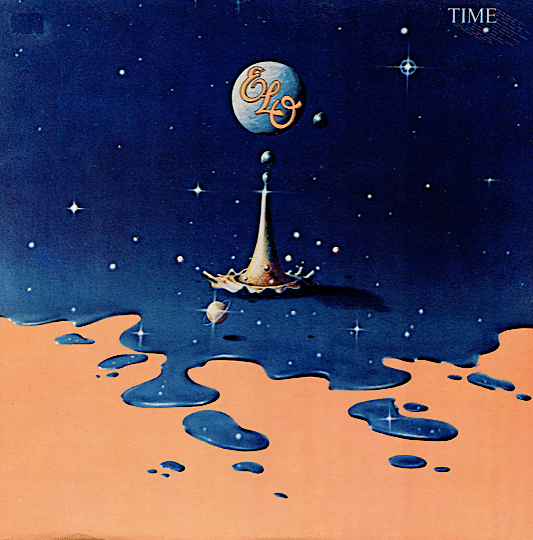
Time (1981)
(UK #1, US #16)
MATTHEW: “Ticket to the Moon” was the gateway drug that had me hooked on Time. I loved how that single starts like a play on Beethoven’s “Moonlight Sonata,” but avoided being pretentious, staying grounded (as it were) as a perfect little pop song about the corniest of pop topics—heartache. And the twist at the end, that his ticket is “just one way,” sung with commitment by Lynne, is both poignant and cheesy. Its pairing with “Here is the News” as a double A-side in the UK was ideal for me as a teenage ELO fan: the musical and lyrical cross-references of the two songs fascinated me, drawing me into the album’s concept theme (was it just about space and time travel, or …?). (The pairing also cut each song’s radio airplay in half, perhaps the reason why the single peaked at only #24.)
The album’s concept isn’t as coherent as it could be. “Rain is Falling” is very ELO, and matches the heartache theme, but not the theme of space (rain in space?!). “Hold on Tight” sounds like the add-on single that it was, unless we want to be really generous and argue that it reveals the whole space/time memory to be a dream (“hold on tight to your dream”). Years after Time came out, it occurred to me that it was in fact a concept album about being on the road. Lynne had said that while touring incessantly in the late-1970s, he’d been craving a break to enjoy domesticity and work on an album that sounded different. Time certainly is that, more synthesizer-based than orchestral, billed simply as ELO (not Electric Light Orchestra). So, I figured Lynne imagined the loneliness of future space travel as a metaphor for life on the road. Does that make sense? Perhaps, if we take it as just one way of hearing the album.
HOPE: Despite multiple attempts at connecting,Time and me have never completely clicked. Your genuinely feasible take, that Time is a famous rock star’s metaphorical story about how tired he is of traveling the world and his wanting to “enjoy domesticity” doesn’t endear it. That is a far less romantic and compelling notion to me than the idea of the album being “about” the loneliness of a machinated future. And the latter notion was the primary thing that motivated me to keep trying with Time. But no matter how many times I’ve played it, I’ve never been able to get into it in any meaningful way, which truly disappoints me! I like a few specific songs and that’s as far as it goes. Gorgeous nostalgic yearner “Ticket To The Moon” is more than deserving of a spot in the hypothetical ELO Top 25 Tunes of All-Time list (“Remember the good ol’ 1980’s, when things were so uncomplicated”. True. Who knew? Jeff did). “When Time Stood Still”—the non-LP B-Side of the album’s first (heinous) single “Hold On Tight” as well as a bonus track on 2001 Time reissue— is also a pretty thing, sitting there being all mournful, Beatlesque and lush.
MATTHEW: Yes, that “remember the good ol’ 1980s” seemed in the 1980s like one of the best opening lines to any single ever. I still love it, and the whole album, with all its weirdness and little bleeps to remind us of the concept and its contradictions and endless hooks and imaginative musical references—from Beethoven to Beatles, reggae to rockabilly tucked into synth-pop, and even earlier ELO albums. It always seemed like the true sequel to Out of the Blue. It isn’t just a collection of songs (like Discovery) or half an album unwisely attached to a crap movie (Xanadu), but a loosely-conceived concept-album exploration of those classic ELO metaphors of rain/sad and space/lonely. And if “Hold on Tight” threatens to crash land the spaceship’s Side Two, its Side One rivals A New World Record’s first side as the best in the catalog.
HOPE: Wow, can I tell you, that just hearing you say that instantly inspired me to relisten to Side One again (hmmm)…and okay, as a gang of songs holding hands with each other, it’s at least interesting. But, but, apart from “Ticket”, none of the songs hold up as singular entities and that’s a bigger priority for me. And here’s where things get murkier. One of my favorite YouTube activities is listening to the “Slowed and Reverb” versions of favorite old songs (which involves a creative soul manipulating the speed and sonics of existing songs). It can quite literally make an old fave sound new (no, really). Here’s where I ruefully admit that the unsanctioned, unofficial, slowed-reverbin’ version of “Rain Is Falling” is my favorite version of the song (hear here). And, and, I also weirdly prefer the slowed version of the handsomely-boned “Twilight” which sounds positively immense compared to the original (hear here). These goofy remixes aren’t criticisms of Lynne’s original recordings, they are just peculiar little love letters…and for some reason they sound better to me. I know, it’s weird.
Okay, time to talk about Time’s most unwelcome occupant: ‘50s rock meets outer space cheeseball “Hold On Tight”. It is arguably the worst ELO single ever (it sounds like “Love Missile F1-11” by Sigue Sigue Sputnik’s Grandfather and not in a good way because there isn’t one). Yet, as mentioned earlier, its non-LP B-Side, the swoony-tuned “When Time Stood Still”, with its lonely apocalyptic inner visions, is freakin’ gorgeous. It’s a damn shame it didn’t end up on the original album. Also wanna offer a tip of the hat to Lynne’s cute melodic nod to Out of the Blue’s “Across the Border” in “The Way Life’s Meant To Be”. Very cute.
I’ve often thought Time the album could’ve been turned into a pretty cool animated midnight movie in the style of the goofy sci-fi with an FM radio-heartbeat, Heavy Metal (1981). With visual accompaniment, I feel like the songs would’ve hit a lot harder.
While I think Time is flawed, I also find it somewhat fascinating. Who knows, I may well succumb to it in time (yeah, I just did that and I’m sorry).
MATTHEW: Yes you did! You also suggested that the album would sound better slowed down or attached to a goofy sci-fi B-movie. Which is all pretty funny. Some fans might object to such sacrilege, but I don’t think albums are holy objects to be revered untouched. Time embedded itself in my 17-year-old brain, and I love it—need it, even—exactly as it is. But Xanadu delivered to us on a silver platter a license to re-imagine ELO albums, and the two that followed Time positively begged to be re-imagined. So why not? And you’re right that those slowed-down mixes are love letters (and worth a listen)!
Favorite tracks: Hope, “Ticket to the Moon,” “When Time Stood Still” (yeah, I know I’m cheating slightly); Matthew, “Ticket to the Moon,” “Here is the News.”
Album Rating: Hope, 6/10; Matthew, 10/10.

Secret Messages (1983)
(UK #4, US #36)
MATTHEW: During those amazing years in popular music culture from roughly 1977 to 1983, I was too much of a sponge to care much about what was cool and uncool. After all, I stuck with ELO through their three 1979-81 albums, even as their cool stock steadily fell—passionately defending Time to school friends who worshiped the likes of Echo and the Bunnymen. But I never tried to convince anyone that Secret Messages was yet another manifestation of Lynne’s genius. I couldn’t even convince myself. That didn’t stop me playing it—I still have my well-worn Indonesian bootleg cassette copy, titled Secret Massages (I kid you not!)—but I restricted it to, ahem, secret listening. And I’m pretty sure I only played Side One (the title track through “Take Me On and On”), as it remains very familiar, and Side Two is far less familiar (and, to be honest, pretty patchy—although I think “Letter from Spain” is a forgotten ELO gem). That was then, however. Now . . .
HOPE: Secret Massages. Hot…but I digress. You were clearly more musically mature than me in 1983. I was in full Duran-Culture Club-Wham worship mode when Secret Messages was first released. Maintaining steadfast loyalty to an old rock band vs. pretties like Simon Lebon, Boy George and George Michael doing basically anything, well, at that point in my teen life, it was no competition: I wanted the boys and Boy. My dislike of the irritatingly bouncy synthetic sound of Secret Messages first single, ‘50s tribute “Rock and Roll Is King” and its outdated sentiment sealed the deal. All of which is to say, I waited months before I bothered buying the album, which I only did out of pure, albeit belated, loyalty. And I ended up feeling seriously disappointed. The original ten-track vinyl version was home to (only) three keepers: Dreamy, shimmery wanderer “Stranger”, romantic spacey soul sweetheart “Take Me On and On” and the propulsive oh-so-eighties pop radio-friendly title track. The rest remains forgettable, though I’ll give an honorable mention to “Letter From Spain” which, as you noted, is an unassuming li’l gem.
Secret Messages has been reissued twice: In 2001 w/bonus tracks and in 2018 as a four-sided double LP with several songs that had been edited off the original version of the LP. In regards to the latter, Lynne had wanted Secret Messages to be issued as a double album but was vetoed by the record company CBS who released it as a single LP with fewer songs. I can’t believe I’m saying this but CBS were right i.e. none of the songs edited off the original LP were thrilling.
MATTHEW: Yes, CBS rejected the double album as a way to fulfill the contract (which called for two more albums), obliging Lynne to cut half an hour and eight songs (seven for the CD and cassette releases). We had to wait until 2001 for a 14-track version, and 2018 for the original 18-track double album. If I had to make a single album from those 18 songs, I’d have made slightly different selections and sequencing. I suppose all fans would have made (or did eventually make) their own version. In the end, I think the double works better. It’s not a great album either way, but it’s very good as a well-paced four-sider, the vinyl sounding excellent. (And to me it’ll always be Secret Massages.)
HOPE: Before we move on, we should offer a quick hello to Secret Message’s fabled “lost” track which has yet to be released officially, “Beatles Forever”. It is both heartfelt and supremely silly. Listen here, and feel free to smile at its cuteness, yeah-yeah-yeah.
MATTHEW: Yes, it’s cute and goofy, almost child-like, and I understand why Lynne felt it should be kept off all versions of the album. But here’s a thought: Secret Messages was enough of a commercial and critical come-down from Time, and ELO so un-cool by this point, that there would have been little to lose by releasing “Beatles Forever” as a single; and I bet it would have been a hit!
Favorite two tracks: Matthew, “Bluebird,” “Letter from Spain” (tied with “Take Me On and On”); Hope, “Stranger”, “Take Me On and On”
Album Rating: Matthew, 6/10 (1983 single album), 7/10 (2018 double); Hope, 4/10 (1983 single album, 4/10 (2018 double)
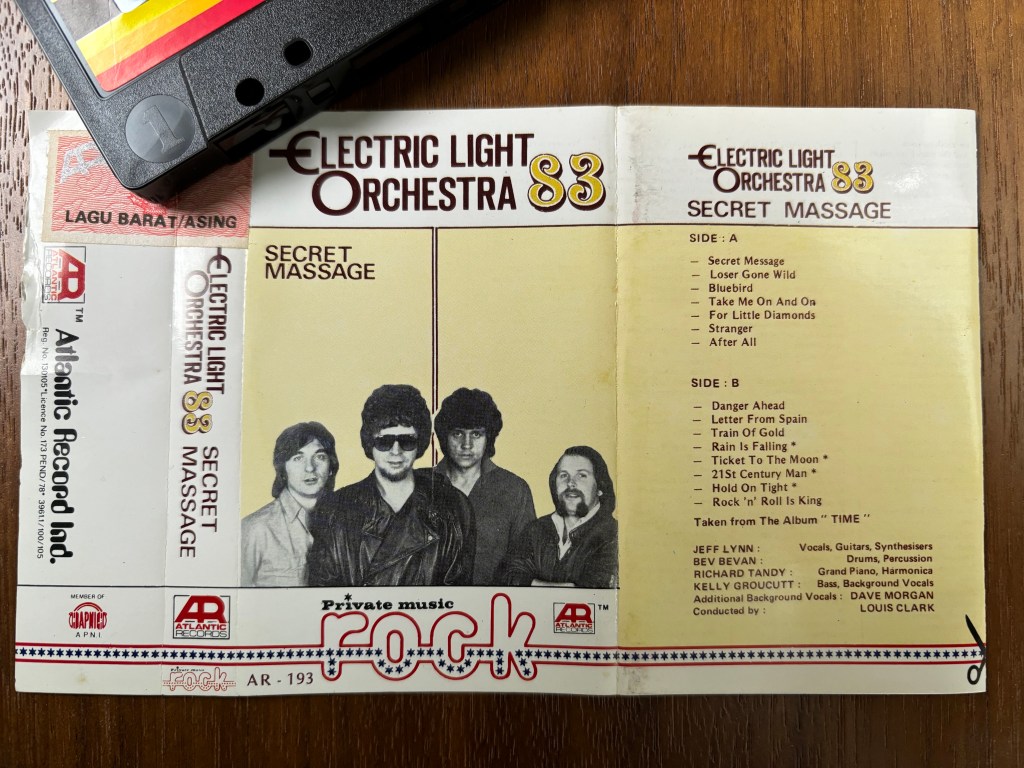
Matthew’s treasured ‘Secret Massage’ cassette. That’s a luscious title, but “Four Little Diamonds” being altered to “For Little Diamonds” is even better.
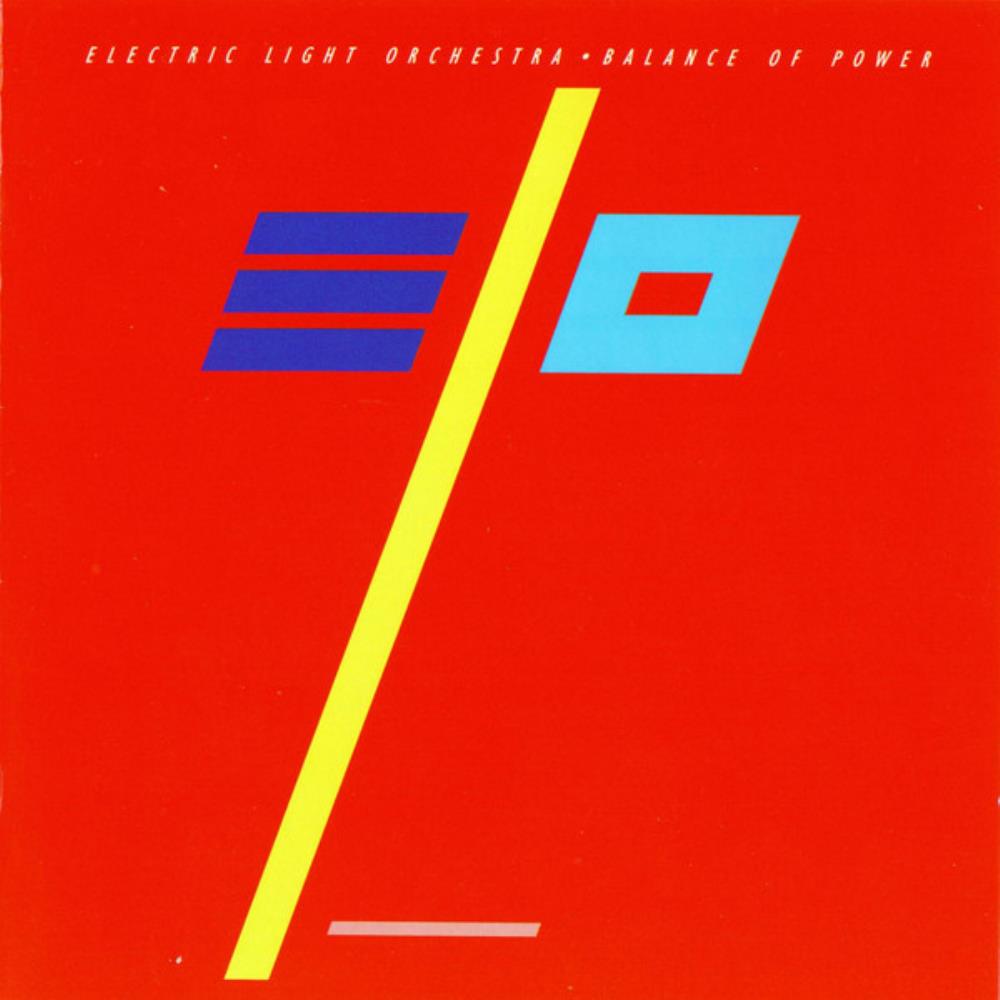
Balance Of Power (1986)
(UK #9, US #49)
HOPE: Turns out sometimes you can judge a book by its cover. The sleeve for Balance of Power is some kinda bullshit…and its musical contents aren’t much better. It oozes “legacy artist trying to sound modern in 1986” from its every pore. ELO had slimmed down to a trio consisting of Lynne, keyboard maestro Richard Tandy and drummer Bev Bevan by this point and the waning of passion for doing the ELO thing feels palpable.
MATTHEW: Some kinda bullshit is sadly right! As an ELO album, this just, well, isn’t. It is very much a 1986 pop album, and good as such, and not very ELO. And that means it fares very poorly in a ranking of the whole catalog, giving the band’s bell curve of success something of the shape of a roller-coaster segment: a slow climb through five albums, a high peak of four or five albums, then a downward curve that is gentle for one album, then a precipitous drop for this album (with the riders screaming “Jeff, nooooooo!!”).
HOPE: Spot on. The album’s twee, synthetic production is a killer, but the real problem is the supremely faceless and unmemorable quality of the songs themselves. BOP (let’s just call it, though it is by no means overflowing with “bops”) sounds like a cheap plastic version of ELO. As far as picking standout songs well…I kind of like busy, synth-dance, tres-eighties “Heaven Only Knows” which sits somewhere between Wang Chung and a Kenny Loggins-style soundtrack tune, thus is fun to me (Love that chorus line, “I’m really on the level”). Also nice is bombastic big boy “Getting to the Point” which bears a striking resemblance to an old school ELO song from a structural standpoint automatically qualifying it as a standout track on BOP. “Secret Lives” is sorta infectious too and not a million miles from the kind of thing the Bee Gees were doing in the latter half of the ‘80s.
MATTHEW: I rather like “Getting to the Point,” with its pop lushness and sax solo. The sax returns elsewhere, rather nicely on “Sorrow About to Fall,” for example. But wait, sax solos on an ELO album? And as one of the better touches? Gulp. Lynne is such a masterful producer by this point that he could create something that sounds this professional and polished in his sleep. But that’s the problem. The 35-minute BOP feels too professional and insufficiently personal. That the lyrical and musical hallmarks of imperial-phase ELO occasionally peep through the slick facade of cringey mid-80s production (twee and synthetic is right, Hope!) only reminds us that this is a contractual obligation album—and we have no obligation to like it.
HOPE: Insert sexy ‘80s-style sax solo here…
Favorite two tracks: Hope, “Heaven Only Knows”, “Getting to the Point”; Matthew, “Getting to the Point,” and “Sorrow About to Fall.”
Album Rating: Hope, 3/10; Matthew, 4/10.
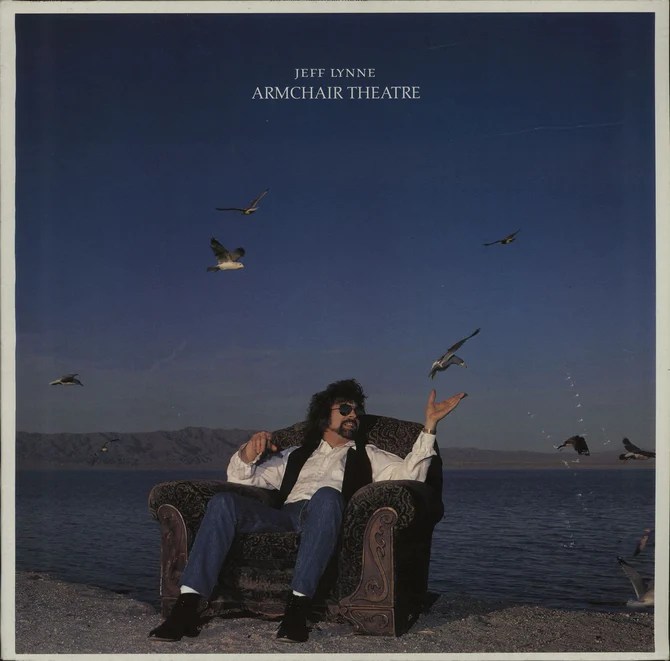
Armchair Theatre (1990, as Jeff Lynne)
(UK #24, US #83)
MATTHEW: Is it unfair to include this (and Long Wave)? After all, the weakness of Armchair Theatre is that it lacks the thematic and musical coherence of most ELO albums, yet “ELO” appears nowhere on the cover. This isn’t trying to be anything other than what it is: part ELO (more anticipating Jeff Lynne’s ELO than the band’s back catalogue); part Lynne’s childhood songbook (see Long Wave); part Traveling Wilburys (but, to my tastes, much better; Wilburys, ugh). So, up against the ELO catalogue, this first solo album of Jeff’s falters. But taken on its own terms, there’s much to appreciate here.
HOPE: I love the ocean, the sound of wind blowing through the trees and baby animals. I’m only stating this to assure you I am not a monster which many folks will likely think after I say what I’m about to say: I absolutely detest the music of the Travelling Wilburys. I realize they are a foundational stone in the mountain of Dad Rock and fat with legendary members but their smug, cartoonish shuffles make me feel insane.
MATTHEW: I think you are being generous to the TW, actually. I never got them. They always seemed like such an incredible array of talent adding up to so much less than the sum of those legendary parts. In fact, I could never shake the notion that the whole TW was a parody, a joke at our expense, a bunch of rockstars having a bit of a laugh. Sorry, you TW’ers!
Armchair Theatre is far superior. Ironically, I overlooked it for years because I unfairly judged it to be a TW side-project with a few odd covers thrown in to bring it over half an hour. Yes, it lacks the musical coherence of the best ELO albums. And its finest tracks work better on mixtapes or playlists, from singles like “Lift Me Up” to surprises like “Now You’re Gone”—a hidden gem whose Middle Eastern touches are pure production genius. But by skipping the three covers, the eight Lynne originals (including the pretty good “Blown Away,” co-written with Tom Petty, and the Petty-ish “What Would It Take”) comprise a really good 27-minute album. As a bit of ELO-nerd fun, I made a hybrid album mixing those eight originals from Armchair Theatre with the best few from Balance of Power (call it Armchair Power). Fun, yes, but in the end merely confirming that Armchair Theatre is a better Lynne and ELO album than Balance of Power.
HOPE: After reading your paragraph above, I went and assembled a hybrid album to see if it would work. I titled it Power Balance and plugged in the best five tracks from Armchair and best four from BOP…and what the holy hell, once the chaff was edited off and the good songs were merged into one actual album I genuinely liked it. Prior to doing that, I had been completely freakin’ indifferent to Armchair. Now I’m kind of charmed by it (or at least half of it).
Armchair occupies the same soundscape as George Harrison’s 1987 comeback album Cloud Nine and/or Tom Petty’s 1989 debut solo album Full Moon Fever, both of which Jeff produced, wrote and played on. In terms of listenability I would place it in the middle, better than the former (which I don’t like), lesser than the latter (which I do). The simultaneously shiny and laid back ”What Would It Take” and head-bobbing, blissful bop “Lift Me Up” are peak “L’eighties-Lynne”. And gotta give a dual nod of approval to “Blown Away” and “Now You’re Gone” which proved Jeff hadn’t ventured too far from the ELO Mothership after all.
Favorite two tracks: Hope,”What Would It Take”, “Lift Me Up”; Matthew, “Lift Me Up” and “Now You’re Gone”.
Album Rating: Hope, 5/10; Matthew, 6/10.
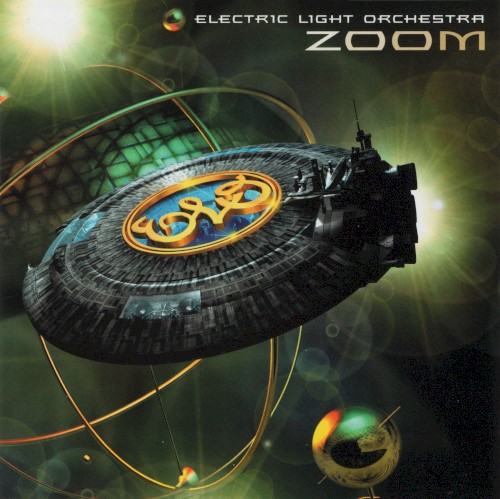
Zoom (2001)
(UK #34, US #94)
HOPE: Zoom touches upon nearly all eras in ELO history. There’s early ‘70s era style rock (“All She Wanted”, “Alright”, “Easy Money”, “Lonesome Lullaby”, “Stranger On A Quiet Street”). There’s ‘80s-ish ELO (“It Really Doesn’t Matter”, “Melting In The Sun”, “State Of Mind”). There are even a few tracks reminiscent of peak ELO aka 1975-79 aka the Imperial Years (“Just For Love”, “A Long Time Gone”, “Ordinary Dream”). Despite all this, there is something significant missing from Zoom: The magically melodic hook-iness of the past.
Sure, “Just For Love” and “A Long Time Gone” with their noticeably similar choruses are low-key lovely, but the rest of the tunes are kind of predictable in terms of which way they’re gonna turn at any given moment. So while Zoom did provide a refreshing reassurance that Jeff still kinda had it, the album as a whole was not remotely dreamy, swoony or hooky enough to be able to stand with the ELO album gods of the past. I don’t know though, is that even a fair comparison/assessment? Should Zoom be graded on a curve the same way latter 2000s era McCartney or Springsteen albums are, where several points are awarded because they are still creating new material and the songs for the most part are structurally sound?
MATTHEW: No grading on a curve! Life’s too short to give artists a pass for being older, when there are so many great albums to enjoy (including by those same older artists). But Zoom is still tricky to evaluate: is it Lynne or ELO or Lynne’s ELO? The album is somewhat stranded in time, with 15 years after the last album billed as by ELO, and 14 years before the next one. And if we count Lynne’s solo albums, it’s still 11 years on either side. It also has a reputation for being a disappointment at the time—with lower sales than expected, its North American support tour canceled due to poor advance ticket sales. Furthermore, billed as Electric Light Orchestra (not Jeff Lynne’s ELO), it has only one other ELO member on just one track (Richard Tandy on “Alright”), with two ex-Beatles featuring on four tracks. In fact, it sounds more like a latter-day Beatles album than an ELO one, and that feel is far from limited to the four tracks on which George Harrison or Ringo Starr play. Confused? I admit I was a little, when I first heard it in 2001. But I soon realized that if taken as a new Lynne solo album, Zoom is excellent, the best Lynne or ELO album since Secret Messages—perhaps since Time over two decades earlier. I have way more affection for Zoom than you do, Hope, but based on its impact at the time of its release, you’re on the money and I’m a weirdo.
Favorite two tracks: Hope, “Just For Love”, “A Long Time Gone”; Matthew, “Alright” and “Just For Love.”
Album Rating: Hope, 4/10; Matthew, 8/10.
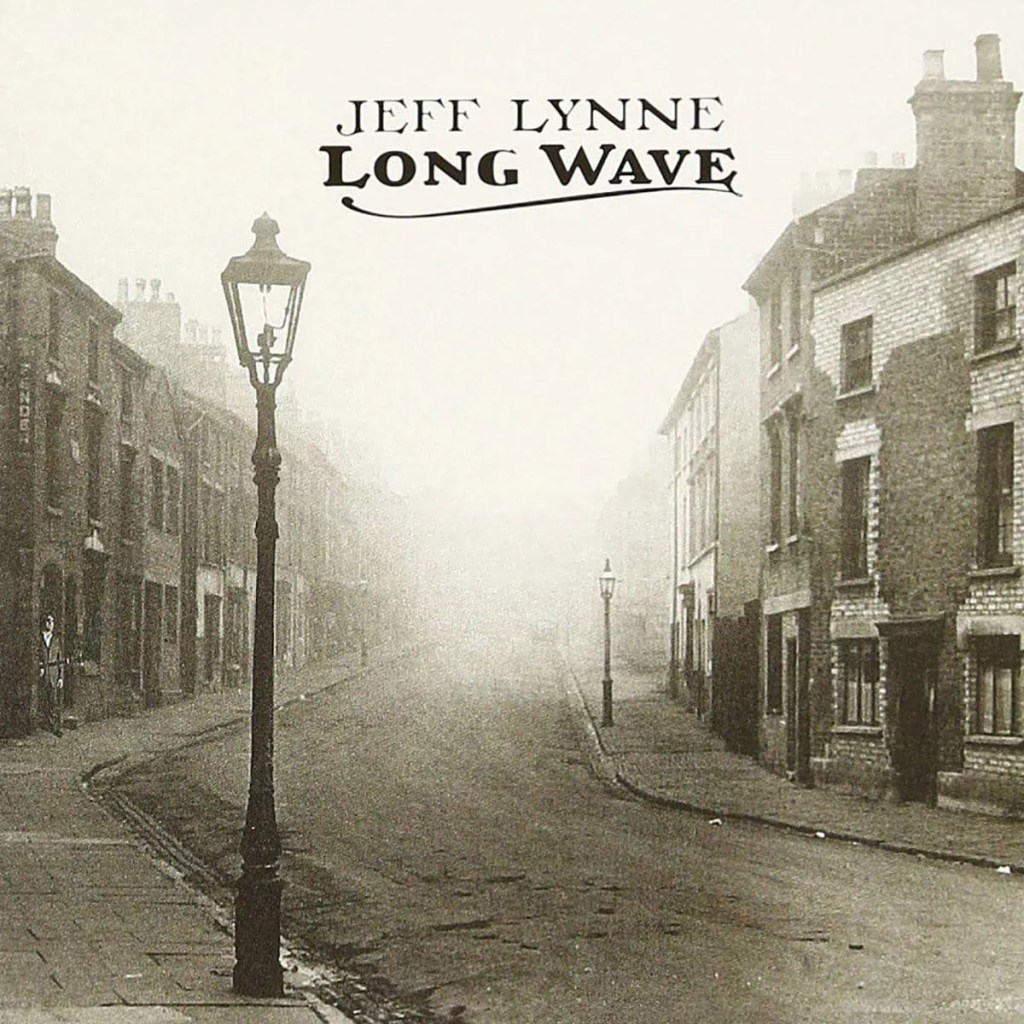
Long Wave (2012, as Jeff Lynne)
(UK #7, US #113)
HOPE: I see what you did here Jeff Lynne. You not only started the album with a couple of quirky and genuinely endearing cover picks, you seductively slathered them in that old sweet ELO sauce we know and love. Hearing the album’s first two tracks—Charles Aznavour’s ”She” and Rodgers and Hammerstein’s “If I Loved You”—stunningly reshaped into vintage ELO-flavored balladry, gave me hope.
Unfortunately, it turned out to be the false kind. Those two retro dreamboats turned out to be the best things on the LP (by far). Enjoying Long Wave as a whole depends on one’s unfaltering loyalty to Lynne and tolerance for hearing hoary old chestnuts like “Bewitched, Bothered and Bewildered”, “At Last”, “Love is a Many-Splendored Thing” and “Beyond The Sea” being trotted out for roughly the billionth time in recorded history. While not as aurally challenging as McCartney’s similarly nostalgic cover 2012 LP, Kisses On The Bottom (UGH), it ain’t much better.
MATTHEW: I agree that Long Wave is more palatable than Macca’s Kisses (beginning with their titles). It has a certain charm, especially if you have affection for old standards and you’re a die-hard Jeff fan; the rich timbre of his voice is nicely showcased here. But as you say, Hope, you really need to be both those things to enjoy this all the way to the end. Sure, it starts strong (“She” always reminds me of Elvis Costello’s cover for the Notting Hill soundtrack; I like Lynne’s version better). But the returns are diminishing from then on. It’s only 27” but feels longer, partly because the little moments that remind me of ELO songs—the way Lynne curls around a phrase, or his use of a favored production trick—only make me wish I was listening to those ELO songs.
It’s probably not really fair of us to include Long Wave. It deserves appreciation on its own terms, not up against the ELO catalogue. But Armchair Theatre sounds more like ELO than Balance of Power, and Lynne has made himself so synonymous with the band that he gives us no choice. Blame Jeff!
Favorite two tracks: Hope, “If I Loved You”, “She”; Matthew, “She,” “If I Loved You.”
Album Rating: Hope, 3/10; Matthew, 4/10.

Alone In The Universe (2015, as Jeff Lynne’s ELO)
(UK #4, US #23)
MATTHEW: As hyperbolic as this might seem, I find it incredibly life-affirming that more than thirty years after ELO’s imperial phase petered out, Lynne created an album this bloody good. None of it is filler, most of it is great. For me, it’s one of the five best records in the whole ELO/Lynne catalog. If you substitute Side One’s “Dirty to the Bone” with one of Side Two’s gems (like “One Step at a Time”, which sounds like a lost early 80s hit single), then Side One is a serious contender for the best Side One in the catalog. And although Lynne left concept-album thinking back in the early 80s, there is something of a conceptual coherence to these ten songs and their 33 minutes of 8-bar blues-based melancholic pop nuggets. Masterful!
HOPE: I love a nice “Majestic Loner” song where the protagonist ponders their otherness and romanticizes their perpetual view from the outside. Sad yet hopeful. AITU (let’s just call it) offers a beauteous pair of “Majestic Loner” tunes for the misty-eyed unicorns among us: The glistening hymnal sway “The Sun Will Shine On You” and ”Alone in the Universe”, an epic throwback with a bit of “Can’t Get It Out of My Head” running through its yearn-ful veins. Other standouts include nostalgic origin story “When I Was a Boy” and late ‘70s-flavored groover “One Step at a Time”. The album is solid and consistent overall (and yes, it feels like there is a subtle thread connecting the songs). But here is where we part Matthew…melodically AITU falls short for me (why does this keep happening?!). Apart from “The Sun…” and “Alone…” none of the songs move the needle on the swoon scale. Also, a big f-u to that disgracefully cheap-looking font on the front cover.
Favorite two tracks: Hope, “The Sun Will Shine on You”, ”Alone in the Universe”; Matthew, “When I Was a Boy” is the perfect opener to an ELO/Lynne mixtape, and “The Sun Will Shine on You” is lovely enough to bring tears to my eyes.
Album Rating: Hope, 5/10; Matthew, 9/10.
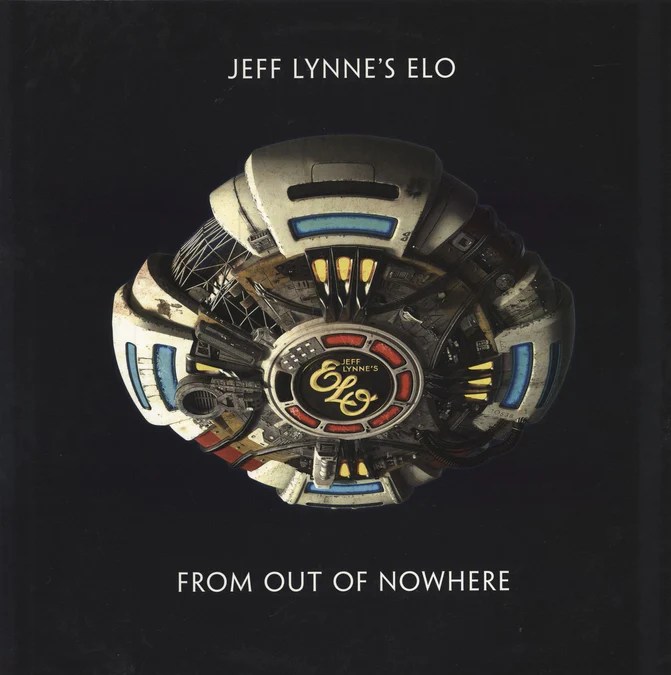
From Out Of Nowhere (2019, as Jeff Lynne’s ELO)
(UK #1, US #47)
MATTHEW: When From Out of Nowhere came out in 2019, Classic Pop editor Steve Harnell reviewed the album. He lightly praised a few tracks, noting that “’All My Love’ is undeniably pretty” (which it is) and that “Losing You” has “George Harrison-esque grace” (which it does). But he emphasized that Lynne was “in familiar territory,” the album was “unapologetically set in its ways,” and he set his 3-star review between reviews of a new Ringo Starr album (3 ½) and a posthumous Leonard Cohen release (4 stars). So, a so-so predictable throw-back record from an old guy? Fair enough? Or an unfair dismissal of an album almost as good as its predecessor?
HOPE: The fact that this got to #1 in the UK album chart seems like it had nothing to do with the album’s actual merits. Its success felt more like a sweet acknowledgement of all the pop perfection Jeff Lynne had served up over the previous years as opposed to the appeal of the LP’s actual contents. So I think Harnell was spot on and maybe even a little kind. Describing the album as “unapologetically set in its ways” is just a gentler way of saying that it’s boring. And he’s not wrong. There’s a real sonic sameness to the songs on From Out of Nowhere and nothing truly stands out. It’s ELO wallpaper. As far as praise, the best I can offer is that the closing track, moodily romantic “Songbird” is kind of pleasant and the LP as a whole is accomplished. Remember when you forbade me to grade on a curve a few albums ago? I’m taking it to heart.
MATTHEW: ELO wallpaper? Ouch! Well, I think that’s definitely true of Side Two—with the exception of album closer “Songbird.” Having this on vinyl, and mostly only playing Side One, has skewed this album upwards in my rankings. That’s 6 of 10 tracks that are hooky and melodic and worthy of playlist spots; 4 that are, well, ok, wallpaper! But I suspect that more listeners would agree with you, Hope, than with me. You are able to be fairly objective, whereas I have such a positive and primal response to Lynne’s voice, words, and studio sound that I cannot help but be happy upon hearing them.
HOPE: Though it may be hard to tell from these last few album blurbs, I really do fuckin’ love ELO.
Favorite two tracks: Matthew, “Down Came the Rain” (Lynne’s signature metaphor!), and “Losing You” (showing he still has his ballad-writing chops); Hope, “Songbird” (but I only like as a friend, not as a love interest)
Album Rating: Hope, 4/10; Matthew, 7/10.
Box Sets & Compilations


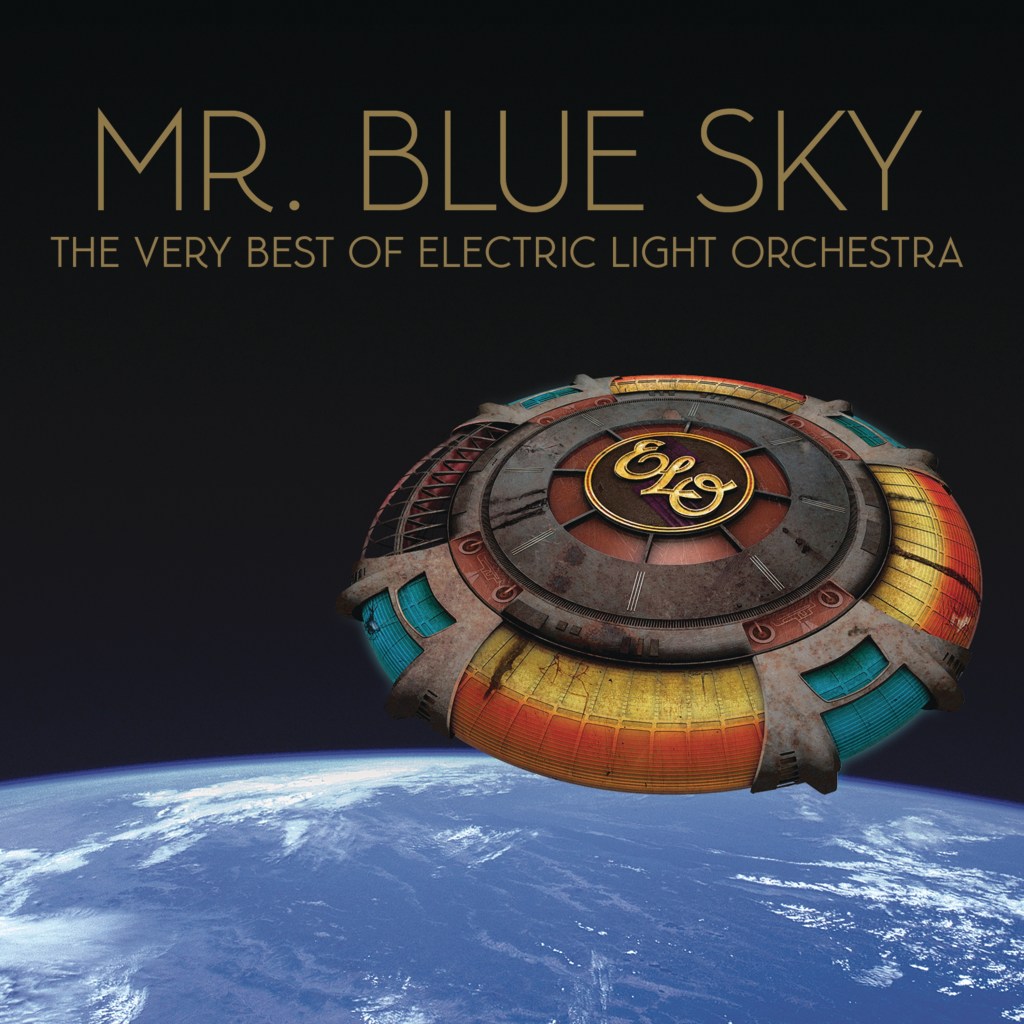
MATTHEW: There are a crazy number of compilations out there—18 by my count, and I probably missed a couple. I seem to have picked up a third of them or more over the years, in one format or another. The ‘70s ones are historic curiosities, whereas the more recent ones tend to be too short and predictable. But four are worth a mention.
All Over the World: The Very Best of Electric Light Orchestra (2005 and 2011) had sold over a million copies in the UK by 2016, when a rare reunion appearance of the band (at that year’s Glastonbury Festival) nudged the compilation album to #1. Alone, it is yet another predictable CD of hits. But paired with Ticket to the Moon: The Very Best of Electric Light Orchestra, Volume 2 (2007), it becomes a more interesting and representative survey of the catalog. Still, both volumes ignore the first two ELO albums (and, of course, the two most recent ones, which had yet to be created). Sorely needed is a 4-CD update (like the Genesis one you don’t like, Hope!), that covers 1971 to 2019, with all the singles plus more of the rarities and oddities that are lightly represented on The Very Best of Electric Light Orchestra, Volume 2. Any chance, Mr. Lynne, sir?
HOPE: I agree that as a duo, these Very Best’s are alright. Honestly, it’s hard to talk about compilations with any passion (except maybe ABBA Gold). While not completely redundant, they are the aural equivalent of a travel umbrella i.e. Cool to have as you never know when you might need them and useful in specific situations, like a car journey (I see you Matthew!). They are not necessarily the first choice/favored song assortment for a nerdy fan (a specific studio album or self-curated playlist being the preferred choices). That mouthful said, these two comps serve as a safe and welcoming ELO kiddie pool for new and future ELO fans to get them acclimated.
MATTHEW: I’m counting the two Very Best of compilations as one, with my second pick being 2012’s Mr. Blue Sky. This hits mix is also a different kind of animal. What do you think of it, Hope?
HOPE: I don’t like it, but it’s for a somewhat altruistic (!) reason which I’ll get to. Mr. Blue Sky features re-recorded versions of ELO classics. In a 2012 interview with music radar Jeff was asked why he felt the need to re-record already “perfect” and beloved songs from his catalog:
“Over the years, I’ve played some of the albums from time to time, and I would go, ‘Hmm… I don’t know.’ And then I’d hear some of the songs on the radio and I’d say, ‘That doesn’t sound like I thought it did.’ So I thought, Maybe I should have another go at these…to see if I could do it again. I mean, I have a studio – why not have a go at it?’
The new versions of old established tunes on Mr. Blue Sky don’t sound better, they just sound different…or to those more familiar and worshipful of the original versions, they sound weird. The vocals are prominently pushed up front in a way that wipes clean the smoky-dreaminess that made “Telephone Line” and “Strange Magic” so beautiful the first time. In fact, there is a distractingly, sharp-edged clarity to Jeff’s voice on every song, like the original versions were dirty windows and this what they sound like wiped clean.
My main issue is this: I don’t like that these new versions might be someone’s first experience of hearing ELO and that these re-records might be mistaken for the originals. So I need to know, Matthew, what do you think ?! And do you believe presenting it as a standard “Best of” is misleading?
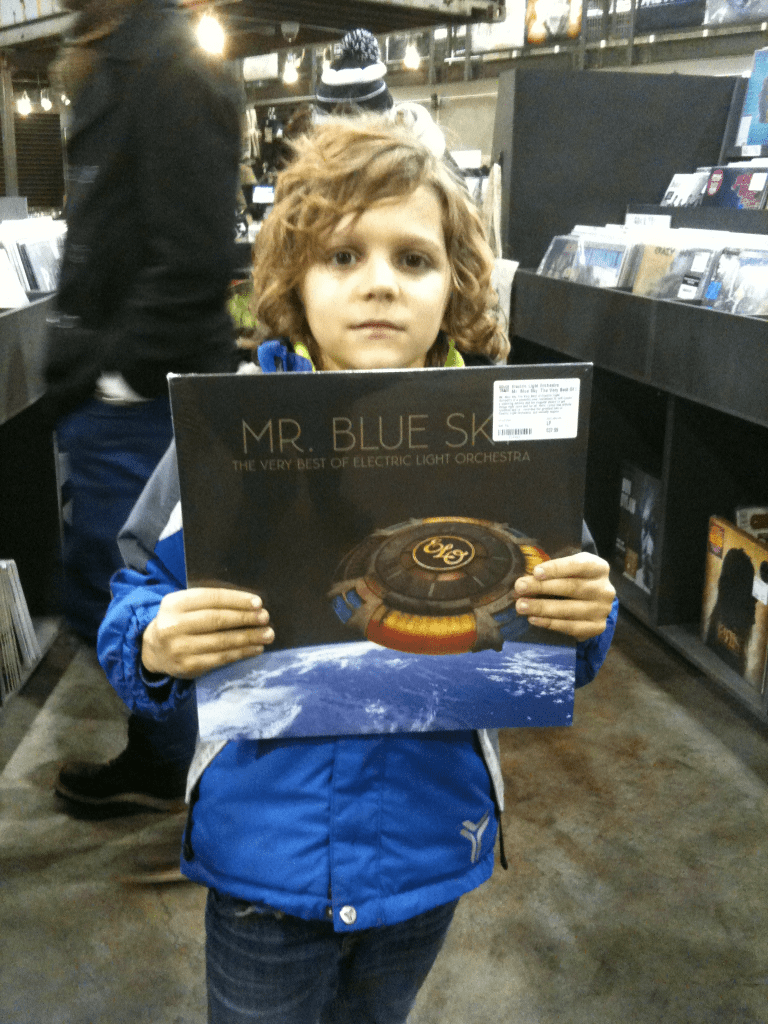
Here is a pic I took back in my record store days in ye olde 2014. I noticed this young lad walking around with a Mr.Blue Sky LP, got excited and asked his Dad if I could take a pic. I hope he loved the album enough to dig into the catalog and ultimately leave the re-recorded versions behind. But it’s okay if he didn’t.
MATTHEW: Yes, Hope, spot on: I agree that the billing of Mr. Blue Sky is misleading. It is as if Jeff is trying to lead us away from the originals because these new recordings are improved replacements. They’re not. They are enjoyable and worth a listen, but they are curiosities for fans, not a good entry point for newcomers. I think of them as “Jeff’s Versions” (a la branding of the Taylor Swift rerecordings).
A far better entry-point for new fans—which also serves as a must-have compilation for die-hard fans—is the third of the many compilations mentioned here, 2000’s Flashback. Do you agree, Hope?
HOPE: Yes! The three CDs of Flashback feature songs from every ELO studio album released up to that point, providing a fine overview as far as singles and deep cuts. Sure Xanadu’s representation is limited to a re-recorded version of the title track and neither “All Over the World” and “I’m Alive” are included (ouch)…but all the other key stuff is here. As far as the ten requisite rarities and curios included, only 1980’s windswept locomotive “Love Changes All” and 1982’s sweetly spacy instrumental b-side “After All” are real keepers. That said I wish there had been a bigger selection of rare and unreleased cuts!
MATTHEW: Absolutely. And the copyright issues keeping Xanadu out of these compilations is annoying. Hey Jeff, if you are going to re-record old songs, re-record all your Xanadu tracks for inclusion in compilations! The issue also impacts The Classic Albums Collection (2011), the final comp worth a mention. This CD box set collected all eleven ELO albums from No Answer through Balance of Power (Xanadu excluded), in card sleeves in a cardboard box. This was Lynne’s project, so the remastering was supervised by him, and the 27-page booklet has new liner notes by him, with a comment on every track (albeit some of them only a few words). There are between two and four bonus tracks on every disc—most of them previously unreleased demos or alternate takes or unused tracks. The extras are curiosities of interest to serious fans only. I appreciate having them, but I rather wish they were collected on a couple of extra discs, so I could enjoy each album as it was originally released. The culture of—and market for—“deluxe editions” has developed so much since 2011 that I would imagine a 2020s version of this would have a disc of extras for every album; or is that wishful thinking on my part?! As far as we know, this has yet to be released on vinyl, so perhaps a vinyl issue would by necessity put the extras on separate discs.
HOPE: Yes on that thought! Tacking demos, rarities and my most hated bonus bit, snippets, onto the end of physical albums wrecks the flow, especially if you have nostalgic bonds to the original versions.
Live Albums

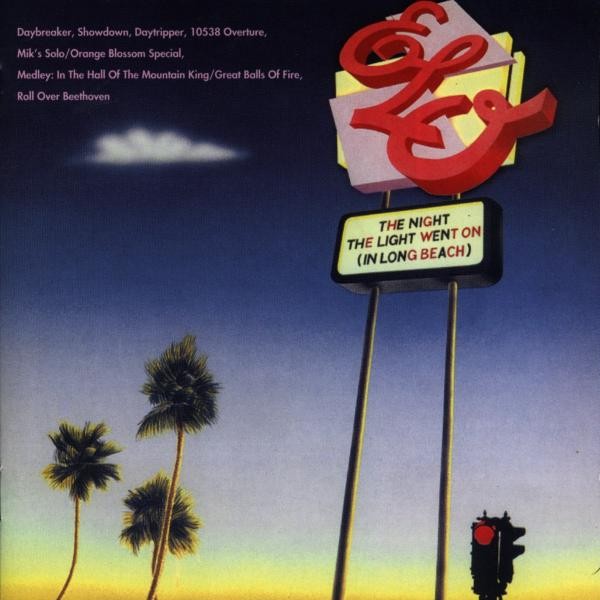
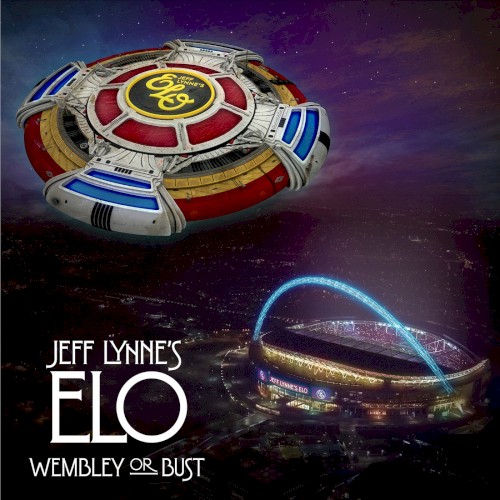
MATTHEW: There are apparently seven live ELO albums. I say apparently, as I’ve spent many decades as an ELO fan blithely unaware of the first six (1974 to 2013). I’d question my own fandom, but I see that none of them charted anywhere. And most weren’t even released in most countries. A 1974 live recording, The Night the Light Went On In Long Beach, has a complex and elusive release history, but may be worth the hunt for fans of the early albums (the 6-minute “Day Tripper” cover slips in snippets of Mozart and Handel!). The seventh live album, however, 2017’s Wembley or Bust, is one I’ve seen (the concert film) and played (the CD), and it is thoroughly enjoyable. Lynne and Tandy recruited a superb band. Lynne applied his famously meticulous production skills to reproducing ELO’s complex sound to perfection (almost to a fault?). And (in the film version) the shots of an enraptured audience complete the emotional experience, making this a must-have for any ELO fan. Lynne was so happy with the Wembley Stadium concert that he wrote a song about it: the uncomfortably cheesy yet charming “Time of Our Life” is on From Out of Nowhere.
HOPE: I too had no idea there were so many ELO live albums. The Night the Light Went On In Long Beach was recorded live before they really hit their stride song-wise and feels more like a collectible curiosity than a definitive document. As it was common in the seventies for established rock artists to release fat double live albums in between studio releases, it’s disappointing that nothing more substantial surfaced during that decade. I can see it now, under the fantasy 1978 Xmas tree, an ELO triple live album with a fold-out sleeve, stickers and a giant poster (two-sided of course). It would no doubt have been a sentimental fave for all of us! But because this specific thing didn’t happen, I’m indifferent about ELO’s live albums (P.S. I officially acknowledge how weird this is).
MATTHEW: Ha! Fair enough! So how about this: the concert video is worth a watch for those who like the format, but for listening-only skip Wembley and hit the studio classics? And perhaps that’s just as well, as Lynne has said he’ll no longer tour after 2025. But he’ll surely make another album, or three, perhaps continuing to revisit the catalog. And what a catalog of wonders it is!
HOPE’s Postscript: I finally watched Wembley or Bust in its entirety after only having seen a few singular songs from it. The performances were quite nice but the thing that really pierced my heart was seeing the audience’s beatific faces and their reactions to the songs. The joy was so palpable, it made my eyes well up. Wembley or Bust is well worth watching. Eating my hat right now (or at least part of it).
I bow to the palpable joy of “Evil Woman” live at Wembley.
In Conclusion
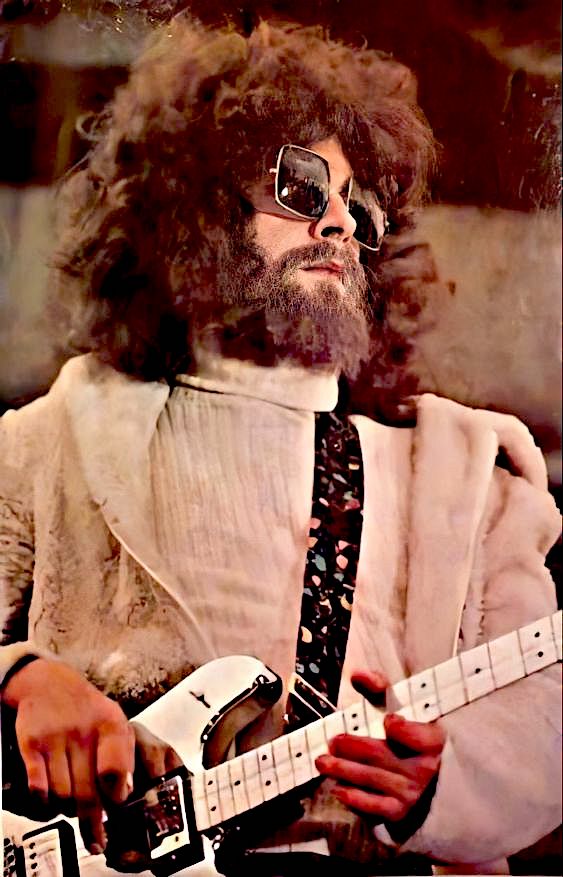
This pic once graced the wall of my childhood bedroom. Even now I find Lynne to be weirdly era-appropriate foxy in it.
HOPE: What’s the first thing that pops into your head when you think about ELO? The deranged bridge in “Turn to Stone”? The pointedly precise string plucking in “Livin’ Thing”? Your teardrops hitting the floor whenever “Telephone Line” plays? That’s a trick question of course. It’s never just one thing. If you love even one ELO song, you are very likely to love another…and another. They really are a bag of candy. But seriously, ELO contained multitudes. They could be regal and symphonic. Starry-eyed and romantic. Lonely. Silly. Brazenly bombastic. They were occasionally all of those things at once (lookin’ at you Mr. “The Diary of Horace Wimp”).
“Mr. Blue Sky” has been streamed over a billion freakin’ times. A billion. Not bad for a bearded Beatle worshiper from Birmingham, who was once described in an old review as “passionless” and “self-indulgent”.
All I know is that if I were ever to start a themed-cover band, ELO are unquestionably the band I would pay tribute to (We’d be called H.E.L.O. aka Hellectric Light Orchestra). There’s something genuinely magical about these crazy songs.
MATTHEW: Here’s a strange thing: there aren’t that many covers of ELO songs out there, not compared to other artists with similarly deep and popular catalogs. Perhaps that is because Lynne’s attention to every aspect of the creative process—writing the music and lyrics, singing and playing many (sometimes most) of the instruments, doing most (if not all) of the production—makes these songs utterly and holistically his. That helps hold the catalogue together, the 17 albums spread over 48 years, despite the stylistic contrast between No Answer and From Out of Nowhere. And it encourages fandom, as songs from any of those albums evoke songs from others. For example, for me personally, Lynne’s use of weather, especially rain, as a metaphor for love’s heartache, works as a comforting thread or leitmotif running through the catalog. It may be simple, but it is like an old friend. “Love and Rain” is at the end of my list of favorite ELO songs (see below) because it always makes me smile for that reason; it reminds me of all Jeff’s love and rain songs (and there’s love or rain or both on every album), and how grateful I am for the joy they have given—to me and to millions.
But that’s not quite all. For there is one cover album of ELO songs, and it is superb: Juliana Hatfield Sings ELO (2023). Hatfield’s latest contribution to her own Sings series is a masterclass in how to create a covers collection: respectful, loving, artful, yet interpretive and distinct from the originals; and above all, a reminder of how extraordinarily talented a songwriter is our Jeff.

This album is awesome and you can listen to it right here, here or here…
HOPE: Juliana was born in 1967 so she has a strong lifelong connection with these songs and the album is freakin’ superb. Her versions of “Sweet Is The Night” and “Bluebird Is Dead” are particularly fabulous (ooh). In a 2023 interview with Under The Radar, she described her love for ELO in the most perfect way imaginable:
“I can completely relate to the idea of being a child and being just obsessed with the magic of music on the radio. And ELO is one of those magical sounds that I would hear on the radio and I would be transported to a beautiful place”
That’s it right there. Take me us on and on.
The Ranking Summary!
Here are our best-to-worst album rankings, in descending order .
MATTHEW:
1.Out of the Blue
2.A New World Record
3.Time
4.Discovery
5.Alone in the Universe
6.Face the Music
7.Zoom
8.Secret Messages
9.From Out of Nowhere
10.Eldorado
11.Xanadu
12.Armchair Theatre
13.On the Third Day
14.Long Wave
15.Balance of Power
16.The Electric Light Orchestra/No Answer
17.ELO 2/ELO II
HOPE:
1.Out of the Blue
2.A New World Record
2.Discovery
4.Time
5.Face the Music
6.Eldorado
7.Alone in the Universe
8.Armchair Theatre
9.Xanadu
10.Secret Messages
11.Zoom
12.From Out of Nowhere
13.Balance of Power
14.On the Third Day
15.Long Wave
16.The Electric Light Orchestra/No Answer
17.ELO 2/ELO II

Hope & Matthew’s Top 15 favorite ELO songs ever!
Our original plan was to share our top 10 favorite ELO songs but that proved too restrictive as there are just too many brilliantly beautiful and beloved songs (dammit)! Thus we have decided to “deluxe” things and pick 15 songs each. Here are our faves (in no particular order)!
HOPE’S (in no particular order):
1.So Fine
2.Starlight
3.Need Her Love
4.Stranger
5.Big Wheels
6.Above the Clouds
7.Tightrope
8.Last Train to London
9.Bluebird is Dead
10.Telephone Line
11.The Whale
12.Sweet Is The Night
13.One Summer Dream
14.Take Me On and On
15.Jungle
MATTHEW’s (also in no particular order):
1.When I Was a Boy
2.Showdown
3.Strange Magic
4.Tightrope
5.Telephone Line
6.Shangri-La
7.Standing in the Rain
8.Big Wheels
9.Steppin’ Out
10.Last Train to London
11.Need Her Love
12.Ticket to the Moon
13.Take Me On and On
14.Now You’re Gone
15.Love and Rain
 PICKING UP ROCKS