Obsessively devoted to excavating the unjustifiably overlooked, forgotten, hidden in plain sight & truly underappreciated in the musical universe, old and new.
This is weird but I want to “advertise ” the piece posted just before this latest edition of WEEKLY NEW WONDERS I’m about to serve up, aka our round-up of the best new songs from recent days which are seriously exquisite but hold that thought!
A few months ago, PuR reader-friend Tim asked if he could write a piece for the blog about how influential a particular book had been in his burgeoning musical nerdom as a child. When he told me it was The Illustrated Encyclopedia Of Rock by Nick Logan and Bob Woffinden, I couldn’t f*cking believe it for this book had been a foundational piece in my childhood as well.
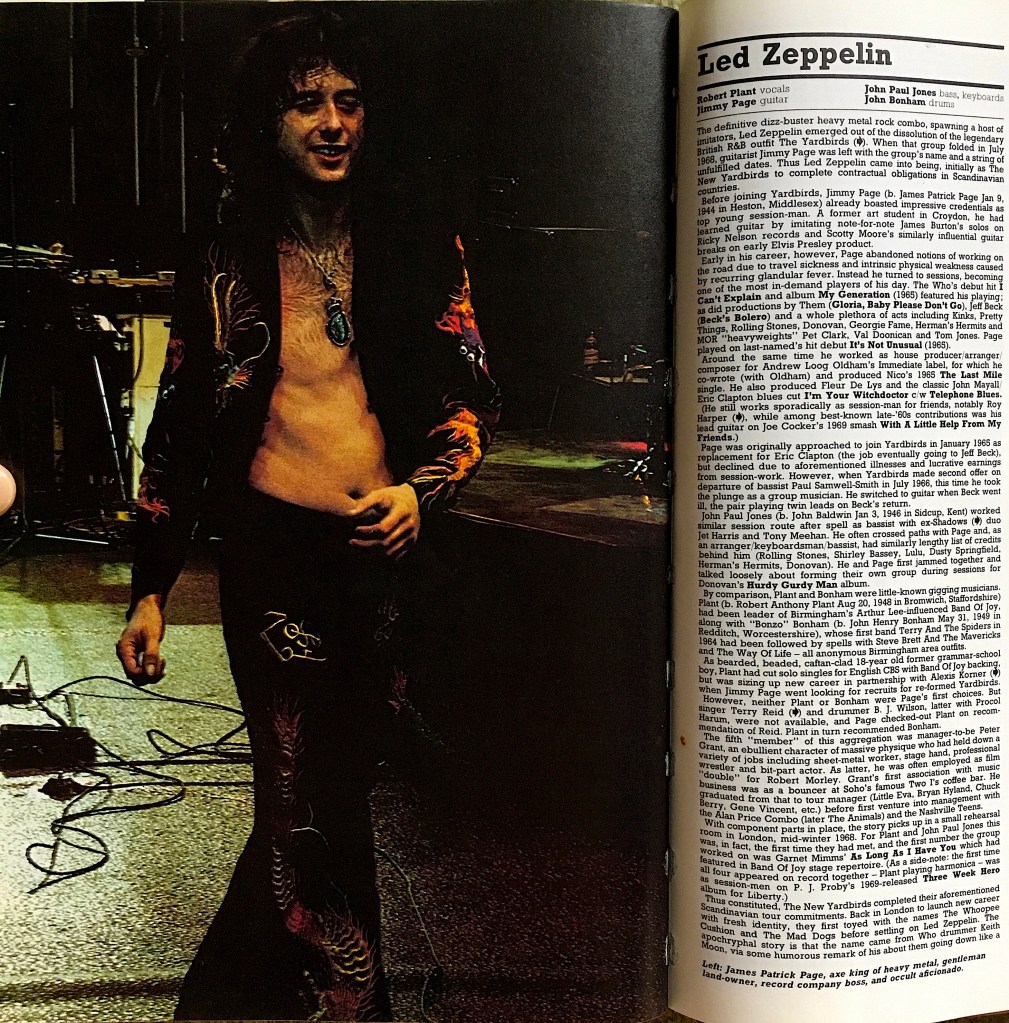
I get how Where The Wild Things Are, Harry Potter or The Baby-sitters Club books were seminal for millions of normal kids, inspiring their love of reading, dreaming and all that. But for me, no book was as glamorous or spoke to me as profoundly as The Illustrated Encyclopedia Of Rock. It was home to a full-page picture of sweaty Jimmy Page coming offstage that I was both fascinated with and completely disgusted by. It featured hundreds of entries about bands I had never heard of like “Fairport Convention” (who?) and “Slade”(again, who?), and depicted album covers I’d never seen. Plus there were all sorts of sordid anecdotes about musicians OD-ing and jumping in front of trains. As a child who kept a scrapbook of obituaries for “fun”, I found these grim factoids to be especially intoxicating (I was a real Wednesday Addams). I used to sit for hours in my walk-in closet reading and re-reading this book, making lists of bands I wanted to seek out at the record store while gawping at, and occasionally being scared by the weird pictures (true).
And so after you listen to these brilliant new songs, please read Tim’s fabulous piece below. Or hell, why not multi-task and listen to the WEEKLY NEW WONDERS PLAYLIST while you read Tim’s piece and immerse yourself in a full-on musical haze. Rock on…
There was once a book, a magical, mystical book. It was called The Illustrated Encyclopedia Of Rock. It had a life-altering effect on two children growing up on opposite sides of the Atlantic Ocean, kickstarting their musical passion and turning them into nerds forever. The curious kids were PuR friend Tim Procter and myself. Tim wanted to write a piece paying tribute to this mad book that has been so foundational for both of us, a truly absurd coincidence that still blows my freakin’ mind. Come now and meet the greatest book ever written. Take it away Tim…
“We’ve done our best”
-from the introduction of The Illustrated Encyclopedia Of Rock
I have a theory. That at some crucial point in every music nerd’s life, something came along that nudged them from loving music into needing to devote significant chunks of their brains to it, and not just the sounds but all the contextual gubbins that enrich and enhance the noises coming out of the speakers; you know this or you wouldn’t be on this site. And I don’t mean establishing some canon or Weight of Rock History; just knowing some stuff can make the sound of the most obscure West Coast ‘80s soft rocker or grubby one-album Mancunian indie band that much more real to you, if your brain is wired that way and the right object fell into your lap at the right time. Chances are if you’re a music obsessive of the ‘70s or ‘80s, this key thing was a book. Some codex that opened up the world of discographies, biographies, release dates, and suitably amazing facts. There are some big hitters alright—The Guinness Book of British Hit Singles, Pete Frame’s Rock Family Trees. The lush Album Cover Albums that Hipgnosis put out must have fused music and art obsessions in many impressionable minds. And here’s mine, dear readers—introducing 1977’s The Illustrated Encyclopedia of Rock. Not just The Encyclopedia of Rock. The Illustrated Encyclopedia of Rock, if you please.
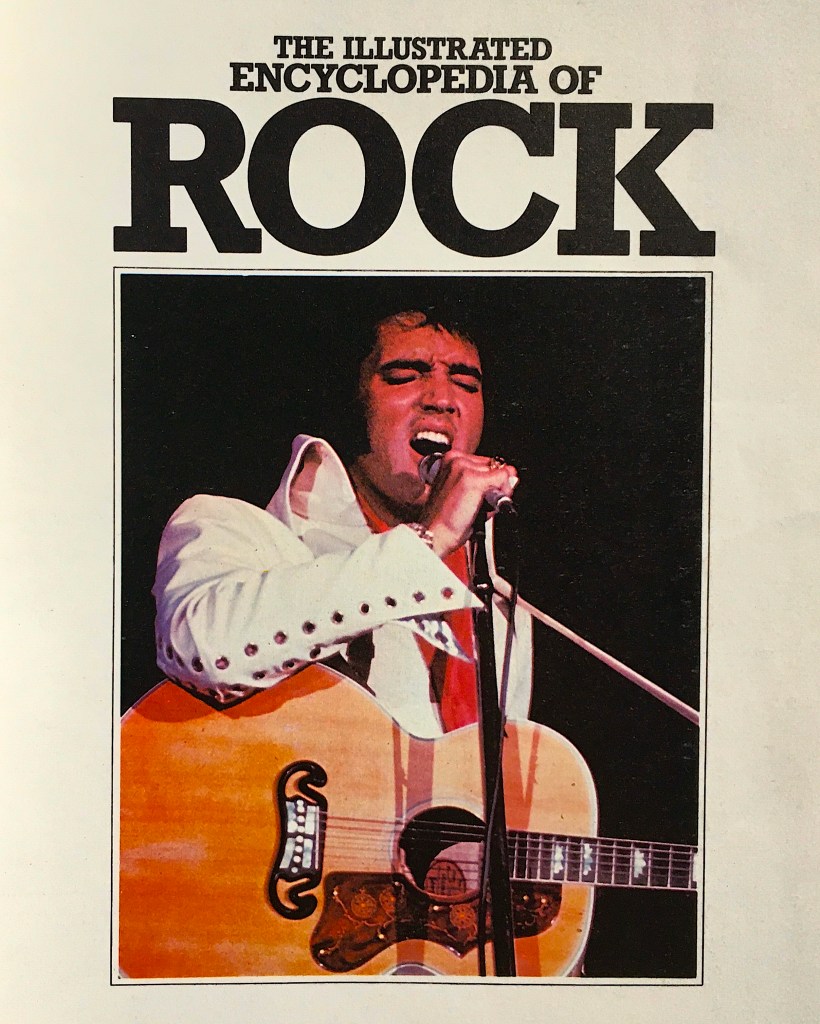
Page one of ye olde encyclopedia, starring The King.
Because of my own reverence for the book, I’d assumed it was regarded as something of a classic in music nerd circles, but it appears not. The Pink Floyd Archives with its comprehensive survey of all print things Floydian, skims over it—“Includes an entry on Pink Floyd.” They’re on the cover! The Dark Side of the Moon prism is on the inner cover! The authors even claim that the absolute slog of Ummagumma is “of interest”!! The book is readily available on second-hand sites and rarely cited, unlike a lot of other reference works of the time.
It was written by two NME journalists, Nick Logan and Bob Woffinden; parts of it appeared in NME and the first edition was published by Harmony Books in 1976 but the widely available version, in the UK at least, was published in July 1977 by Salamander Books. Ah, Salamander Books, purveyors of many “encyclopedias” of coffee table size and glossy production value that would never see an actual coffee table but would see the floor of a teenage boy’s bedroom – combat aircraft, trains, tanks, Salamander had encyclopedias for them all.
Publishers Salamander Books were all over the boy-dreamer market.
The IEoR (as I’ll now call it as endlessly typing The Illustrated Encyclopedia of Rock is a faff) wasn’t the first rock encyclopedia; Lilian Roxon’s Rock Encyclopedia came out in ’69, and the 3-volume Encyclopedia of Rockby Phil Hardy and Dave Laing just beat it out in 1976 (now that one was an attempt at a canonical Weight of Rock History – I kind of hope it was sold in sets door to door along with Britannica…). But I would contend that The IEoR was the first one to be affordable and accessible to the teenage market.
In the summer of 1980, I was about 10, nearing 11. Music already had deep hooks in me. Only Doctor Who approached the sacredness of Top of the Pops and Radio 1’s Sunday Top 40 countdown. Blondie, Abba, Madness, Kate Bush; my parents’ battered copy of The Beatles 1962-1966 (aka The Red Album, as every schoolkid knows). Adam & The Ants, Ultravox, and Kim Wilde were about to happen. Dragged round to a friend of my dad’s house one afternoon, I volunteered to tidy up their son’s records. He’d recently left home and left an unruly heap of vinyl and mostly inner sleeves spilling out of the cabinet under their music centre, and his dad was complaining about not being able to find his favourite brass band record. I saw a chance to get away from having to help plan cricket matches. Amidst the battered bargain Jethro Tull and ELP compilations I found a book. “An encyclopedia, like we have at school? Booooori… wait, it’s about music? Wow, Abba are in it. Are Madness in it? No, well, that’s useless then. Wait, it’s got, like a gazillion pages on The Beatles and a cool picture of them coming out of an airliner!” “I’m borrowing this, is that alright?” I never got an answer, cricket team selection was in full swing. I put it in my bag.
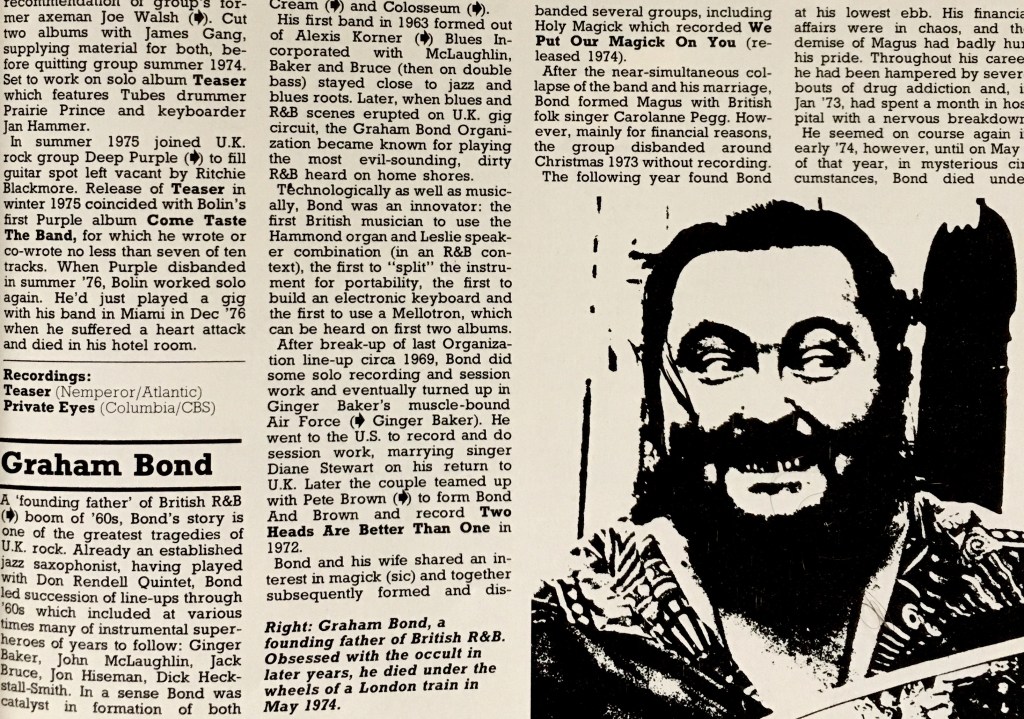
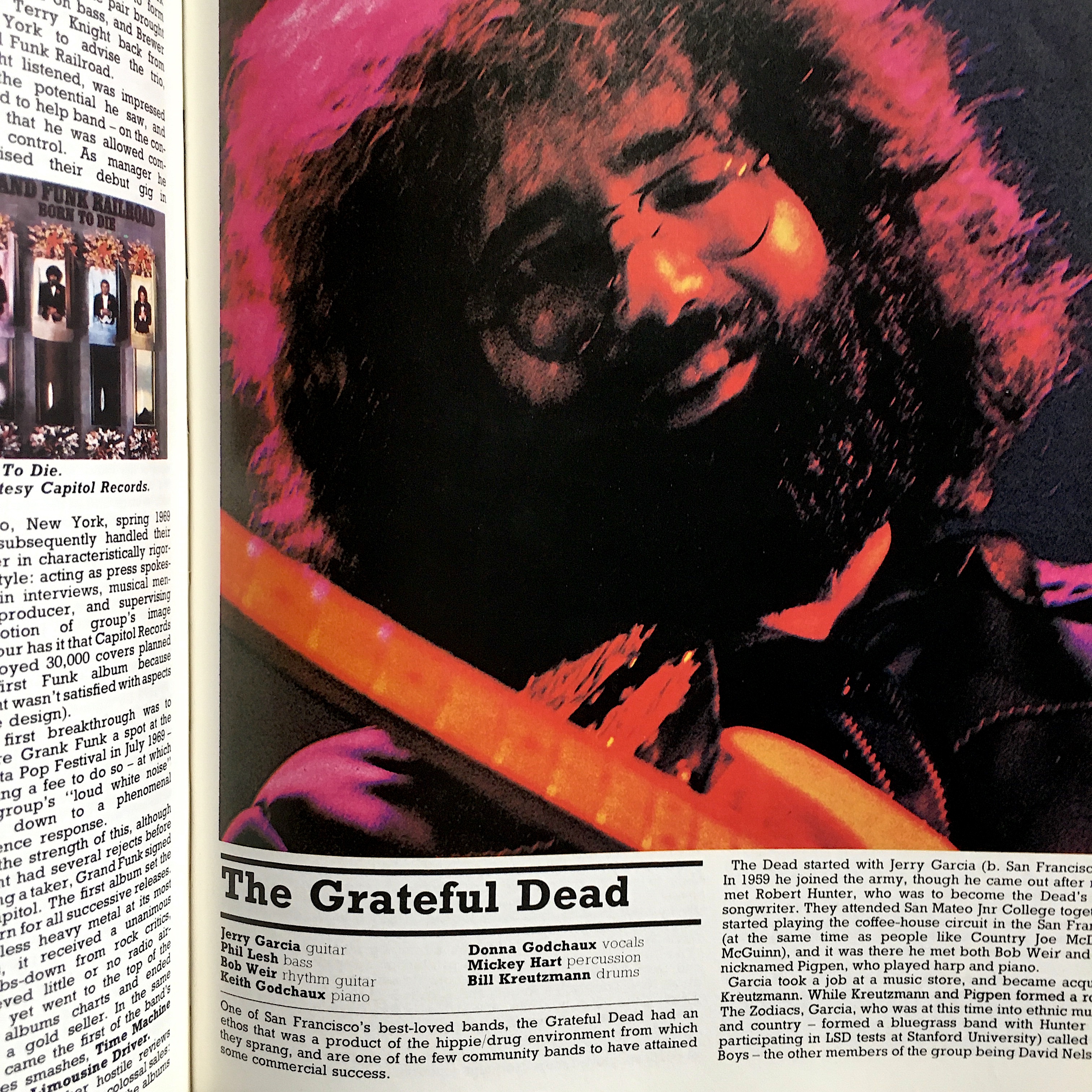
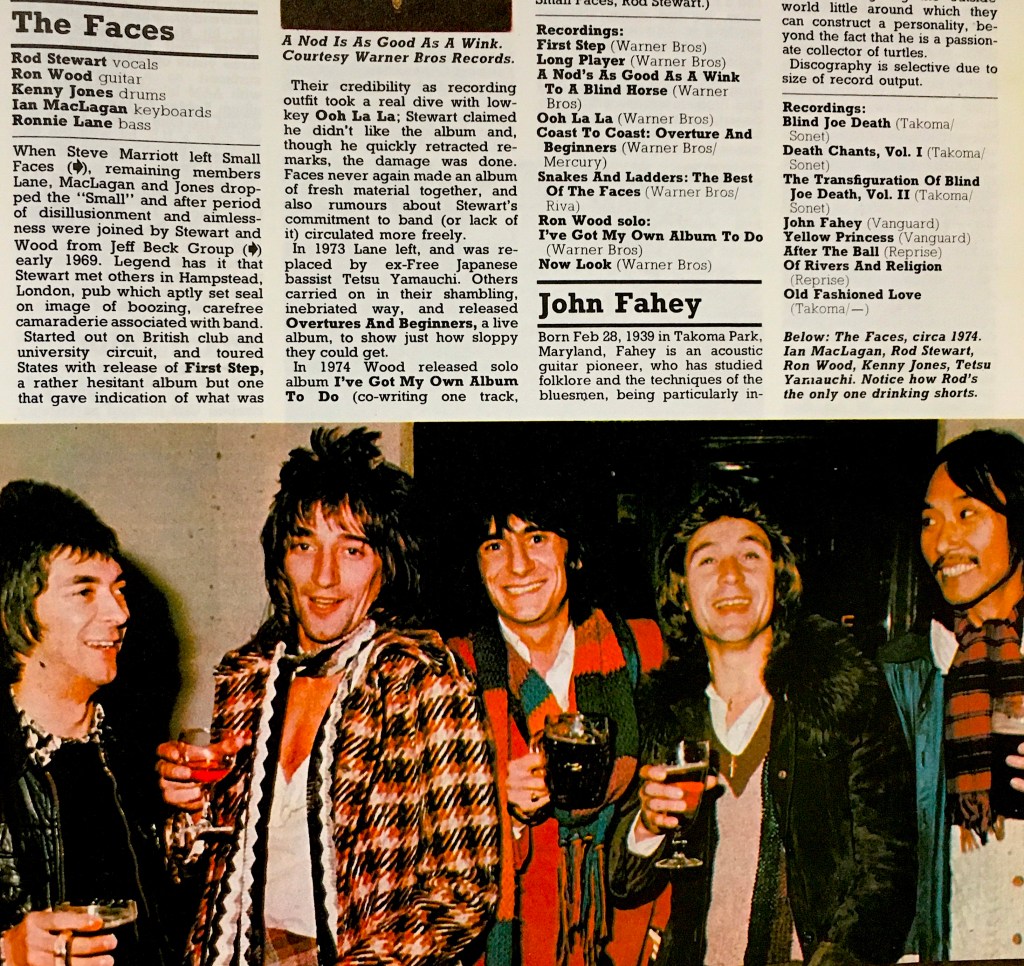
Messrs Logan and Woffinden make a pretty lofty claim for their book, as well they might—“the most complete one-volume rock encyclopedia there’s ever been.” They may be right. They actually asked record labels to stop releasing records for nine months (seriously!!) to allow the 1977 version to be definitive. Imagine the author of another Salamander cracker, Airliners: The Flagships of the Jet Age asking the same—“Dear Boeing, can you, like, stop making planes for nine months, so my book, can be, you know, definitive? Please?” They were definitely right to call it “Illustrated”. Forgive the 1970s printing and repro quality a bit, and it still looks lush. Hundreds of album covers were photographed specially for it, there’s press and publicity shots, Abbey Road blown up to nearly a double-page spread, a winsome Joni Mitchell is given half a page, there’s a mad tinted pic of Jerry Garcia in full-bearded flow, a gem of a pic of The Faces all boozed up looking like they’re having the best time on the ale, and a (deliberately I suspect) low-quality black and white shot of tragic British blues pioneer Graham Bond that makes him look truly deranged.
Meet the entry on Graham Bond. Terrifying kids since 1977™
Awesome, majestic Moody Blues spookfest “Nights in White Satin” had enjoyed yet another long chart run just before I got The IEoR. It really haunted me, that tune. So I looked up The Moody Blues in my newly-purloined volume: “…following [of] semi-Messianic proportions”? What? They’re like Jesus?! Oh, hang on, “became obsessed with their own importance,… ever more burdened with clichéd cosmic messages”? No thanks, I’m nearly 11 and The Police are at Number 1. (But thanks to the discography I knew that This Is The Moody Blues was a double comp that covered all their late ‘60s/early ‘70s stuff in one neat package. I found it recently for a couple of quid in a charity shop, tatty as hell, and what do you know, there’s a scratch across “Nights in White Satin”. That’s cosmic justice at work. But other haunting, beautiful tracks like “New Horizons” and “Melancholy Man” play just fine.) Playground consensus in 1980 (well, me and the two friends who would talk about music) was that Peter Gabriel’s “Games Without Frontiers” was shit. Weird, grating and the dressing up in the video was creepy, not fun like Madness or dashing like Adam Ant. I suspect I secretly liked it though, because I looked Mr. Gabriel up in The IEoR—wait, what? He was in Genesis?? Genesis who’ve just had that cool “Turn It On Again”, made even cooler by Top of the Pops putting swooshy effects on Phil Collins’ Hawaiian shirt??? Phil Collins took over from Gabriel on vocals??? And played drums on his albums??? Wooaah, OK. Maybe there’s something to this Gabriel bloke after all.
The actual, ailing LP that stayed alive long enough for Tim to rescue it in 2022.
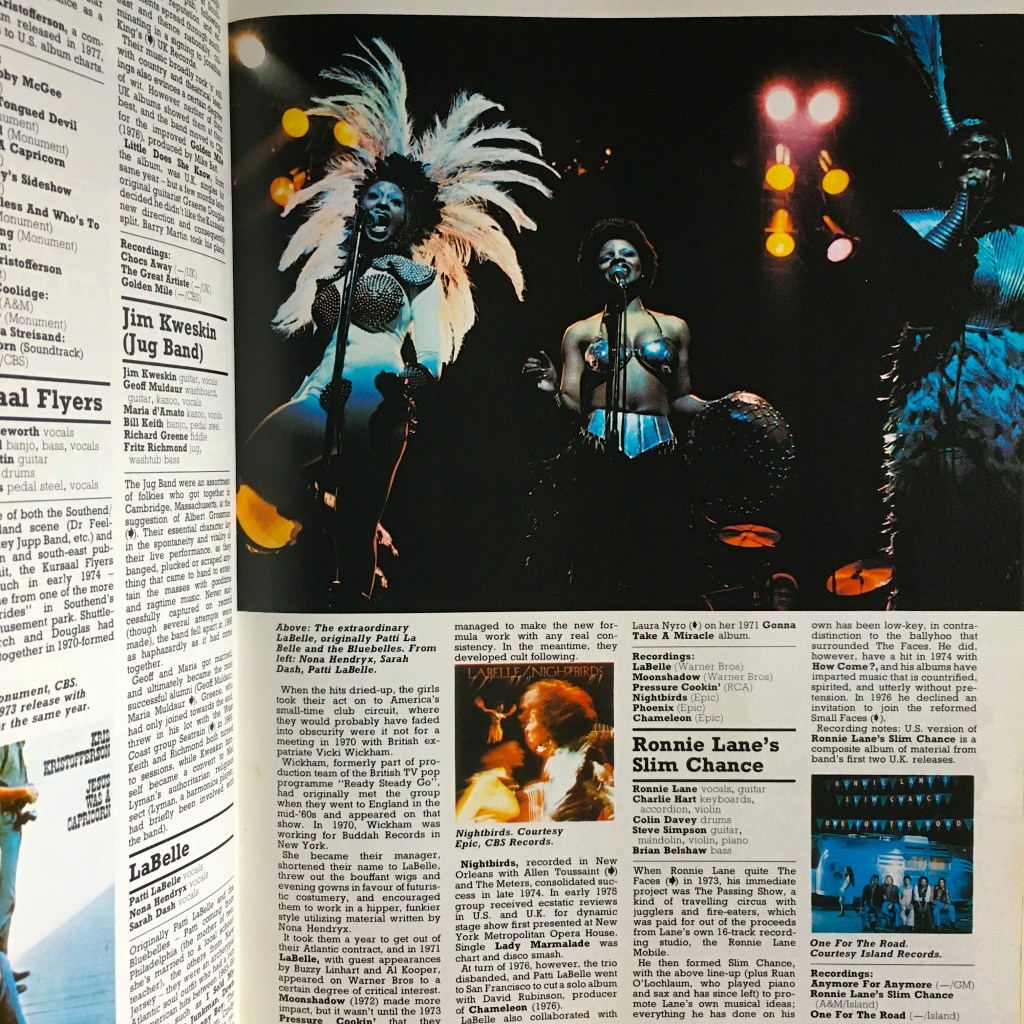
Yes, The IEoR is dated in its writing style. But – and looking back, this is dead important – it’s a hell of a broad church of a book for one that professes to focus on rock. Yes, the entries for Led Zep and Floyd are immense and fawning (“Jimmy Page, axe king of heavy metal, gentleman land-owner…”), especially as in ’77 the latter were redundant. Logan and Woffinden like their British guitar rock. But as noted, Abba are in there. ELO. Hot Chocolate (honestly! And it’s a really positive entry). Their weaker points are not surprisingly, pop and disco—wherefore art thou Rose Royce, Thelma Houston, and other big mid-‘70s disco players? But LaBelle are in, with a truly bonkers picture to boot.
Here’s LaBelle absolutely owning their pages in The IEoR. Apologies to Jug Band for their unfortunate placement in this scenario.
It’s a lot more diverse than you’d expect from two white male NME writers in 1977. And yes, they embrace punk although they clearly prefer the term “New Wave”. The Pistols (who hadn’t released an album by their deadline), The Clash, Ramones, New York Dolls, Stranglers, Eddie & The Hot Rods all get good write-ups. There’s the odd occasion where they catch themselves putting someone in who they admire and find a really stretched rock connection to justify it, like their words on Dolly Parton’s New Harvest…First Gathering; “Dolly’s most rock-oriented effort yet was indicated as much by the denim clothes…” In the late 1970s, it wasn’t so acceptable for rock blokes to like Dolly Parton’s music. The book is also refreshingly free of ‘70s sexism (mostly – they point out Joni Mitchell was photographed nude for, For the Roses and “like everything Joni does, it was very tasteful.” Did I check my local library for a copy of For the Roses? Yes. They didn’t have it.). They champion some quite unexpected female artists: the aforementioned Dolly; arty, cerebral Dory Previn; and Laura Nyro who is likened to the poet Rimbaud. I had no idea who either were, I tried a Laura Nyro record and did not get it one iota at age 11… And while entries are mostly praising or at least neutral, when they do let their prejudices slip, it produces some hilarious hyperbole: “…as good an example as any with which to approach the theory of the vacuum effect in rock” (Queen), or “… [her] tiresome public persona was embarrassing even her die-hard fans (Patti Smith – ouch!)
Pages from the lushest of all Rock reference books ever.
In all honesty, though, the majority of music in The IEoR passed me by. It landed on me too early to make me a collector, and I didn’t have the pocket money, cool friends, or older siblings through which to access the old stuff they were waxing lyrical about. As the constant newness of early ‘80s pop bombarded me, reading about the old stuff faded. Then heavy metal got me and I scorned The IEoR. Not including Motorhead, I could just about forgive as they had one patchy underground album to their name in ’77, but omitting Judas Priest was heresy, blasphemy, and tons of other “ys”. Priest kick-started modern metal with 1976’s Sad Wings of Destiny and 1977’s Sin After Sin. Both are awesome. The latter was on CBS. WHY are they not in, my proto-outraged metalhead self ranted. The IEoR became more shelf-bound and was left behind when I went to university…Logan and Woffinden were not metal fans. Kiss were dismissed as “recycled heavy metal grunge decked out in comic book trappings” when grunge was not a good thing to be. There you go, lexicon devils, the use of ‘grunge’ in 1977!
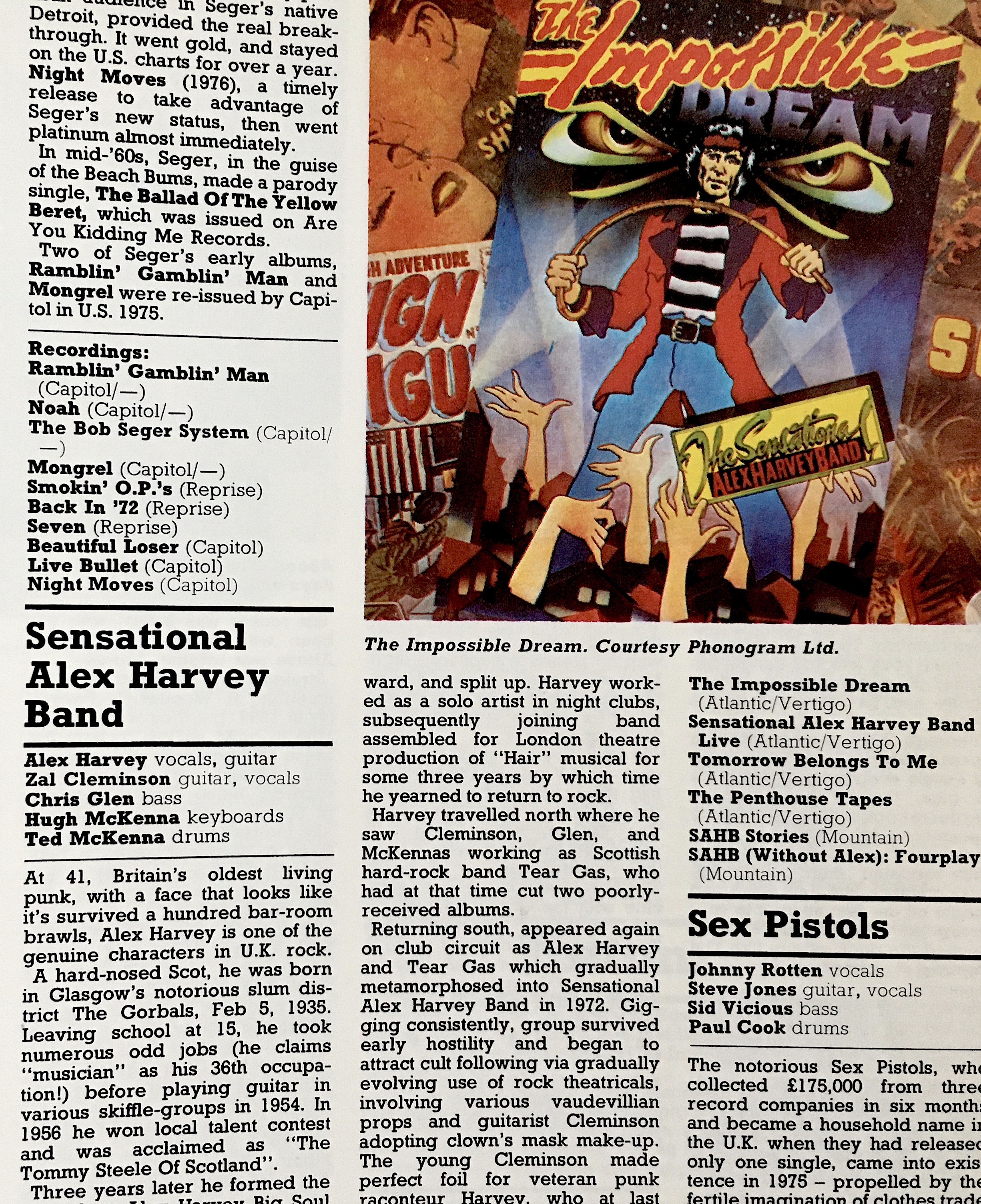
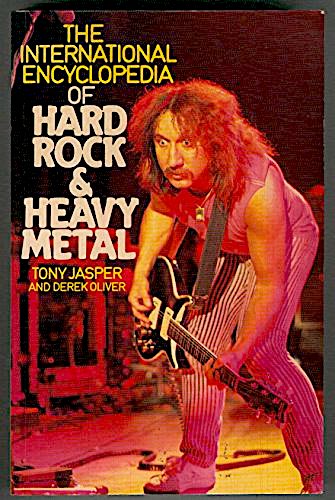
But The IEoR had lodged something in my brain. For a start, it taught me, however subconsciously, that music was a massively broad church with lots to be enjoyed all over the shop. It probably saved me from getting too tribal over genres I got obsessed with in my teens and early ‘20s, like metal or US underground noise rock. The interesting stuff I’d read about in IEoR had become embedded in my memory banks and would often surface when crate digging or charity shop trawling – a Sensational Alex Harvey Band album here, a Four Tops comp there. It taught me the joy of a good music reference book, and no other encyclopedia quite lived up to it. 1983’s International Encyclopedia of Hard Rock and Heavy Metal was a pale shadow, barely illustrated and often too dismissive.
The entry in this book for Metallica simply reads “Motorhead clones.” Um, yeah, okay.
Then there was The Rough Guide to Rock which was not only lacking on the illustration and discography front but whose 2003 edition was littered with sloppy mistakes. I mean, The Minutemen were fronted by Daniel Boone? Seriously?
Daniel Boone and D. Boon of punk-hardcore legends, Minutemen. Not the same person.
The internet and Wikipedia may now supply all the music reference material you can consume in a dozen lifetimes, but give me the enthusiasm of a pre-‘net music encyclopedia over Wikipedia any day. And on the net, although rabbit holes beckon, you still have to decide your start point, and what your first search term is. With an encyclopedia, there’s the genuinely random nature of letting it fall open and going “ooh, I’ll try that.” Valentinian Chance, I believe. It’s how the Grateful Dead found their name—in an encyclopedia.
A toast to the Greatest Book Ever Written…
The IEoR went through a couple more editions in the late ‘70s, expanded and with new hipper artists like The Police on the cover, but it sadly didn’t stick as a constantly updated institution like the Guinness Book of British Hit Singles. A shame, but the vagaries of pre-digital publishing and the sheer effort involved surely meant it was unsustainable, and it could never be as definitive as its authors desired. To net-nerds it’ll be a curio, but a curio well worth seeking out, if only to understand how we pre-digital nerds hungrily consumed music facts. So Tony Jackson, I still have your copy of The Illustrated Encyclopedia of Rock. I’d like to borrow it a little longer…
Editors postscript!: This crazy old book is easy to find on the cheap on your eBay’s, Amazon’s and such. It’s probably not going to change your life at this stage of humanity but it makes a sweet and, yes, lush addition to any music book library. IEoR forever!
Yes, it’s Kate Bush again. I thought I was done writing about her after our recent feature (here!) but no, I had just a little more in the tank. I now humbly, beggingly invite you to visit Cover Me, home of everything cover version, for a feature scribbled by my nerdy arse, on the evergreen classic Hounds Of Love (here!). I listened to what felt like hundreds of covers of songs from the album, delicately extracted and exalted the best, then wrote some love notes to them. There are some magnificent specimens in there for you to hear, I promise! Unfortunately, my immersion in Kate covers has resulted in a trial separation between “Running Up That Hill”and myself. I still love “RUTH” but I need a break from her for a while so I can learn to appreciate her again. I’ll be back girl, just give me a few years.
It is now time for the latest WEEKLY NEW WONDERS PLAYLIST featuring the finest new songs that have crossed our path this week. They are lustrous and wonderful to the last and you can listen to ’em below on Soundcloud or Spotify.
I don’t think a week has gone by in the past century that I haven’t listened to at least one Olivia Newton-John song (with “Sam”, “A Little More Love” and her duet w/Cliff Richard “Suddenly” topping the playlist). As with most Gen X-ers, she was a constant pop presence through most of my childhood and teenage years. It wasn’t Grease that hooked me, or her brilliant string of AM radio hits (though I did love them) but her 1978 album “Totally Hot” where for the first time, she began to ROCK (not too hard mind you, this is Olivia Newton-John we’re talking about). I can’t adequately explain how jarring her sonic transformation seemed at the time, how back-alley dirty “A Little More Love” sounded compared to everything else she’d ever done. I recollect being kind of shocked (I was an unworldly child). Up until then, she’d been “sweet Olivia” and her tough girl persona had just been a performative thing in a movie. To a kid who’d only known that side of her, it was very “scary” indeed…scary exciting. It turned out Olivia wanted to “rock”, just like me, who freakin’ knew? I was all in after that.
When she passed away this week, it hit a particular nerve with me (as it did with a million other people) and so I just wanted to take a moment to acknowledge her awesomeness and reiterate how she was so much more than Grease. ONJ forever.
It is now time for the WEEKLY NEW WONDERS PLAYLIST featuring the finest new songs that have crossed our path this week. They are weird and wonderful to the last. Listen below on Soundcloud or Spotify. And HEY, there’s a little treat following the playlists so please mr. please keep scrolling 😉
Listen on Soundcloud
Listen on Spotify
Bonus beats!
PuR pal Ed Zed of the band Strange Flesh (formerly known as The Casual Sexists) wrote us a review of the new album by New Zealand radio legend Stinky Jim, called Spacial Awareness, which he has been seriously digging and wanted to share with all you adventurers. Lay it on us hero Ed…
Meet Stinky Jim…
The venerable Stinky Jim – now into his fourth decade of bringing much of the world’s finest new music to the listeners of his Stinky Grooves radio show on Auckland’s 95bFM – is back with a brand new album to remind us that he too makes utterly corking music of his own.
Spacial Awareness is a reggaematical kaleidoscope, encompassing dancehall, dub, roots, and even a skeletal smattering of reggaeton. But what makes it so hypnotically compelling is the fusion of these elements with Jim’s unique avant garde electronic sensibilities that truly know no bounds.
The album is festooned with vocal fragments, which often feel like instruments in their own right, and on other occasions hint tantalisingly—dubwise style—at whole vocal tracks that might exist elsewhere.
The one fully fledged vocal performance on the album is the truly spectacular ‘Steam Fish’, featuring Kingston dub poet Nazamba, whose gravelly baritone carries the ominous beauty of a summer thunderstorm.
This luscious opus is out now on Bandcamp. Get involved, good people.















 PICKING UP ROCKS